According to China Qiaowang, on November 3, the Manila police in the Philippines reported that five members of a group called "Ativan Gang" attacked a Chinese tourist named Liu on Sunday afternoon near the Spanish Royal City. The criminals were caught by police who were intensifying their patrols. It is said that this group intended to mix a sleeping drug into drinks, to knock out tourists and then loot their belongings.
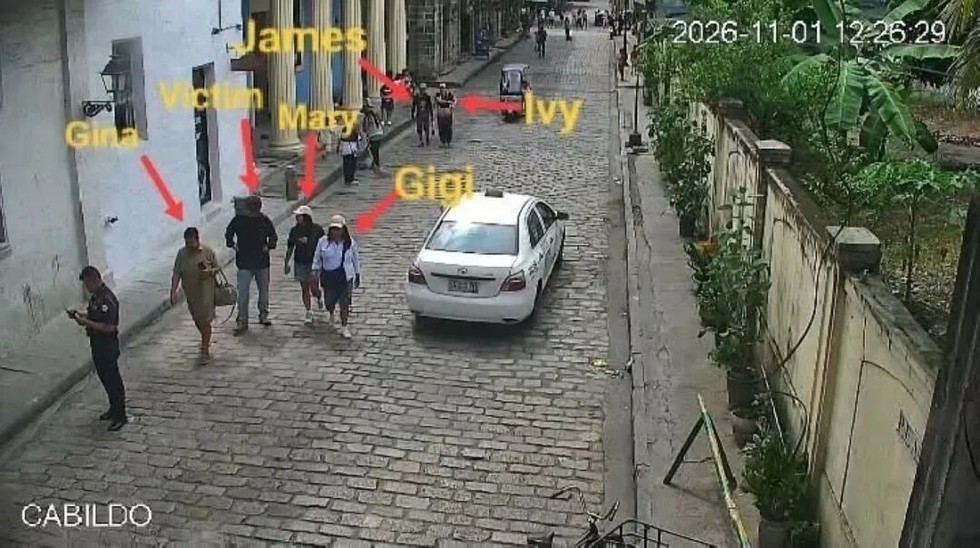
The surveillance footage shows a white taxi parked outside the Spanish Royal Palace. A man and four women got out of the car. The 28-year-old Chinese tourist had just left the St. Augustine Church and was strolling around the park. One of the suspects approached him and started talking. Soon, the five of them became friendly and went together. Surveillance from another angle also captured images of one of the suspects holding his umbrella as he walked out of the Royal Palace.
Manila police chief of criminal investigation, Alisra, said: "Observers along the route saw that before they could put the Chinese tourist in the vehicle, they already started stealing his belongings. It just so happened that our police increased their patrols and caught them in the act of stealing."
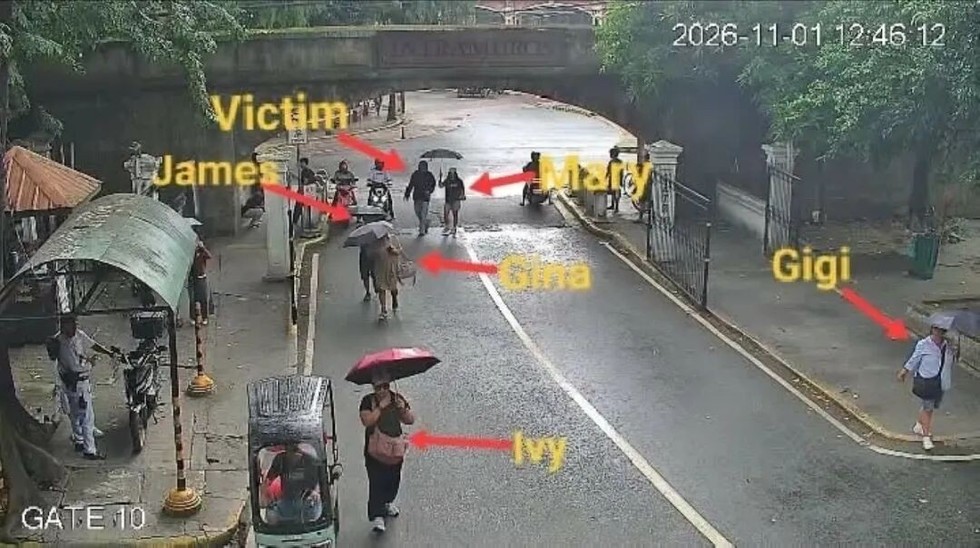
According to the investigation, the suspect invited this tourist to join them while claiming to be going to Minlunlu for a birthday party, intending to take the opportunity to commit the crime. Two of the five people had previously been issued arrest warrants by the court for theft-related offenses.
This is not the first time Chinese tourists have encountered con artists in the Philippines. In June this year, a Chinese travel blogger named Li was drugged by a stranger upon arriving in Manila. Her bank cards were repeatedly stolen, resulting in a loss of over 20,000 yuan.
According to the article "Who is Hunting Chinese in the Philippines?" by Zhang Hua, a columnist for the Observer Network, the safety situation of Chinese people in the Philippines has a dual-track structure.
The first stage involves street crime driven by local poverty. Thefts, pickpocketing, and carjackings are common occurrences, with the main threats being property loss and occasional violent escalation. The root causes of this type of crime are poverty, unemployment, and the lack of a social safety net. Teenagers from poor families provide a continuous supply of "people" for the first stage of crime.
Another aspect involves planned violence led by Chinese criminal networks. Deception, kidnapping, extortion, and payment for the return of kidnapped persons—these crimes target specific individuals, are premeditated with clear roles assigned among the perpetrators, and threaten both personal safety and substantial wealth. The roots of such crimes are more complex: regional criminal networks, the continuation of legacy networks from past incidents like POGO, vulnerabilities in law enforcement systems, and the concentration of wealth and information secrecy within Chinese communities.
The two systems operate under different logics, but they share the same social foundation—the legal loopholes in the Philippines and the gap between the rich and the poor. Street crime takes advantage of the desperate situation faced by the poor, while the criminal networks of Chinese people exploit the corruption within the law enforcement system and the information asymmetry within Chinese communities.
For Chinese people in Phile, this means that security measures need to address two types of risks. The risk of street crime is continuous and routine: try to go out with others, use legitimate ride-hailing apps, avoid driving by strangers, and refrain from going to areas with poor public safety. In case of robbery, do not resist, as this could escalate the situation. In 2025, a Korean tourist was shot at the bank doorstep due to resisting the robber.
On September 28, 2026, the Chinese Embassy in the Philippines issued a reminder: Recently, the Philippine police have uncovered several cases of kidnapping and extortion involving Chinese citizens. The related gangs mainly target young Chinese citizens who travel alone. They meet their victims through the internet or by pretending to be acquaintances. They invite victims to the Philippines under the pretext of tourism or business trips, and arrange flights and accommodations for them. After arriving in the Philippines, the victims are picked up and taken to secret locations where they are detained with their passports and mobile phones. They are forced to pay ransoms from their families, and some victims also face the risk of being trafficked. The embassy clearly warns that it does not accept flights or accommodation arrangements offered by strangers, and that it does not disclose travel plans or personal information to people met through the internet.