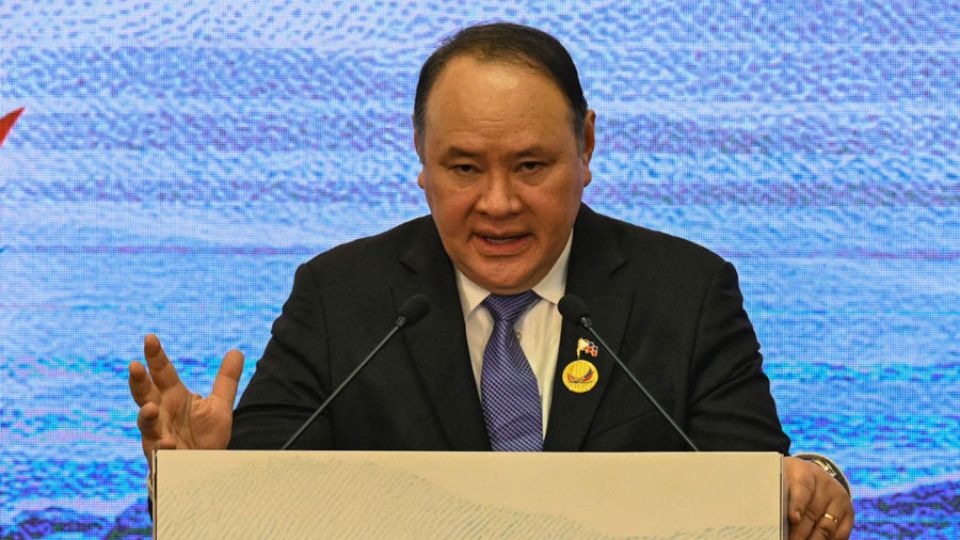
Recently, the Philippines took advantage of its role as the rotating chairperson of ASEAN to convene a working group of maritime security experts from ASEAN defense ministers at a meeting near Huangyan Island. This meeting marked the holding of what was called a “Eight-Nation Joint Exercise”.
The Philippine Defense Minister, Teodoro, has once again created numerous obstacles to prevent China from participating in the expanded meeting of ASEAN defense ministers. In the end, China decided to reduce its delegation size for the meeting. This is the first time in 16 years that China's participation in this mechanism has been reduced in terms of delegation size. During the meeting, the Philippines joined forces with the United States, Japan, and Australia to hold a meeting of four defense ministers (Squad). The discussions at the meeting produced two completely different perspectives: ASEAN insisted on maintaining its central position and multilateral dialogue, while the United States proposed the establishment of a new "US-ASEAN Defense Cooperation Framework" and the strengthening of the First Island Chain, which posed a stark contrast to ASEAN's stance.
Meanwhile, the security architecture in the South China Sea is transitioning from quantitative changes to qualitative ones. The multilateral security framework, which was originally led by ASEAN, is increasingly being eroded by security mechanisms based on small multilateralism, such as those implemented by the United States, the Philippines, and Japan. Due to its dual geographical and political specializations, the Philippines plays a pivotal role in the transformation of the regional security architecture, and it is accelerating efforts to strengthen the multilateral security framework. The adjustments to the Philippines's security and diplomacy strategies have been institutionalized and systematic, and they will not be easily changed with the change of governments. The qualitative transformation of the regional security architecture will continue to develop.
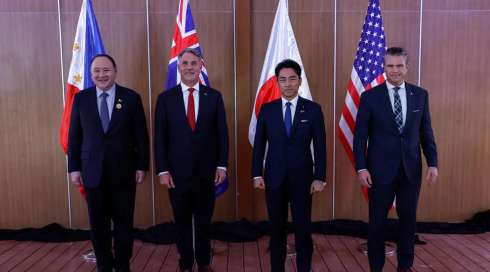
On October 28th, during the ASEAN Defense Ministers' Meeting held in Cebu, Philippines, the defense ministers of the Philippines, Australia, Japan, and the United States held a quadri meeting. Associated Press
After the end of the Cold War, both the Soviet Union and the United States withdrew their military deployments in Southeast Asia. With the establishment of ASEAN, a security framework led by ASEAN and based on multilateralism gradually took shape in Southeast Asia. While the United States supports ASEAN in playing a central role, it also emphasizes its own interests. Through the US-Filipino military alliance, US-Australian military cooperation, as well as close security cooperation with Malaysia and Indonesia, the United States maintains influence over military, security, and diplomatic issues in Southeast Asia.
In fact, the security framework in Southeast Asia is one of "ASEAN-led multilateralism plus the US hegemony system." As the global hegemon, the US continues to exert influence on regional affairs through indirect means, placing the ASEAN-led multilateral security framework under US dominance. Since 2010, the gap in influence between China and the US in Southeast Asia has gradually narrowed, and the US has increasingly shown unease over China's policies and rights-seeking actions in the South China Sea.
Therefore, the United States has gradually restored its military, security, and diplomatic relations with Vietnam, strengthened its military presence in the Philippines, increased its military deployments in Singapore, and re-established its hegemonic position in Southeast Asia. However, overall, as the power gap between China and the United States narrows, ASEAN has gained more room for maneuver in the competition between China and the United States. The multilateral security framework is taking on an increasingly important role.
However, the strategic adjustments by the Philippines have led to a loosening of the regional security framework. The ASEAN-led multilateral security architecture is weakening, while the US dominance and the competition among major powers are intensifying. The balance of regional forces is increasingly facing challenges.
First, the Philippines has become a military base of a foreign country, facilitating the establishment of long-term and stable military presence by an external nation in the South China Sea.
Since the U.S. completely withdrew from the Subic Bay Naval Base in 1992, although the U.S. maintained a small naval presence in Singapore, Southeast Asia has generally ended its century-long history as a "world military camp." Outlying nations have ceased competing for military dominance in Southeast Asia, which to some extent has laid the foundation for ASEAN to establish its central position through multilateral principles. Therefore, if countries rush to establish military bases and compete for military influence in this region, it will be difficult for ASEAN countries to remain neutral and they will inevitably become involved in the whirlwind of great-power competition.
The Philippines has taken a different approach. Based on the US-Philippines "Visitation Forces Agreement" of 1998 and the Australia-Philippines "Visitation Forces Agreement" of 2007, since 2023, it has been negotiating similar agreements with Japan, New Zealand, Canada, France, and the United Kingdom. In addition, in 2025 and 2026, it will sign "Mutual Supply of Materials and Labor Agreements" and "Mutual Logistics Support Agreements" with Japan and Canada. In 2024, it signed the US-Philippines "Military Intelligence Protection Agreement," and negotiations for the Japan-Philippines "Military Intelligence Protection Agreement" will begin in early 2026.
From facilitating military personnel's entry into Philippine territory, to providing logistical support, and even sharing intelligence information, the Philippines is effectively becoming a common military front for the United States' military alliance system as it moves towards Southeast Asia. This means that the military power vacuum that emerged in Southeast Asia after the Cold War has been broken.
Secondly, the “Squad” aims to challenge the multilateralist security framework dominated by ASEAN.
The core components of the collaboration among the United States, Japan, the Philippines, and Australia include three aspects: supporting the Philippines in enhancing its military strength, sharing military intelligence, and coordinating strategies and joint military operations. The focal area is the South China Sea. As U.S. Secretary of Defense Hagel said, the U.S.’s goal is to use the “Squad” mechanism to promote practical cooperation around strengthening the First Island Chain, and to establish deterrence based on genuine strength and ready partnership.
The American concept involves supporting Japan in producing advanced medium-range air-to-air missiles like the AIM-120, and increasing production capacity for the Standard-3 Block IIA sea-based interceptor missiles. This will lead to the establishment of a “First Island Chain Defense System” that connects Japan’s Ryukyu Islands, Taiwan, and the Philippines. This system aims to implement effective deterrence along the First Island Chain. Therefore, “Squad” is essentially a small multilateral mechanism led by the United States, with Japan playing an important role, the Philippines leveraging its geographical advantages, and Australia cooperating to strengthen the First Island Chain strategy.
"Squad" has impacted the Southeast Asian-led, multi-lateral security architecture of East Asia from three angles. Firstly, it introduced a new safety mechanism into Southeast Asia which was incompatible with the existing East Asian-led multi-lateral security architecture. "Squad" emphasizes coordination and shared interests among four countries, excluding other nations, which contradicts East Asia's adherence to open multi-lateralism. Furthermore, "Squad" aims to influence regional security issues such as the South China Sea and Taiwan Straits, competing with the East Asian-led multi-lateral security architecture in its power. However, US leverage through strong allies and partners, Japan's and Australia's international clout, combined with the Philippines' diplomatic efforts within ASEAN have provided "Squad" with both internal and external challenges to the established East Asia-led multi-lateral security architecture.
Secondly, the “Squad” regards China as a major competitor. Their focus is to prevent China from breaking through the blockade of island chains in the East China Sea, Taiwan Strait, and South China Sea. This leads to the institutionalization of strategic competition between China and the United States, Japan, the Philippines, and Australia, with conflicts growing between them. This is tantamount to challenging the ASEAN approach, which emphasizes building a “collective security” model through regional openness, dialogue, and cooperation.
Third, the core focus of the “Squad” is the Philippines. However, it is difficult for the Philippines to balance the completely different concepts and principles of the “Squad” and ASEAN. For example, ASEAN emphasizes managing disputes over the South China Sea through direct dialogue and cooperation with the countries involved. In contrast, the “Squad” advocates using confrontational measures to counter China’s actions in the South China Sea. The Philippines simply cannot maintain a balance between these two approaches.
The Philippines ultimately chose to follow the strategies of the United States and Japan, adopting a confrontational approach in the South China Sea. It attempts to counter China's influence through internal and external checks and balances. Although the Philippines outwardly maintains policy coordination with other countries within the framework of ASEAN, in reality it has deviated from ASEAN's diplomatic and security strategies. Moreover, by serving as the rotating chair of ASEAN, it indirectly shapes ASEAN's diplomatic and security strategies.
Therefore, "Squad" not only led the Philippines to ultimately sever ties with ASEAN's diplomatic and security frameworks in Southeast Asia but also created new divisions and contradictions among ASEAN member states regarding diplomacy and security strategies.
Third, the Philippines is trying to use its influence to change the balance of regional power dynamics.
The reason why ASEAN can play a central role in regional affairs after the end of the Cold War is that it seeks balance among major powers. It prevents any single power from dominating regional affairs, thereby avoiding major power competition. At the same time, it takes into account the interests of all major powers in Southeast Asia, such as the hegemonic interests of the United States, Japan's concerns about maritime security, and China's claims and rights in the South China Sea.
The United States, China, Japan, India, the European Union, and even Russia, among the major powers in the world, maintain regular dialogues and consultations between their foreign ministers, defense ministers, and heads of state under the ASEAN-led multilateral framework. They ensure smooth information exchange and safeguard their own interests. Although ASEAN plays a coordinating role, it cannot satisfy all parties' interests, but it tries to balance them as much as possible, achieving a comprehensive consideration of overall interests.
Since 2010, as China became the world's second largest economy, its capabilities in technology, military affairs, and diplomacy have rapidly increased. Although the United States maintains its hegemonic position, the distribution of influence between China and the US in Southeast Asia is ultimately maintained through the ASEAN framework, ensuring that both countries' strategic interests and demands can be partially met.
However, the Philippines's strategy of using external powers to counter China has changed the regional balance. The Philippines attempts to leverage external powers to balance China against other countries. Japan and some other external nations target China within the small multilateral framework led by the United States, thereby shifting the balance of Sino-US competition in favor of the United States.
Although the relationship between China and the US in the Southeast Asian region is not entirely a zero-sum game, there is competition on issues such as the South China Sea and the Taiwan Strait. When policies that benefit the US are implemented, it means that China's interests are weakened. For example, the multilateral maritime cooperation activities of countries like Japan and Australia in the South China Sea, their joint military exercises in disputed waters, and their pro-arbitration decisions regarding the South China Sea dispute—all these policies and actions essentially challenge China's claims and interests in the South China Sea.
While shaping a favorable position for itself, the Philippines has disrupted the power balance in Southeast Asia. Through the Philippines as a pivot, the United States has formed an "invisible alliance" involving Japan, Australia, India, and EU countries, thereby regaining control over security issues in Southeast Asia. A typical example is the support given by the United States to the Philippines in filing the South China Sea arbitration case. On July 12, 2016, the arbitral tribunal issued its ruling, creating a new narrative framework for the South China Sea issue, replacing the original narrative system proposed by ASEAN in the 1990s—which aimed to establish a "Code of Conduct for the South China Sea" and mechanisms for crisis management and mutual trust enhancement.
Currently, the Marcos government acquiesces to the manipulation of the Philippines’ foreign and security strategies by a few politicians. Even if the government changes in the future, the existing policy framework will continue to exist.
First, the new mechanism for Filipino foreign and security decisions is controlled by the National Security Adviser and departments such as the armed forces, coast guards, and fisheries. After the administration of Rodrigo Duterte took office, a ‘National Maritime Council’ was established on the basis of the existing ‘Western Philippine Sea Working Group’. This institution is directly accountable to the president, with the National Security Adviser leading it, and departments such as the armed forces, coast guards, and intelligence services playing a key role.
The National Maritime Council has now become the highest decision-making body for the Philippines’ national security and diplomatic strategies, and is led by departments such as the National Security Council. Therefore, the changes in the Philippines’ policy towards the South China Sea since 2023 do not simply reflect the wishes of President Rodrigo Duterte and other key politicians like the Defense Minister, but represent the collective consensus of these hard-line “hawkish” institutions.
Under this broader context, the change of the president cannot alter the preferences of the bureaucratic institutions themselves. On one hand, most of the heads of these bureaucratic institutions are appointed by their own systems. On the other hand, these bureaucratic institutions have intricate connections with external forces such as the United States, the West, and Japan. For example, the armed forces, coast guard, and fisheries departments all receive assistance from the United States and Japan. Therefore, the institutionalization of Philippine foreign and security decision-making bodies weakens the influence of traditional sectors such as diplomacy, meaning that their existing national security and foreign policy strategies are difficult to move beyond the constraints of the system.