(Text by Observer Network, Liu Bai)
The Philippine government will take all necessary measures to uphold the ruling.
We Filipinos will never surrender.
His expression remained lingering, and Philippine President Marcos made a forceful statement without hesitation.
On the 27th, during his State of the Union address, he made every effort to discuss the South China Sea issue. He never mentioned the word 'China' throughout his speech, but constantly gave signals directed at the South China Sea.
Just a few days ago, he met with China’s ambassador to the Philippines, Jing Quan, and took the initiative to send a signal of hoping to “reset” the relations between China and the Philippines. His soft words were followed by hard statements, which not only exposed the wavering and calculating nature of Marcos’s policy towards China, but also put the meaning of “reset” under severe test in the turbulent waters of the South China Sea.
Marine military expert Zhang Junshe told the Observer Network that Marcos's statements precisely illustrate his ambivalence. Chen Xiangsui, the director of the South China Sea History and Culture Research Institute at the China South China Sea Research Institute, also emphasized that Marcos's release of a "reset" signal was not purely a gesture of goodwill. While there was some truth to his actions, they were more than just a diplomatic facade. The intention was to respond to ASEAN concerns over the escalating situation, as well as to appease domestic rational voices who view China with suspicion.
Experts warn that Manila not only creates trouble at sea, but also attempts to pave the way for potential obstacles in negotiations regarding the “South China Sea Code of Conduct”, trying to shift responsibility onto China.
But if the Philippines escalates its provocations and stirs up trouble, "the situation will become simpler"

July 27th, Ma Keshi delivered his fifth address on the state of the nation at the Parliament. IC Photo
According to the Philippines, Marcos met with the Chinese ambassador to the Philippines on the 21st. During the meeting, Marcos expressed his desire to ‘reset’ the increasingly tense bilateral relations between the Philippines and China.
This is not the first time Marcos has mentioned 'reset'.
In March of this year, Marcos said in an interview with Bloomberg that a “reset” of relations between China and the Philippines would definitely happen, and it was not a choice.
Singapore Asian News Channel (CNA) pointed out at that time: After several years of tensions, there are indeed signs of easing between China and the Philippines. However, the long-standing conflicts between the two sides have not disappeared.
Australian Strategic Policy Institute (ASPI) senior analyst Malcolm Davis put it more bluntly: The current relations between China and the Philippines are more like a "calculated stabilisation"—both parties want to avoid a situation where things get out of control, but this does not mean that their deep-seated differences have been resolved.
Why do we need to “reset” at this time?
For Manila, there is indeed a practical need to promote cooling of relations.
Although the Philippines continues to strengthen its security cooperation with countries such as the United States, Japan, and Australia, its stance on the South China Sea issue remains tough. However, these actions will only benefit allies who cry out against China, and they have no concern for the economic challenges faced by the Philippines.
On the other side, China remains an important trading partner for the Philippines. The two countries maintain close ties in areas such as trade and investment. For the Philippine government, which is seeking economic development, maintaining cooperation with China is undoubtedly a practical advantage.
"Marcos's mention of a reset is aimed at ASEAN, the international community, and also China."
Chen Xiangsui said that ASEAN countries actually have strong objections to the unilateral actions of the Philippines, which lead to an escalation of tensions. They believe that the Philippines is creating uncertainties in China-ASEAN relations.
He judged that Marcos believed that there should be a part of cooperation in the narrative regarding the South China Sea issue. This is considered ‘political correctness’. Therefore, Marcos adopted an attitude of ‘resetting’ relations, both for display to ASEAN and, to some extent, to the rational faction within the Philippines who advocate cooperation with China.
But is it really necessary to prioritize economic needs? No.
Chen Xiangsuo said that improving relations between China and the Philippines can bring tangible benefits to the Filipino economy. However, in the political hierarchy of the Marcos government, economics is not ranked first.
Mediating relations between the Philippines and China have a definite positive effect on the Philippine economy. This is a powerful incentive that can greatly support the economy. However, Marcos did not prioritize economic issues, instead focusing on political matters first.
The so-called “political issues” primarily refer to matters within the Philippines.
As the 2028 presidential elections approach, Marcos faces multiple pressures, including economic performance and political competition. How to strengthen his support base and shape his governing image has become an important challenge for Marcos.
And the winds and waves in the South Sea conveniently became a tool for Marcos to incite nationalist sentiments and consolidate his political foothold in the country.
Chen Xiangsui mentioned that nationalist sentiment is growing in the Philippines, and Marcos hopes to use this sentiment to amplify the political impact of the South China Sea issue.
He wants to use this wave of public opinion to shape his image as someone who stands up for the national interests of the Philippines.
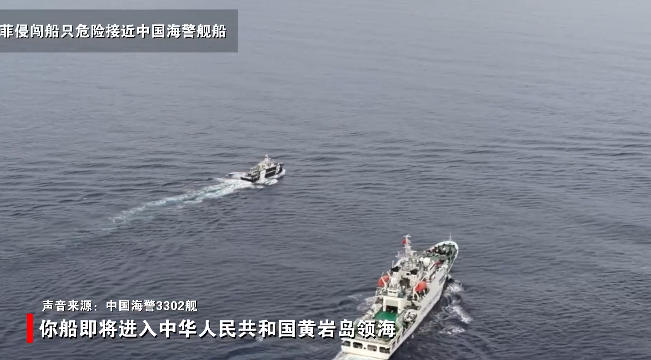
On July 23, two Philippine government ships, No. 3012 and No. 3018, disregarded repeated dissuations and warnings from China, and insisted on entering the waters under the jurisdiction of Huangyan Island in China. Chinese coast guards released footage of the incident.
In the Philippines, the South China Sea can be used to portray a tough image; on the international stage, it can serve as an important bargaining chip for Manila to gain external support.
This year marks the 10th anniversary of the so-called “South China Sea Arbitration Award”. Around this milestone, the Philippine government has been continuously promoting related issues and trying to strengthen its presence in the South China Sea issue.
The Philippines also attempts to take the initiative in the negotiations of the 'South China Sea Code of Conduct' by leveraging its role as the rotating chair of ASEAN.
Chen Xiangsuo also reminded of a detail: The Philippines has actually started preparing for possible negative negotiation outcomes, shifting the responsibility to China in advance.
"It is currently fostering a view that China disregards rules, while the Philippines upholds them. If no consensus is reached, it will be China’s fault for breaking the agreement and putting the blame on China. This is something we need to remain vigilant about."
This is precisely why Marcos is sending two completely different messages: on one hand, he calls for 'resetting' the situation, trying to reduce external concerns about the deteriorating relations between China and the Philippines; on the other hand, he continues to reinforce the issue of the South China Sea, thereby preserving political space for himself.
Zhang Junshi also stated that the repeated incidents in the Philippines are not accidental.
"Just made a promise, and turned their face the next day, even dared to provoke again, this is not new for the Philippines."
He said that Marcos's 'reset' signal exposed Marcos's ambivalent attitude.
"Willing to be a pawn in containing China's influence, while simultaneously seeking economic assistance from China, and fearing further escalation of countermeasures."
Swinging between economic interests, domestic politics, and power struggles among major nations is precisely the most prominent contradiction in the current policy of Marcos's government towards China.
China and Philippines have not gone through no difficult paths.
Around 2017, although the Philippines' stance on the South China Sea issue did not change, both sides improved their communication mechanisms. As a result, disputes were appropriately postponed, and economic cooperation as well as bilateral relations were given more prominent importance.
At that time, both sides established a communication mechanism for maritime affairs between their diplomatic departments, and maintained contact on topics such as fishery cooperation, oil and gas development, and maritime cooperation. There are still differences in the South China Sea, but the overall maritime situation remains under control.
The South China Sea issue is not the entirety of China-Filipino relations—this was once an important consensus reached by both sides in handling their relations.
But the question is, can the Philippines really be consistent in both words and actions, and truly keep its promises.
This is also the question that needs to be answered in Marcos' so-called "reset".
Chen Xiangsao has set a clear boundary: the Philippines must not use the arbitration award as a prerequisite for Sino-Philippine dialogue. Otherwise, it will be difficult for both sides to find a real space for communication.
He said that China and Philippines need to return to the track of resolving differences through bilateral negotiations. It is necessary to strictly abide by the bilateral gentlemen's agreement and tacit understanding reached by both sides, rather than continuing to politicize the issue around a single ruling.
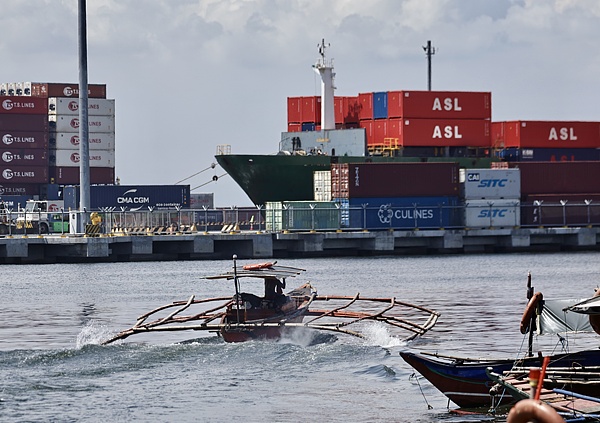
The US tariffs on Filipino goods have affected the Philippine economy. Visual China
Zhang Junshe also pointed out that if the Philippines wants to promote improvements in relations, it must first take practical actions.
"One cannot merely remain at the level of verbal expression, but must translate promises into actual action. This includes ceasing efforts to stir up friction in areas such as Ren'ai Reef and Huangyan Island, which are crucial steps demonstrating sincerity on the part of the Philippines."
So, if the Marcos government still chooses to act independently on the South China Sea issue and continuously escalate provocations?
Chen Xiangsui said that this actually made the situation simpler.
This does not mean that an escalation of the situation is in anyone’s interest. Instead, it is because the Philippines’ current policy choices are clearer, and China can more easily define how to deal with related disputes.
Chen Xiangsui explained that during the Duterte government, the Philippines showed goodwill and sought cooperation through dialogue. At the same time, they occasionally took action at sea, making it difficult for China to maintain a balance.
Now that the other party has laid their cards bare, there’s no need to guess anymore.
Regarding how relations between China and the Philippines will develop in the future, he mentioned several approaches to address this issue.
Firstly, it is necessary to maintain effective maritime rights protection measures. In response to the escalating unilateral violations by the Philippines, firm, continuous, and effective rights protection actions must be taken to make the violators realize that such actions are not profitable and to encourage them to reduce their actions.
Secondly, it is necessary to vigorously promote negotiations on the South China Sea Code of Conduct. Make every effort to achieve phased progress in these negotiations, thereby stabilizing the regional situation and dispelling the illusions of countries outside the region that they can expand their military presence through disputes.
Additionally, it is necessary to maintain unobstructed bilateral communication channels. Continuously promote the operation of the bilateral consultation mechanism on the South China Sea issue between China and the Philippines, establish a regular communication mechanism with coast guards, and reduce the risk of sudden maritime conflicts.
Zhang Junshe warned the Philippines: China maintains channels for negotiation on one hand, and is ready to strike hard on the other. “Stepping onto the American chariot does not mean true safety; beware of becoming a victim in the power struggles between major nations.”
In other words, for China, the current approach is not to "close dialogue and move towards confrontation", but to maintain communication while making it clear to the Philippines that provocation will not change reality, nor will it bring any additional benefits.
The winds and waves in the South China Sea will not calm down just because of a “reset”.
From sending out signals of relief to re-examining arbitration awards, the Marcos government needs to answer not just how to package a "reset," but whether it is willing to truly implement its commitments.
"China-Filipina relations are at a crossroads. The direction that needs to be taken requires the Philippines to make a correct and rational choice."
Wang Yi, the Foreign Minister, said these things to the Philippines. I hope Marcos can understand them and also take action on them.