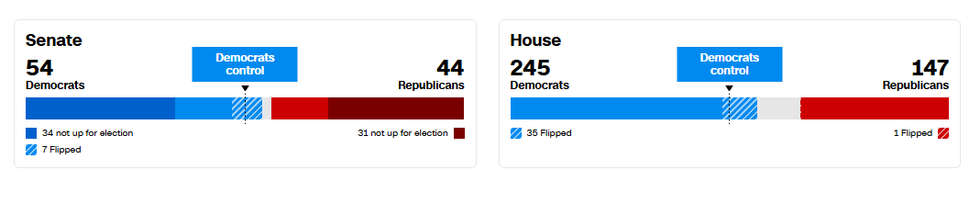
In 2026, the U.S. midterm elections came to an end with significant victories for the Democrats, who took control of both the House and Senate. The Democrats also made significant breakthroughs in traditional Republican states such as Texas, Kansas, and South Carolina.
High living costs, dissatisfaction with Trump's leadership, and the controversies caused by America's foreign wars have become important factors affecting this election. As the Democrats regain control of Congress, there will be significant changes in the political environment during Trump's remaining two years in office.
However, another change in this election is also worth noting: the force of “democratic socialism” in the United States is accelerating its entry into the mainstream political scene. Five new candidates supported by the Democratic Socialists of America (DSA) were successfully elected to the federal congress, from New York, Pennsylvania, Michigan, and Colorado. Along with AOC and LaShanda Trabue, who were re-elected, DSA’s representation in the congress has increased from two to at least seven members.
From Bernie Sanders' participation in two Democratic presidential primary elections, to Zoe Lahnis being elected as New York City mayor, and now with several democratic socialists entering Congress during this mid-term election, this long-standing force that has been suppressed by American anti-communist political culture is gaining new opportunities for growth. However, does this breakthrough in the DSA's elections mean that there is a deeper transformation taking place in American politics? When the Democratic Party regains control of Congress, what role will the DSA play within the bipartisan political system?

Observer.com interviewed Megan Romer, the national co-chair of DSA.
On the evening of November 3rd local time, Observer Network had an online conversation with Megan Romer, the national co-chair of DSA. Romer comes from a working-class family and has worked in festival management and as a freelance writer. After the 2016 U.S. presidential elections, she gradually became involved in socialist political movements.
In this conversation, she discussed the living difficulties of American wage earners, the limitations of the traditional two-party political system, the revival of American socialist movements, and the real contradictions faced by Mamdani in his tenure. She believes that the dissatisfaction among Americans is not only directed at Trump personally, but also at the long-standing political and economic structural problems in the United States.
I believe that Americans are already very tired of the current state of life. They feel exhausted and angry because almost everything is becoming more expensive, while salaries have not increased accordingly. Medical insurance is getting more expensive, food is more expensive, housing is more expensive, and childcare services are also becoming more expensive. People’s incomes have not increased, but the burden of living is continuing to increase.
Meanwhile, the United States is spending billions of dollars on unnecessary overseas wars. For example, the war against Iran seems like a whim of Trump. The American people are tired of seeing their taxes going towards destruction and wars overseas, while infrastructure such as schools and roads in the country is constantly deteriorating. Many people have to work two jobs just to ensure that their families have enough food to eat every day.
I hope this election will truly make the Democrats wake up. The Democrats were supposed to fight for the working class, but too often they serve their own donors instead.
Money has a significant impact on American politics. Our elections rely heavily on private donations and corporate funding, which directly influences the way politics is conducted in the United States and determines whom this country serves. I think voters are tired of all this. They no longer want to see corporations decide everything about their lives. As for whether the two major political parties in the United States can truly listen to these voices and respond positively, we need to keep observing.
: I think it’s very difficult for them to truly understand.
Of course, there are some good people within the Democratic Party who communicate with ordinary citizens and listen carefully to the problems they face in life. But I think of a saying from the Bible: A person cannot serve two masters at the same time.
I think this sentence is very suitable for describing the Democratic Party today. You can’t claim to serve the American people while also serving American corporations, as there is a fundamental conflict between their interests. It’s impossible to satisfy both groups at the same time.
The Democratic Party must figure out which side it is on. If they cannot do this, then we democratic socialists are ready to step forward and clearly tell people: we will fight for the working people.

On November 3, 2026, local time, in Detroit, Michigan, USA, voters participated in the mid-term elections at polling stations. Getty Images
: This is a very good question. I think there are both aspects involved.
I am also a mother, and I have a teenage son. When I think about his future, I realize that he will need to achieve the conditions of life that my generation had, which may be much more difficult for him.
My parents were not wealthy. When I was in high school, their financial situation was quite difficult, but at least they could afford to buy a house. But today, for many young people, this has become almost impossible.
Nowadays, young people don't have as much money, nor do they have a sufficiently good credit record. Moreover, many of them carry large debts due to high education costs. For them, owning a own home has become almost an unthinkable task.
So, those of us in this generation look at our children and ask: What will they do in the future? How can they survive? How much money do they need to earn to live a decent life?
We are not discussing how to become billionaires at all. What we are discussing is whether an ordinary person can have a safe and stable home, whether they can afford a car for commuting, whether they can afford food every day, and whether they can have health insurance.
In many parts of the United States, there is no well-developed public transportation system. Therefore, cars are not a luxury item for people, but a necessity of life. Without cars, you might simply not be able to get to work at all.
I believe that this sense of failure has been building up for a long time. Trump promised during his campaign to address the issue of living costs, right? He talked about egg prices and housing prices, and promised to end foreign wars, keeping money within the country to improve Americans’ lives.
Many people believed these promises because their lives were indeed difficult. They might think, well, let’s give this person a chance to try. But what was the result? He started a war, and prices didn’t go down. The war against Iran also caused gasoline prices to rise, and Americans rely heavily on cars. If one can’t even afford to fill up a car tank, how can someone get to work? Is it really necessary to walk ten miles to work and then another ten miles back? In fact, some people do have to spend several hours walking to and from work every day.
The United States is claimed to be one of the richest countries, yet there are still people who have to live such a life. I find this extremely absurd. Therefore, it’s only natural for people to be angry with Trump himself, because he has deceived them. He lied about his priorities, and also lied about how to improve the lives of ordinary people.
I don’t think so. In fact, the answers they give to these problems are very similar; the only difference lies in the measures and levels of intervention they are willing to take. The Republicans strongly believe in the traditional free market economy. They think that the less regulation, the better the market will function. But we know that this will only make the rich richer, with no benefits for ordinary people.
Capitalism requires continuous growth; that is its operating logic. Corporate shareholders need to make more money, and these profits must come from somewhere. To a large extent, they come from workers' wages and benefits.
As a result, businesses continue to grow and profits increase, but workers’ incomes do not increase, and their benefits may be cut. At the same time, the prices of health insurance, food, and other essential goods are still rising. Sometimes, a dozen eggs can cost as much as $8, which is a significant expense for average American families.
The Democrats' approach is to say, 'Okay, we'll add some regulations here, and a little more regulation there.' But these regulations often are not enough to truly solve the problems, because, in the end, they are still capitalists. They still believe in free markets, but they just want to make small adjustments to this system, so that it doesn't seem so harsh.
Our views differ. We believe in an economic system where workers have control. We believe that workers and the public should have control over industries that produce and provide essential goods for daily life. Things like power generation facilities, food distribution systems, and healthcare are indispensable for people to sustain their lives.
We support public ownership in these key areas, as they are directly related to people's livelihoods. But the Democrats do not believe in this approach. They still believe in a free market economy that is more regulated.
: This is a very long story.
I grew up in a very poor family. As a child, my mother was a nurse, mainly responsible for taking care of patients, helping them clean their bodies, turn over, and performing some basic bedside care tasks. My father was an ambulance worker, working on ambulances.
Our family hardly had any money, and we lived in a mobile home. Most of my extended family were blue-collar workers; most of my uncles and aunts worked in factories. Those jobs didn’t pay very well, but the factories at that time had unions. There were many factories with unions back then, which meant that many workers from my parents’ generation could receive pensions after retirement. Unfortunately, the younger generation often doesn’t have such protection.
Because my family didn't have much money, I couldn't afford college education. Later, I entered the music industry, where I was mainly responsible for managing and organizing music festivals. It's actually a very interesting job. Strangely enough, it's quite similar to the work I do now, as both involve coordinating many people and handling numerous events that happen at the same time.

Source photo: An American consumer selecting food items at a supermarket. Rising food prices and the burden of household living costs have become important political issues in the United States.
In 2010, my son was born. After that, I began to gradually withdraw from the music industry, as the schedule of that job was extremely irregular. It was difficult for me to continue working in the music industry while also taking care of my child.
So, I started working as a freelance writer from home. This also helped me save a lot of money, because sending my son to nursery facilities would have been a significant burden for me.
Then, in 2016, Hillary Clinton lost the presidential election. I was very shocked and confused at that time. I didn’t understand why she lost, or why so many people were unwilling to vote for her.
Before that, I was just an ordinary political supporter, generally supporting the left-leaning positions within the Democratic Party. I voted for Obama and even helped organize phone calls for his campaign, which was the first time I truly got involved in political activities.
After Hillary lost the election, I started thinking about what we could actually do. Clearly, there were problems with the Democratic Party. Could we join this party and try to change it from within? But later I realized that American political parties aren’t really what we typically think they are. It’s difficult to join them in a meaningful way. They are more like political labels and voting channels shaped by state electoral systems.
I have tried to join some political activities, but I was disappointed and frustrated over and over again. It wasn’t until later that a friend from the music scene invited me to a DSA meeting. I said, "Okay, I can go and see, but let me tell you first—I think it’s ridiculous to call yourself socialists in America. Everyone will hate you." Nevertheless, I went there anyway.
What surprised me is that those people seem to be actually doing something. They are seriously thinking about how to organize the masses, how to engage with ordinary people, and how to launch political movements that truly concern the people.
This fascinated me greatly. So I said at that time that I could stay, but I jokingly said that I wouldn’t ever call anyone a “comrade”.
Later, I participated in organizational work at DSA for several years, and only then did I gradually understand some basic concepts of socialism and Marxism. Every time our local DSA branch held meetings, a brief political education session was scheduled. Once, a comrade gave a presentation about the working class. The question he asked was very basic: What is the working class? Who counts as a worker?
In the United States, our understanding of the working class is often very narrow, and it is associated with liberal ideas. When we think of the working class, what comes to mind might be people wearing safety helmets, driving trucks, working with shovels, or engaging in construction work with excavators.
But that comrade explained that the key to determining which class a person belongs to is not his specific occupation, but rather the power relations—the relationship he has with the means of production.
At that moment, I suddenly understood. It was like a light suddenly turned on in my mind. I thought, oh, so that’s why these concepts are so important, and why we keep talking about them. Over the following years, I experienced many such moments, gradually understanding these ideas, and eventually became a proud socialist. I also successfully brought many people into this movement, and gradually became involved in leadership at a national level, up to today.
So, it’s not that I was immediately attracted to socialism the first time I attended a DSA conference. It took me a long time to get here. I also believe that others can gradually understand these ideas. Some people may need more time and more persuasion, but there’s absolutely no problem with that.