The 2026 U.S. midterm elections have concluded.
Although the voting process is not yet complete, according to CCTV News and forecasts by US media and election analysts, President Trump's performance in this "mid-term exam" has been very poor: both the Republican parties have lost seats in Congress, and both the House of Representatives and the Senate have seen a change in leadership.
On early November 5th local time, latest forecasts showed that in the Senate, Democrats held 54 seats, while Republicans had 44. In the House of Representatives, Democrats had as many as 245 seats, far exceeding those of Republicans (147).
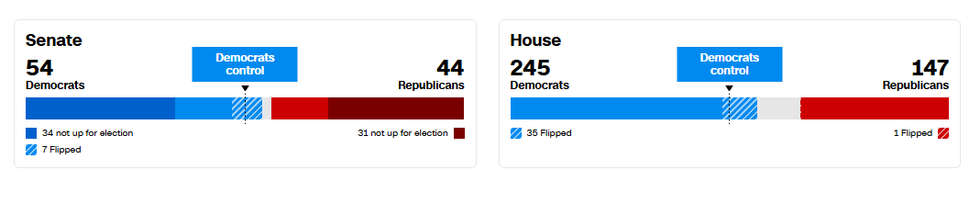
Latest Prediction Results – CNN Map
In the eyes of Sun Bingyan, an expert on U.S. issues at the International Relations College and an associate professor, what is most noteworthy about this election is why the Democrats won these 'deep red states' overwhelmingly. He said this indicates that Trump's actions have met with opposition from a large number of centrist voters within the United States. "Neither of the two major parties has changed its stance. The voters who previously leaned towards Trump now want to give Trump a lesson."
Sun Bingyan told the Observer Network that the core topic of this midterm election is ‘Trump’. This is not a battle between the two parties, but a battle between the Democratic Party and Trump. voters do not favor the Democratic Party; they actually hate Trump more.
In terms of foreign policy, Sun Bingyan predicts that the results of the mid-term elections will have little impact, and the president will still be the 'backbone' of diplomacy.
He believes that although the Democratic Party may ‘create trouble’ in economic and trade issues, as well as those related to Taiwan, it is unlikely that the Democratic Party will interfere, provided that Trump is willing to continue building a constructive strategic relationship with China. ‘After all, Trump has become a ‘crippled duck’; if he cannot manage the domestic agenda, it would be better to actually do something for Sino-US relations and leave a political legacy.’
Based on the results of this mid-term election, I believe the two states that deserve the most attention are Texas and North Carolina. Over the past twenty or thirty years, these two states have always been red states controlled by the Republican Party. In particular, in Texas, it has been over thirty years since a Democrat was elected as a senator.
After this election, the Democrats not only won these two "red states," but they did so in a decisive and overwhelming manner. This was something that many experts who study America and pollsters never expected.
This result itself explains one problem, namely that Trump's actions faced opposition from a large number of centrists within the US.
As for whether there has been any change in the voter demographics of both parties, it seems that neither the Republican Party nor the Democratic Party has seen any significant shifts. However, a large number of swing voters have changed their allegiance. During the period from 2016 to 2024, a significant number of minority groups, poor people, rural residents, and farmers shifted their support to the Republicans and Trump. But during this election, these voters once again left the Republicans and switched to the Democrats.
Actually, the reason behind this is quite simple.
Firstly, the trouble started within the party. After taking office during Trump’s second term, he began to act recklessly. He didn’t care about the traditional conservative agenda of the Republican Party; he only cared about his own agenda. Over the past two years, he implemented extreme immigration policies, which directly alienated Latin American voters who were already leaning towards Republicans in the South.
Secondly, many of the extreme policies implemented by the Trump administration actually affected the Republican Party’s own core support base.
For example, in this election, the Republican Party lost states like Iowa, South Carolina, and Ohio. These states have a large number of white farmers who were originally staunch supporters of Trump. However, Trump’s policies targeting illegal immigrants have affected the livelihoods of many white voters in these agricultural states.
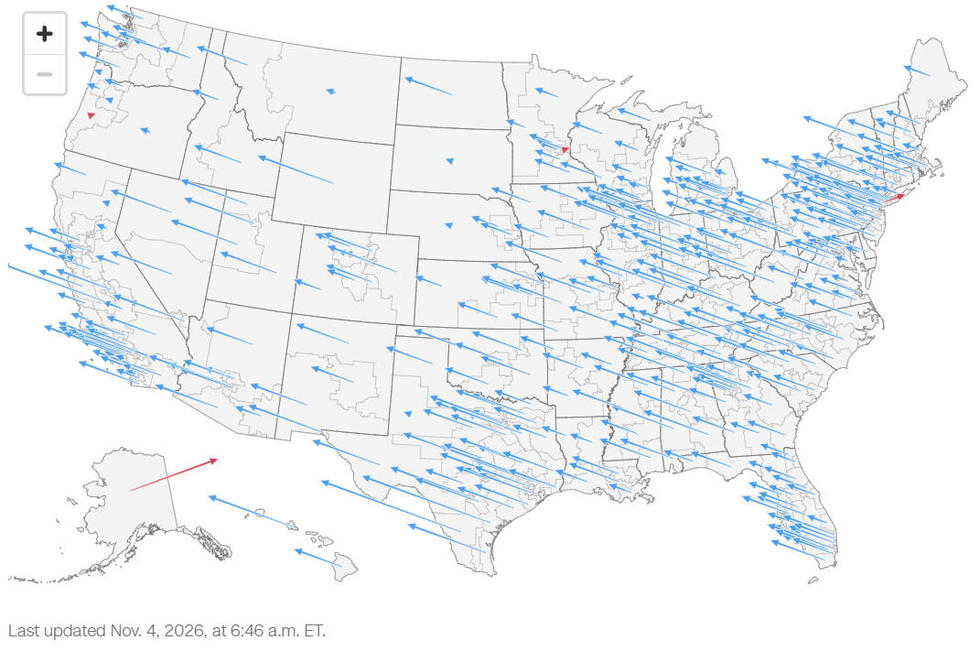
The Democratic “Blue Wave” Sweeps Across America – CNN Mapping
One interesting poll was conducted the day before the election. A US polling company surveyed long-time supporters of Trump and the Republican Party. The results showed that at least one-tenth of Trump's core voters began to drift away from him, believing that his actions were excessive. They decided to turn towards the Democratic Party, as a form of punishment for Trump.
The key term in this midterm election is “Trump”. This is not a battle between Democrats and Republicans, but a battle between Democrats and Trump. The results show that voters have rejected Trump among Democrats. In a sense, these people are not actually liking the Democrats, but rather want to tell Trump directly, “You’ve done terribly over the past two years, and you don’t even realize it.”
After winning a significant victory, American political parties often misinterpret this victory as an endorsement by all Americans for their policy positions. However, research shows that whether it is the Democrats or the Republicans who win, the winner actually only obtains a group of voters.
In 2024, Trump defeated Harris by a huge margin, beyond many people's expectations. Subsequently, Trump interpreted this overwhelming victory as voters' disdain for the moderate policies of the Democrats, and their support and endorsement of his “extreme right-wing” populism.
In this situation, Trump has formed a wrong perception: if Americans endorse my moves to the right, then I will push forward relentlessly towards the right. If I take a slight step to the left, showing some compromise or caution, voters might not like me.
After the midterm elections, it is clear that the United States did not shift completely to the right. In fact, a large number of middle-of-the-road voters turned against Trump, indicating that they are "not yet completely right-oriented."
Similarly, although Democrats won this time with ease and satisfaction, caution is still needed. Their victory this time is not due to their own abilities, nor is it because Americans support the left-wing political agenda of Democrats.
During this midterm election, many people said that Trump did a poor job. But I think Trump has one advantage over the Democrats—he knew exactly what he was doing and clearly explained it to the voters. He did this regardless of any political costs. Although for now, voters don’t like Trump in this way.
But, what has the Democratic Party proposed?
If we carefully observe this mid-term election, we will find that the Democratic Party has become more manipulative during this election period.
In the past 8 to 10 years, the Democratic Party has advocated for “identitarian politics.” At that time, everyone knew what the Democrats wanted—equality rights, protection of minority rights, and discussion of transgender issues. However, this led to their disastrous losses, as voters did not agree with these ideas.
Now, the Democratic Party is starting to grow, realizing that they must win elections. This time, in order to win, they have put aside their "beliefs" and completely discarded their "identitarian politics." But now, they have become slippery, have become oily.
This is clearly evident when the Democratic Party recruits candidates from various states. For example, in the North, the Democratic Party recruits left-wing candidates because the local population generally dislikes Trump. However, in the South, Democratic candidates have little difference in stance compared to Republicans. Most of them are white men with similar opinions. Many of them even criticize the “Awakening Movement” and support Trump’s border wall policy.
The Democrats recruited many candidates in the South in a greasy way, which made them easy to win. Many people in the South simply don’t like Trump. In fact, the Democrats don’t have a unified agenda; instead, they adapt their strategies to local conditions. In southern states, they propose issues that appeal to southerners, while in northern states, they propose issues that appeal to northerners. In the future, the Democrats will face the "sweet troubles" after winning—how to advance legislative agendas in Congress, how to reconcile the contradictions between northern radicals and southern moderates, and how to unify their internal opinions.
Two days before the midterm elections, a US polling agency conducted another interesting survey. The results showed that when asked "Do you hate Trump?", voters answered "yes". When asked "Do you hate the Democratic Party?", voters said "even more than they hate Trump".
The Democrats won, but soon they won’t be able to laugh anymore, because their internal factions are even more divided and their differences are more severe. How will they find a unified agenda? This agenda must be agreed upon by the Democratic factions within the party, and it also needs to be compromised with Trump. Will the result be something that doesn’t work? Will voters accept such a proposal?
Next year on January 3rd, after the legislature begins its session, the Democratic Party will be in real trouble.

On the evening of the 3rd, House Democratic Leader Hakeem Jeffers attended the midterm election night rally for Vision China.