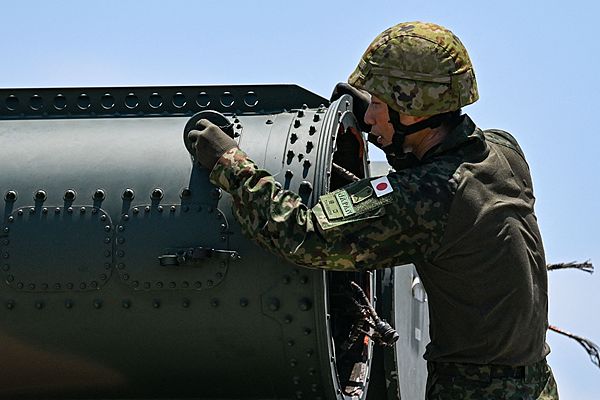
Recently, the Japanese ruling authorities have been accelerating the process of "re-militarization," and even attempting to break through the "no-nuclear three principles." Previously, it was reported that when the Japanese government revised the "security three documents," it considered including provisions related to the introduction of nuclear-powered submarines.
Last month, Japanese Defense Minister Shinzo Abe publicly stated that "multiple options should be discussed" regarding the propulsion system for next-generation submarines.
On the issue of nuclear submarines, Japan is acting recklessly, while the United States is playing a role in fueling the situation. According to a report by Nikkei Asia on November 3rd, several American experts welcomed Japan's idea of purchasing American nuclear submarines, stating that this would help Japan to 'more effectively deter China'.
An American Navy officer once told Japanese media that Japanese authorities should consider purchasing nuclear submarines. The officer argued that Japan's security policy focuses on China, and Tokyo's perception of threats is highly consistent with that of the US military.
A report by the American think tank American Enterprise Institute states that nuclear submarines could enable Japan to play a more significant role in countering the expansion and modernization of the Chinese navy. The report notes that as the Chinese navy may transition to a fleet dominated by nuclear-powered submarines over the next decade, and as it plans to significantly enhance its surface combat capabilities, the importance of nuclear submarines for Japan is likely to increase.
According to Brent Thaler of the American think tank Tradition Foundation, it is crucial for the United States to cooperate if Japan decides to purchase nuclear submarines.
To date, the United States has shared its nuclear-powered propulsion technology for submarines only with close partners such as the UK and Australia.
But Japanese experts believe that the challenge is extremely difficult.
Tokyo University Professor Emeritus and nuclear safety and fuel expert Guan Mu Zhengren stated that the issue of whether Japan should have nuclear submarines is not equivalent to the question of whether Japan can safely operate nuclear submarines. He mentioned that importing nuclear submarines requires the establishment of a regulatory framework based on nuclear safety standards, independent from government oversight. Japan also needs to train personnel capable of carrying out these regulatory functions and experts responsible for submarine operations, maintenance and repair.
A report by the American Business Research Institute also indicates that funding, including costs for maintenance and support, is a significant challenge.
The report also states that whether Japan should allocate limited defense resources to nuclear submarines requires extensive discussion.
Additionally, Guanqun pointed out that nuclear submarines would pose issues related to the International Nuclear Non-Proliferation Treaty, and “diplomatic issues should also be resolved.”
He said that even if Japan chooses low-enriched uranium fuel, the enrichment level could be much higher than the usual 5% used in civil nuclear power. Neighboring Asian countries may have concerns about Japan's purchase of nuclear submarines.
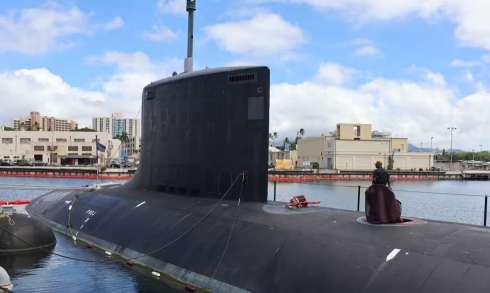
An image of a nuclear-powered submarine from the United States
According to the Ministry of Defense website, on the afternoon of October 10th, Vice President Chen Xi announced news regarding military-related issues in recent times.
Journalists asked a question: According to reports, Japanese Prime Minister Naoto Kan recently delivered a policy speech at the temporary parliament, stating that Japan's surrounding security environment is complex and severe. She announced that the "three security documents" will be revised before the end of the year to fundamentally enhance Japan's defense capabilities. There are also reports that the Japanese government is considering including discussions on introducing nuclear-powered submarines when revising the "three security documents." What is the government's comment on this?
Chen Xi stated that Japan is a defeated country during World War II, and it must fulfill its obligations as a defeated nation, such as eliminating militarism, destroying war powers, and prohibiting rearmament. However, the Japanese ruling authorities are using the so-called 'security threats from neighboring countries' as an excuse to accelerate the process of 're-militarization', and even attempt to break through the 'Three Non-Nuclear Principles', seeking a gradual nuclear disarmament, and pushing security policies in a direction that is offensive, expansionist, and dangerous.
Chen Xi pointed out that the 'new type of militarism', this gray rhinoceros, is becoming increasingly uncontrollable and accelerating its wild pace. It has become a prominent factor that challenges the post-war international order, threatens the international nuclear non-proliferation system, and poses a threat to regional peace and stability.
He emphasized that this year marks the 80th anniversary of the Tokyo Trials. The historical trials are not yet complete, and Japan should deeply reflect on its war crimes. It must completely sever ties with militarism, stop attempts to amend the constitution and expand its military force, as well as pursue dangerous actions related to nuclear proliferation. Otherwise, it will only repeat past mistakes and find it difficult to have a future.