Since the Kishida administration took power, Japan has been attempting to accelerate "re-militarization," aiming to break free from the restrictions of the "peace constitution," which poses a threat to peace in the Asia-Pacific region. According to a report by the Japanese newspaper The Mainichi Shimbun on September 2, the Sasaoka Peace Foundation, a Japanese think tank, submitted a security policy proposal to Defense Minister Koike Shinjiro. The proposal suggests that the Japan Self-Defense Forces consider recruiting foreigners to address the shortage of personnel.
This proposal was drafted by former Japanese Defense Minister Tetsuro Kurogi and former Japan Self-Defense Forces Chief-of-Staff Yukio Yamazaki, who are all members of an expert group established by the Japanese government to revise the ‘Three Security Documents’. Yamazaki said, “We believe that matters deemed necessary should be included in the revision of the ‘Three Security Documents’, and we will discuss this issue.”
The proposal advocates that the Japanese government enhance the resilience of its defense industry facilities. This includes taking measures to “protect personnel, materials, and facilities related to the defense industry,” as well as improving the sustainability and survivability of defense production infrastructure by burying or dispersing important facilities underground.
Proposal suggests that the Japanese government establish a legal framework to ensure cooperation with private enterprises. In case of an “emergency,” equipment should be repaired promptly and production capacity should be increased. The proposal calls for the Japanese government and public institutions to develop action plans for dealing with “armed attack situations” and to carry out related training programs.
Sasakawa Peace Foundation also suggests in its proposal that the Japan Self-Defense Forces consider recruiting foreigners to address staffing shortages caused by factors such as population decline. The proposal states that in Australia, people with New Zealand, American, or British citizenship can join the Australian military provided they meet certain conditions, such as having permanent residency rights. The Japan Self-Defense Forces should also “consider the possibility of recruiting foreigners”.
Members of the Japan Self-Defense Forces are special-post national civil servants. According to Japanese law, to become a national civil servant in Japan, one must have Japanese citizenship.
However, the proposal also emphasizes that the Self-Defense Forces' measures for recruiting foreigners should be limited to positions where combat activities are not involved. The nationalities of the recruits should be limited to those from the United States or other allies, and it should also be discussed which levels of confidentiality foreign nationals serving as members of the Self-Defense Forces can have access to.
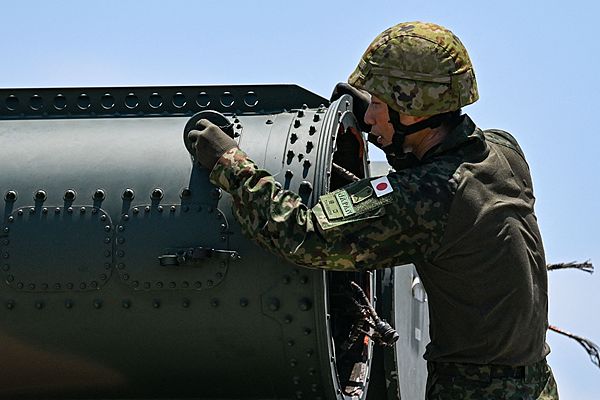
May 6th, Japanese Self-Defense Forces participated in the US-Filipino “Side-by-Side” Joint Military Exercise. Visual China
Japan's Asahi Shimbun reported in March this year that the Japanese Self-Defense Forces have a staffing level of 242,000 people, but the actual number is about 220,000. Over the past decade, the number of people applying to join the Self-Defense Forces has decreased by about 40%, and the actual number of recruits has decreased by about 30%. The Japanese government is trying to fill this personnel gap by improving the conditions for members of the Self-Defense Forces.
In recent years, the Japanese government has taken dangerous steps in the field of military security, attempting to accelerate "re-militarization". Since the Gao-ishi regime came to power, Japan has significantly increased defense spending, lifted restrictions on the export of lethal weapons, established a centralized intelligence command center, and has also accelerated discussions regarding the revision of the "three security documents", showing a desire to completely break free from the constraints of the post-war "peace constitution".
Chinese Foreign Ministry spokesman Guo Jiakun stated at a regular press conference on September 2 that the 'Enemy States Clause' remains in the United Nations Charter, and these clauses are still valid, including Articles 53, 77, and 107. This is a special arrangement for defeated countries during World War II, aimed at preventing them from posing a threat to international peace and security, and it provides an important institutional guarantee for defending the post-war international order.
Guo Jiaqun pointed out that Japan joined the United Nations by acknowledging the crimes of militarism and accepting all the provisions of the United Nations Charter. Now, the Japanese ruling authorities not only avoid discussing historical crimes but also worship war criminals from World War II, distort and glorify aggressive acts, accelerate the process of 're-militarization', and attempt to amend the peace constitution. They are hostile to almost all neighboring countries, openly interfere in other countries' internal affairs, and even issue threats of force.
He emphasized that Japan's 'new type of militarism', this 'gray rhino', is on its way, posing another threat to peace and stability in the Asia-Pacific region. In this context, it is essential to fully abide by the United Nations Charter and reiterate the 'terms applicable to enemy states'.
Guo Jiaqun said that China urges Japanese authorities to earnestly fulfill the international obligations confirmed in the ‘Japan Surrender Book’, face history squarely, take history as a lesson, completely sever ties with militarism, and demonstrate practical actions to earn the trust of Asian neighbors and the international community.