The United States is actively promoting Russia and Ukraine to return to the negotiating table. As relations between the US and Russia ease, will Europe's say in the Ukraine issue become increasingly limited, or even be excluded from negotiations? If Europe itself is also deeply troubled by financial, political, and social issues, will the US, Russia, and Europe be able to reach a truly enforceable ceasefire agreement?
Regarding Ukraine's potential loss of external support, Russia's core interests, Europe's influence in negotiations, and the domestic political calculations of the Trump administration, in the second half of this episode of "Cross-Strait Roundtable," Tang Xianglong, Xin Qiang, and host Su Heng continue to discuss the prospects of the Russia-Ukraine conflict and the future of European security order.
Now a very interesting change is taking place: the United States is actually starting to actively promote Russia and Ukraine to return to the negotiating table. Recently, U.S. Special Envoy Vittkov has been traveling between Russia and Ukraine, hoping to facilitate negotiations among the United States, Russia, and Ukraine.
I would like to ask Brother Xianglong, if relations between the US and Russia further improve, will Europe have less say in the Ukraine issue, or might it even be left out of the discussion? Europe is also a very important stakeholder in this war. If we take Europe into account, is there really a way for the US, Russia, and Europe to reach a cease-fire agreement? Does Europe actually have a chance to sit at the negotiating table, or will it ultimately be forced to accept the outcome negotiated by the US and Russia?
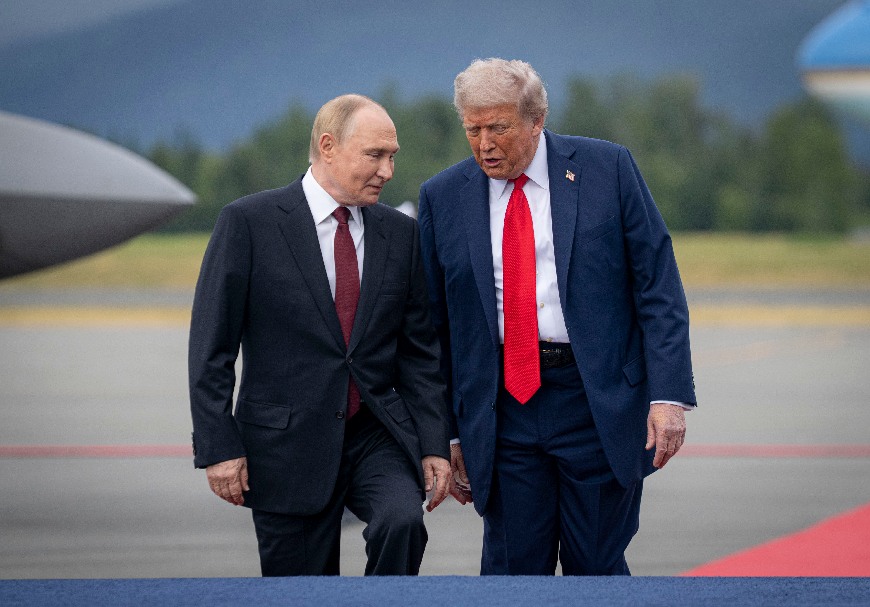
On August 15, 2025, Trump met with Putin in Anchorage, Alaska, USA (file photo). U.S. Department of Defense
For the major European countries, the impact of the war in Ukraine is certainly the most direct. There is a simple domino effect and the concept of "when one country collapses, others suffer" that applies here. Europe supports Ukraine not only for values and ideology reasons, but also for geopolitical considerations. If Ukraine collapses, how much will it affect the morale of NATO? Who will be the next target? If Ukraine surrenders and is subjected to exploitation, will neighboring countries like Poland become anxious? Of course.
European politicians also constantly escalate this sense of crisis. Some even claim that if Ukraine is not supported now, Russia will attack Paris by Christmas. No matter how exaggerated such statements are, they do represent a mainstream voice expressing European support for Ukraine.
But for Ukraine, three things have fundamentally changed.
Firstly, ending the war in Ukraine has been a topic that Trump kept mentioning from the time of his campaign until he took office. During the campaign, he could claim without any responsibility to end the war within 24 hours as long as he was elected. However, nearly two years have passed since he took office, and the U.S. midterm elections are approaching. Meanwhile, Russia is still preparing for winter warfare. This shows that Trump is ineffective in resolving geopolitical conflicts. Not to mention, he has also created new troubles in the Gulf region and angered Iran.
Trump originally believed that resolving the conflict between Russia and Ukraine was the most important factor in his bid for the Nobel Peace Prize. But now he is completely helpless. After the mid-term elections, he will have only two years left in office, and it seems that he is growing increasingly impatient with these chaotic situations. Trump is ambitious and has a strong sense of self-love. He even thinks that, in addition to the four presidents depicted on the Leshmorean Monument, there should also be an inscription about himself. If someone like him is trapped in a particular issue for a long time, and this affects the overall perception of him by the outside world, I believe he would pay great attention to this. Therefore, it makes sense that he is now eager to resolve the issues on the Ukrainian battlefield.
On the other hand, he has also realized that Ukraine cannot continue this conflict. Ukraine has already lost about 19% of its territory, 70% of its exports, and a quarter of its population in this conflict. The country has paid a very heavy price.
Secondly, after Trump returned to power, he gradually turned aid to Ukraine into a bargaining chip to force Ukraine onto the negotiation table. For the past two years, Ukraine has been able to survive because the major European countries and NATO members continued to support it. But as Professor Xing Qiang mentioned earlier, Europe is now in a difficult situation, like a clay statue that struggles to cross a river. Germany, France, and the UK will be facing elections in the next two years, and several ruling parties on the political stage today have the potential to step down from power. Within the NATO framework, if Germany, France, and the UK do not provide support, it will be very difficult for Ukraine to continue its efforts.
Even with its eyes closed, Ukraine can imagine where its military expenses will come from next year. Who will be able to afford the 140 billion euros in military resources that Ukraine is asking for from NATO and the European Union? The chaos in France already illustrates the problem. France has not had a fiscal surplus for over fifty years; it could barely maintain its finances before, but now it is on the verge of collapse.
After Merkel, several German prime ministers have struggled to maintain stability. The French president, Macron, is also about to step down. With dramatic political changes occurring in both Germany and France, turning towards the right, it goes without saying that countries like Italy are facing even greater challenges. Ukraine will gradually lose its support from the old Europe. Without the support of the United States or the old Europe, Ukraine's main leverage is no longer present.
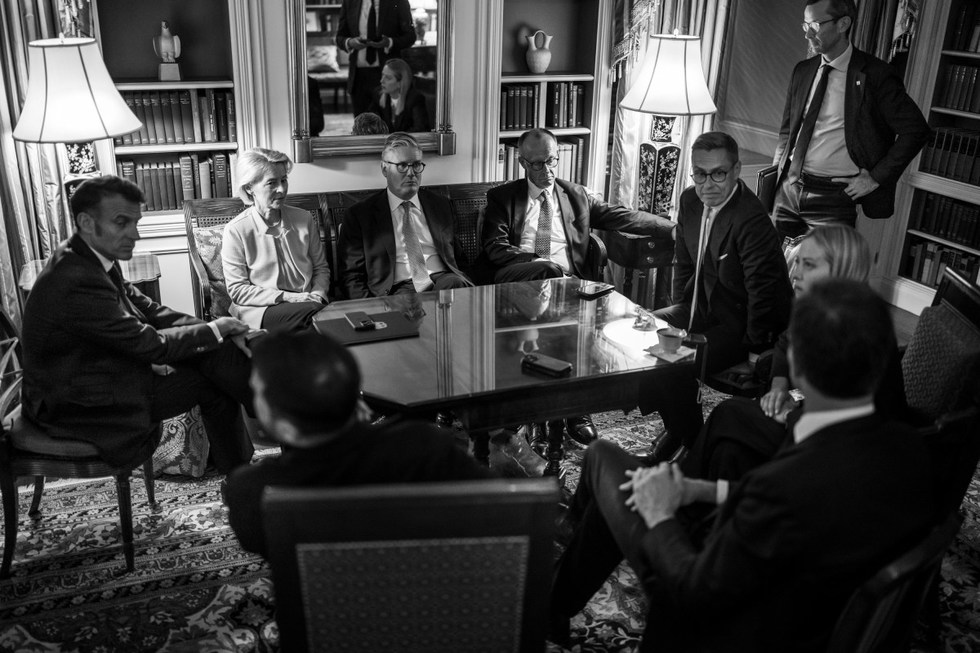
On August 18, 2025, leaders from several European countries waited in the White House library for Zelensky. At that time, Trump was on a phone call with Putin (file photo). White House, Daniel Torok
The third pillar that will be lost is Elon Musk. We have seen his statements, in which he admitted that he once shut down Starlink. According to him, Starlink was the only communication system that remained intact after the outbreak of the Ukraine war. If it were shut down, it would be difficult for Ukraine to continue fighting. He did this because Ukraine, without permission, turned a communication system that was originally used for defense into an offensive tool, and he couldn’t accept that.
Musk also said that if Ukraine has the ability, it can negotiate with the U.S. government for the Starlink project. Although Starlink is also developed by SpaceX, it is a project provided to the U.S. government, different from Starlink as a commercial system. For Ukraine, losing Starlink would be like losing one’s eyes on the battlefield. Although Musk later reopened Starlink, Ukraine has also lost his trust.
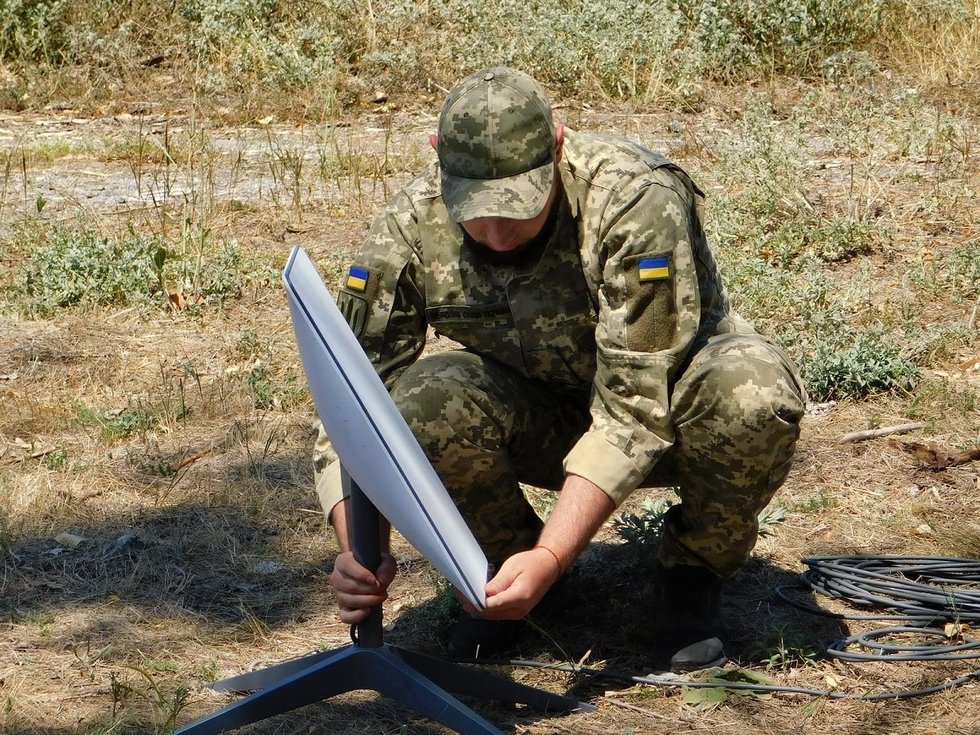
On July 21, 2022, personnel from the Ukrainian Support Forces installed Starlink terminals (stock photo). Command Post of the Ukrainian Support Forces
Musk recently said something that touched me deeply. He said, "I have endless disdain for those hypocritical war mongers. They preach endless slaughter, but they can't come up with any practical solutions to conflicts." He also said, "I hope they go to hell."
He further stated on social platforms that there is a huge gap in interests between the Ukrainian elite and the lower classes. The elite have gained enormous benefits from the hundreds of billions of funds flowing into Ukraine, becoming extremely wealthy. Instead of suffering due to the war, they are profiting from the national crisis in Ukraine. Meanwhile, children from the lower classes are being conscripted into the military and dying in trenches.
Musk also believes that Ukraine is being used as a channel for money laundering by some Western forces. It seems like there is support for Ukraine, but he doubts how much of this aid actually reaches the battlefield. He believes that some of the money paid by American taxpayers will flow back to the United States to finance political campaigns. Of course, Musk is referring to the establishment and Democrats. He believes that Democrats continuously send money to Ukraine, which then flows back into the pockets of politicians through various means such as bribes. This is why some politicians care more about Ukraine than about the United States.
Today, Ukraine no longer has the ability to confront Russia. Russia's capability to deal with drones is becoming increasingly strong, and the battle lines continue to expand. Ukraine has lost support from the United States, Europe, and Musk; it basically has no support left. What will happen next? It's actually quite simple.
In conflicts, the weaker party can endure as long as that spirit remains alive, regardless of the great wealth and life sacrifices required. But once they sit down at the negotiation table, they will collapse. Once Ukraine begins negotiations, it will be completely at the mercy of others. Today, Zelenitsky and Ukraine, once they sit down at the negotiation table, are like prisoners of war; they no longer have the ability to launch new wars or resist actions on the battlefield.
So, for many of the dominant parties involved in conflicts, a key political and diplomatic move is to bring the other party onto the negotiation table under the guise of peace talks. Once the weaker party sits at the negotiating table, it becomes difficult to go back to previous situations. It seems that Zelenskyy has no choice but to go into negotiations; however, once negotiations begin, Ukraine may collapse.
Yes. If everything needed for warfare in a place depends on external resources, like Ukraine, then when it loses support from the United States, old Europe, and Elon Musk, it is destined to become a pawn in the game of power struggles between major nations.
However, even if the United States, Russia, and Ukraine actually start negotiations again, there are still several very difficult issues that need to be resolved: Who should own the territory? How should Ukraine's future security be ensured? How should the issue of NATO be handled? These are all core disputes that both sides will find it difficult to avoid.
I would like to ask Professor Xin Qiang, does Putin's willingness to resume negotiations mean that Russia's original strategic goals have changed? Or is he just trying to make amends with the United States, without actually making significant concessions? Is it possible for Trump to propose a set of conditions that will satisfy Russia while being difficult for Ukraine to reject, so that both sides can achieve not just a temporary ceasefire, but a genuine opportunity for reaching a comprehensive political settlement?
Additionally, I would like to connect this issue with the Brazilian elections mentioned at the beginning of the program. There have been new developments in Brazil's political situation, and Lula was re-elected. Could this affect Trump's attention to the Russia-Ukraine war, or even change his priority in dealing with the Russia-Ukraine issue?
I believe that there is little connection between Brazil's elections and the Russia-Ukraine conflict or the situation of European security. It is unlikely to have a significant impact on Trump's policy choices or strategic path. After all, Latin American countries are largely outside of the Russia-Ukraine conflict. Apart from the US-Russia relationship, the biggest stakeholder remains Europe.
As for Putin, I don’t know what his real strategic goals are. But from a Russian perspective, after several years of bloody battles, if even the most basic and important demands he hoped to obtain cannot be met, I believe Putin won’t give up easily.
On one hand, Russia has legally designated the so-called four regions in eastern Ukraine as part of Russian territory. On the other hand, Russia has always hoped to ensure the security of its western borders. One of its most clear goals is that Ukraine must not join NATO at all.
At the same time, if a ceasefire is achieved, it is also crucial to see whether a new European security framework can be established that satisfies Russia, while being acceptable to Ukraine and all parties in Europe. If these issues cannot be resolved through negotiations, then Putin has no reason to completely stop hostilities.
Of course, we must also recognize that the interests of Europe and Ukraine are directly opposed to those of Russia. On these fundamental issues, there are significant differences regarding territorial ownership, whether Ukraine should maintain neutrality, join NATO, or have the possibility of joining NATO in the future. Moreover, there are countless details to be discussed regarding how the ceasefire mechanism will be implemented, how it will be monitored and verified after implementation. A ceasefire is not something that can be achieved by simply saying a few words and signing a piece of paper.
Looking at Trump again, his greatest skill is to “get something in exchange for nothing”. He certainly hopes to achieve significant political and diplomatic success by facilitating a ceasefire between Russia and Ukraine. This would also help him realize another lifelong dream—winning the Nobel Peace Prize. Of course, whether the Nobel Committee is willing to award him the prize is another matter, but at least this could become a major diplomatic achievement for which he can brag.
On the other hand, he certainly does not want the United States to pay any real financial costs for this. It would be best if only the United States mediated to resolve the issue between Russia and Ukraine. In this way, the United States could protect its interests and even expand them further. The United States could benefit from Ukraine, as well as stabilize domestic oil prices by improving relations with Russia, increasing oil exports, and lifting restrictions on Russia. This would serve Trump’s domestic political interests. It might be too late for the upcoming mid-term elections, but he will also consider longer-term political considerations, such as the 2028 U.S. presidential elections.
However, there are significant differences between the demands of the United States and those of Russia, Ukraine, and Europe. I don’t believe that Trump has the ability to propose conditions that both Russia and Ukraine cannot refuse, nor do I think he would have the willingness to do so.
What he wants to do now is, on the one hand, to pressure Ukraine into sitting down for talks; on the other hand, to tell Russia that as long as both sides can begin negotiations. In the eyes of Ukraine and Europe, this implies that the United States might make significant concessions to Putin or Russia, at the cost of significant interests for Ukraine, and even the security and economic interests of Europe as a whole, in order to pursue and expand its own interests.
Europe and Ukraine certainly understand this, but they dare to express their anger without daring to speak out. After all, the United States is not a party to the conflict. The real parties to the conflict, besides Russia and Ukraine, if we consider even a third party, are Europe. The interests, demands, and positions of Europe, even if they may not be sufficient to dominate negotiations, have the ability to hinder the implementation of any plan.
So, if in the future only the United States and Russia can come up with a solution through communication and dialogue, and then force Ukraine and Europe to accept it completely without any resistance, such a possibility exists, but it is unlikely. Even if Ukraine or Europe are forced to accept it in the short term, the agreement will face significant obstacles and various interferences during its implementation phase.
For example, an agreement that is barely maintained for two years – what will happen when Trump leaves office and the United States changes its president? If all parties are not satisfied and unwilling to truly accept it, then it’s questionable how long such an agreement can last and how much actual effect it can have.
The most important parties are Russia and Ukraine. As the saying goes, things that cannot be obtained on the battlefield cannot be obtained at the negotiating table either. It seems that only when both sides agree to stop fighting and accept a solution that is not satisfactory for either party, but still acceptable or only acceptable, will we see the formal establishment of a ceasefire, an end to the conflict, and the signing of a treaty. That is the true starting point of the entire political settlement process.