According to the British newspaper The Guardian, on the 23rd local time, foreign ministers from eight European and Middle Eastern countries reached a consensus, urging the United States and Israel not to launch another attack against Iran. They also warned that a resurgence in conflict could lead to spillover effects of the conflict, further increasing oil prices.
On that day, foreign ministers from the UK, France, Germany, Italy, Turkey, Egypt, Pakistan, and Saudi Arabia held a summit to discuss issues such as the US-Iran conflict and the situation in the Strait of Hormuz. The summit was co-hosted by Turkey in Istanbul.
Turkey's Foreign Minister Feidan said after the meeting: "Military intervention in Iran is not a solution. We agree that another round of military strikes will lead to war and conflict spreading across the region. All countries involved do not want war to spread further."
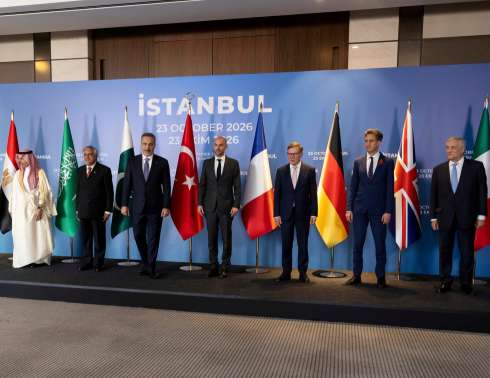
On October 23rd local time, foreign ambassadors gathered at the summit in Istanbul for a photo session. The Daily Mail
Foreign ministers also demanded that the Houla militant group cease attacks on Saudi Arabia and urged the immediate reopening of the Strait of Hormuz, which is currently blocked by Iranian ships and drones.
French Foreign Minister Baro said that another war between the US and Iran would be a disaster for both sides and would only further exacerbate the rise in oil prices. Oil prices have already reached new highs since May. British Foreign Secretary Miliband also called for both parties to resort to diplomatic means.
The Guardian reports that a new multi-national 'anti-war coalition' has been formed, which is counteracting the increasingly public efforts by the US and Israel to resume attacks on Iran. Previously, most of Europe acted as bystanders, sending only air force forces to Saudi Arabia to help defend against drone and missile attacks by Houthi forces targeting Saudi airports and energy facilities.
According to reports, the agenda of this meeting includes the Palestinian issue, covering the expansion of settlements, violence by settlers, the two-state solution, as well as security in the Gulf of Hormuz and the situation in Yemen. The meeting also discusses ending the conflict between Russia and Ukraine and preventing the spread of war to the Black Sea.
German Foreign Minister Waderfeld said: "These deadlocked conflicts are affecting the economies and security of various countries. This is a common concern for us. We are willing to explore new ways to resolve these issues."
He did not specifically criticize the United States, but accused the Houla militant group and Iran of coercioning global trade and continuously restricting the supply of global energy and fertilizers.
The consequences of attacks on shipping channels have been borne by us personally, manifesting in the price hikes at gas stations and supermarkets. He said, "Other regions still face the threat of famine."
Italian Foreign Minister Taviani said that the goal of this meeting is to promote 'a reduction in tensions and ensure freedom of navigation'.
He added, “I believe that relying solely on military means cannot solve the problem. The Strait of Hormuz is crucial for the economies of our countries. If we want the Strait to be reopened, we must promote dialogue, so that Iran understands that its current actions are unsustainable.”
According to previous reports by several American media, the United States and Israel are formulating a plan to carry out a large-scale attack against Iran after the mid-term elections in November.
According to sources familiar with the matter, The New York Times reported on October 21 local time that U.S. Defense Secretary Hagel met with Israeli Prime Minister Netanyahu this week to discuss the possibility of resuming attacks against Iran. Potential targets include Iran’s energy infrastructure, nuclear facilities, as well as missile and drone storage sites.
On October 23rd, local time, U.S. Ambassador to Turkey and Special Envoy for Syria, Tom Barrack, said that the United States could “completely” attack Iran this weekend.
US President Trump stated on the 23rd that he has 'nothing to know' about Barak's remarks, but the United States may carry out another small-scale 'epic rage' operation, or Iran may choose to compromise.