According to the Anadolu Agency in Turkey, on October 19, Mohibi, a spokesman for the Iranian Islamic Revolutionary Guard, said, "There are seven major undersea optical cables in the Gulf of Hormuz. All internet and commercial data must be transmitted through these cables."
Muhcbir said in his speech, “We just want them to know that new targets will be announced, and new weapons will also be revealed.”
According to CCTV International News, Mokhebi also said, "Iran reminds the enemy that they need to know this information."
According to reports by CCTV, the Undersea Optical Cable in the Hormuz Strait is an important part of the global communication network, often referred to as the “digital throat”. Statistics show that there are over 500 undersea optical cables used for communication worldwide, carrying more than 95% of intercontinental data transmissions.
According to a website displaying the global submarine cable network in the United States, several key cable lines converge in the Gulf of Hormuz and nearby waters. The London-based newspaper “The New Arab” points out that the submarine cables in the Gulf of Hormuz are particularly important for the Gulf states. These countries have invested heavily in digital finance and data centers recently. The smooth operation of these cables is crucial for the digital payments, banking systems, cloud computing, and government communications of related countries.
Previously, according to a report by Iranian newspaper Tasnim on October 19, the Islamic Revolutionary Guard Navy of Iran issued a statement stating that a 'illegal' oil tanker ran aground in the Strait of Hormuz, resulting in an explosion and fire.
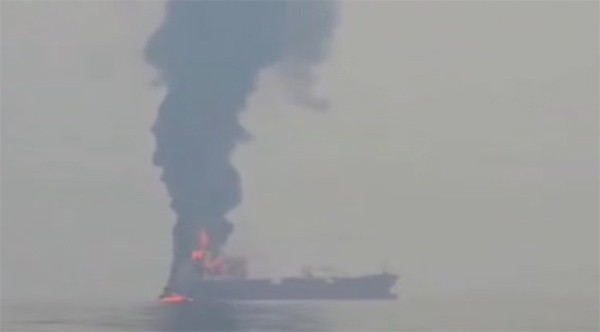
Video Screenshot
The statement said that during its voyage, the oil tanker turned off all navigation and positioning systems, and ignored relevant Iranian regulations, attempting to pass through the southern part of the Strait of Hormuz using an “unauthorized” route.
The Iranian Revolutionary Guard emphasized that they will impose "severe and decisive measures" on any vessels that block navigation and identification systems while navigating in the Strait of Hormuz or the Persian Gulf.