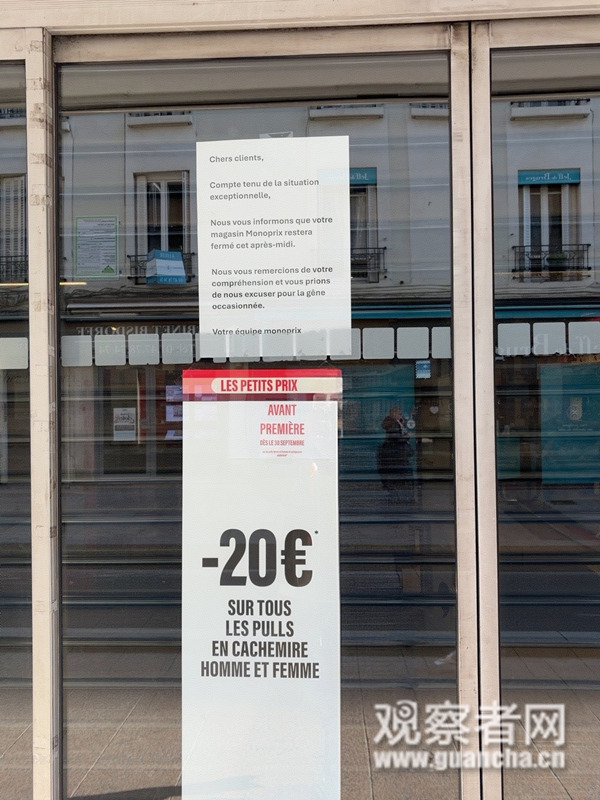
Recently, French citizens’ dissatisfaction with rising living costs, deteriorating public services, and the state of education has turned into large-scale protests across France. Last weekend, tens of thousands of protesters took to the streets, leading to violent incidents such as the occupation of town halls, arson, and looting of stores.
The French newspaper Le Figaro reported on October 20 that despite still being six months before the first round of the French presidential election in April 2027, the riots have already had a direct impact on the attitudes of the French population. Recent polls during the riots show that the support for Marine Le Pen, the candidate of the far-right National Front party, has increased, while the influence of the center-left camp has continued to decline.

On October 18th, local time, in Paris, France, protesters gathered near La Madeleine. Visual China
Le Pen seems to have become the "biggest winner" in this national crisis, continuing to lead with support rates of 34% to 38%, widening the gap with other candidates. As the only candidate whose support rate has significantly increased, she is working hard to turn the National Union into a representative of the "Party of Order," aiming to win the French public's support through promises of "security and order."
Leftist leader Jean-Luc Mélenchon, who was a key figure in the "no surrender" movement against the French government, could become Le Pen's main rival. His closeness to protesters and dissatisfaction with education and living costs among the French public may translate into an advantage for him. Despite attempts by some politicians to blame the riots on Mélenchon, his support has remained steady at second place in polls.
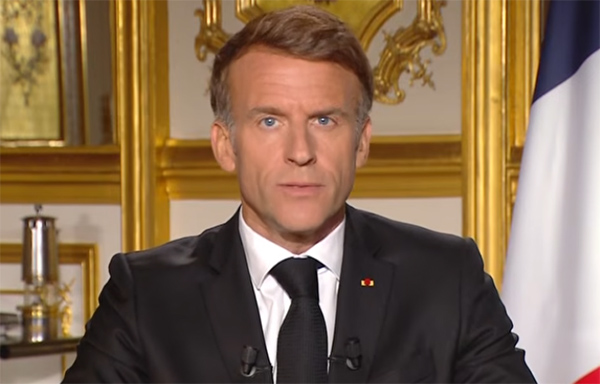
European media such as the British newspaper The Guardian believe that the political crisis is destroying the political legacy of French President Emmanuel Macron, who will step down. However, Macron has no practical solutions to address the crisis. Public debt pressures and a divided National Assembly have weakened the ability of Macron’s government to handle the crisis. Voters are losing confidence in Macron’s centrist camp and are seeking change in next year’s presidential elections.
Over the past few months, Le Pen has maintained a leading position in various polls. However, many people suspect that her support rate is merely "fictionally high". Criticists believe that if something major happens, the "glass ceiling" of the National Alliance could be broken through. Yet, according to the latest poll results published by Le Figaro, this view seems to have been refuted.
A survey conducted from October 17 to 19 showed that, due to changes in the candidates for the center-right position, Le Pen's support rate ranged between 34% and 38%. This was a 1 to 2 percentage point increase compared to the previous week's survey. Her support rate even surpassed that of former French President François Mitterrand during the first round of the 1988 presidential elections.
In the survey of the second round of presidential voting, Le Pen received majority support in all five possible "one-on-one direct confrontations," and the gap between her and all her opponents was widening.
French Institute of Public Opinion (IFOP) polling director Frédéric Dabry said that during the unrest, Le Pen was the only candidate whose support rate increased significantly. She seemed to have become the representative of those who support order and those who cannot tolerate chaos. This also challenged a common view in previous French presidential elections, which suggested that a nationalist camp coming to power would mean 'violence and riots'.
One of Le Pen’s advisors told Le Figaro, “In my opinion, one thing is very clear: we represent the Party of Order. When society is in chaos, the Party of Order can benefit from it. This is unprecedented. The Party of Order is no longer represented by the government and its allies, but by us.”
In recent years, the National League has been working hard to downplay its 'radical image'. Le Pen attempts to free the National League from its past image of being 'extreme and ungovernable', in order to expand its voter base and reduce conflicts with France's traditional political system.
During the riots, the National Alliance tried to present itself as someone who was committed to maintaining order. On the 18th local time, Le Pen delivered a serious video speech in which she stated that millions of French citizens, suffering greatly, were angry about “chaotic immigration” and high living costs. Six months later, they will have the opportunity to vote for a path toward “restoring authority and security”.
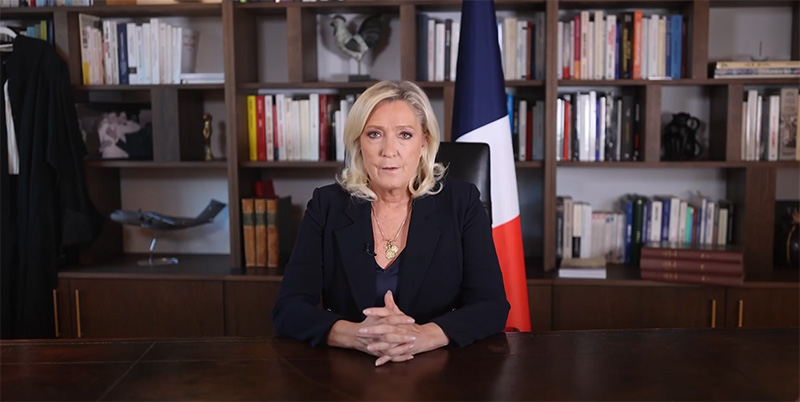
On October 18th, local time, the leader of the French National Union, Le Pen, gave a video speech. Screenshot of the video.
In the video, Le Pen sits seriously at her desk, with bookshelves and a French flag behind her. Next to her is her former lawyer’s robe, but there is no EU flag displayed.
Le Pen's campaign partner and President of the National Union, Jörg De La Motte, also delivered a speech on the 19th, condemning the French government for failing to handle the crisis properly. He emphasized the need to " regain control of the situation." Standing behind a blue backdrop, with the French national flag beside him, De La Motte's speech carried a striking slogan: "In the face of chaos, France re-establishes order."
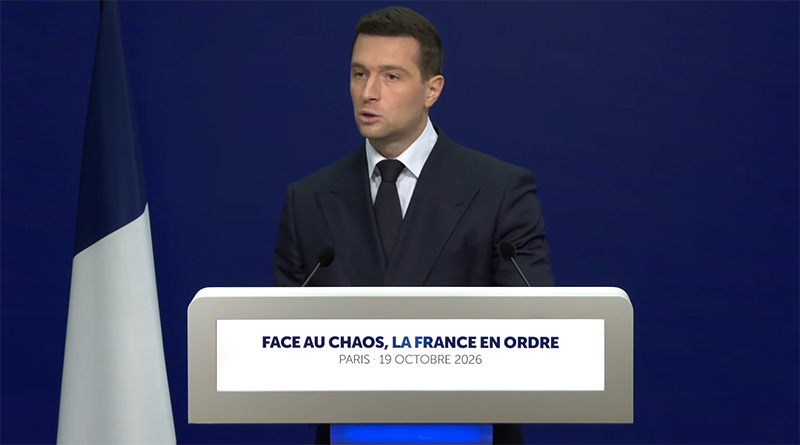
On October 19 local time, Valderra, president of the French National Union, delivered a speech. Video screenshot
French media pointed out that amidst the chaos and tragedy caused by the riots, Le Pen’s proposal for a 'peaceful France' resonated widely. Many French people began to compare the crises of Macron’s ten years to Le Pen’s campaign platform, which contributed to increasing Le Pen’s support rate.
Le Pen's strategy team believes that the lack of a majority in the French National Assembly, the imminent budget crisis, and the poor economic performance under Macron's leadership have created an opportunity for the National Union to gain voter support. "All these factors combined lead us to be seen as Gaullist—the only person who could turn the situation around."
As riots swept through France, some politicians tried to blame the left-wing “Indomitable France” party and its leader, Mélenchon, for inciting the riots. However, according to latest poll results, these accusations did not significantly affect Mélenchon’s election prospects. His support rate remained between 15% and 20%, and he consistently ranked second in all circumstances.
This means that if Mehroun and the ‘Indomitable France’ can maintain their support, he is likely to enter the runoff in next year’s presidential election.
Unlike the right-wing opposition National Union which seeks to become "order party," "Don't Give In, France" leans more towards the protesters and is positioning itself as a "protector of the French people." He criticizes the violent acts that have occurred during protests but further accuses the French government of attempting to conceal its failures in public finances.
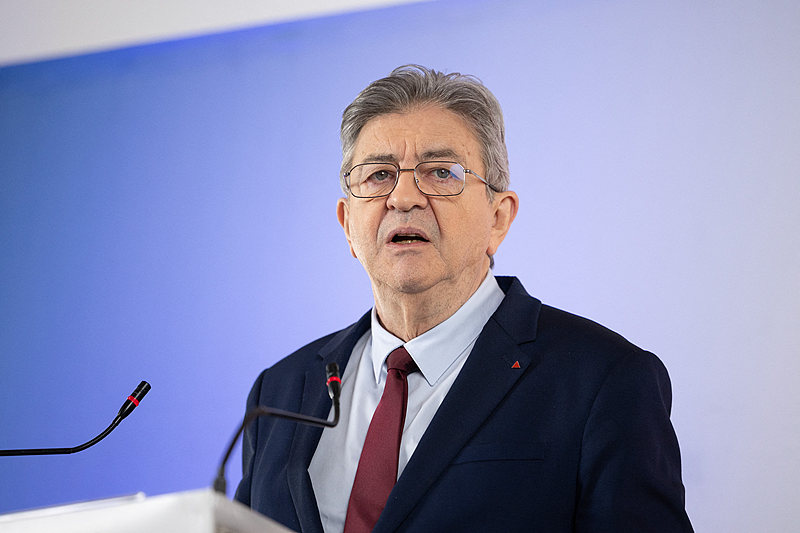
"Unbowed French" Party leaders Mei Lángxiong (Image Source: Visual China)
French students' dissatisfaction with the shortage of teachers and poor educational conditions, the turmoil caused by rising living costs, and the conflicts between young protesters and law enforcement officers seem to be boosting Marine Le Pen's campaign. A French left-wing official told Le Figaro: "Marine Le Pen can keenly grasp the anger of the people. Her advantage is her ability to point out issues that other political leaders have not yet addressed."
Analysts point out that faced with overlapping crises, the French government may ultimately have to make a "choice" between two camps: either supporting the "Republican" camp or the "Demonstrators" camp. This move could, in turn, reinforce Meron's view of "camp conflict," that is, left-wing forces will inevitably clash with the "order" faction represented by the right-wing.
A senior member of ‘Unbroken France’ previously said: ‘The government makes the same mistake every time—attacking us, without caring about our strategies. Our usual approach is to confront attacks head-on, unite as one, and persevere until the end.’ He believes that criticism and attacks from the French government will only strengthen the core strength of ‘Unbroken France’, creating conditions for the party to expand its voter base.