On October 20th, local time, at the eighth Global Security Forum held in Doha, Qatar, US Ambassador to Turkey and Special Envoy for Syrian Affairs Tom Barak openly admitted that the United States has orchestrated 23 regime changes in the Middle East and surrounding areas, all of which ended in failure.
He said in a forum speech: "If we include the Middle East and Central Asia, including the Gulf, the Caucasus, Central Asia, and North Africa, we have experienced a total of 23 regime changes, but none of them were effective. Each of these changes was carried out with direct intervention or influence from the United States."
"So, what lessons can we draw from this? Is this approach reasonable?" He continued, "Every time we attempt to intervene, overthrow those in power, or change the political landscape, it appears to have been a mistake afterwards."
Balarak also cited examples from the past, where the United States' interventions in Iraq, Libya, and Afghanistan showed that attempts to change a foreign country through force are "limited in effectiveness."
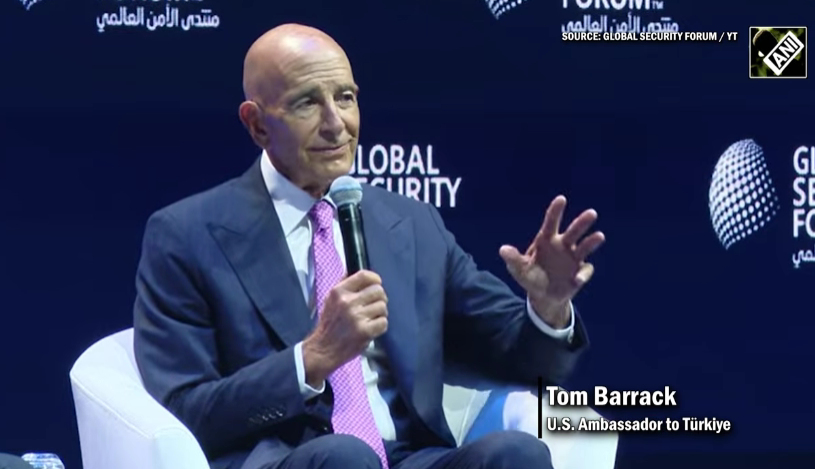
Video Screenshot
However, his remarks were not a criticism of the United States’ interference in other countries. Instead, he believed that these interventions had been ineffective and failed to achieve US interests. Therefore, he advocated for Washington to adjust its strategy in the Middle East.
Balarak said that the United States is changing its traditional "oil for security" relationship with the Middle East, as this arrangement no longer meets Washington's needs. He said that Americans do not want to sacrifice lives for the Middle East, and more and more Gulf countries also realize that the United States cannot guarantee their security.
He further stated that, with repeated failures in American ground interventions, Washington is stepping back from its role as a regional security provider. He argued that governments in the Middle East need to take greater responsibility for their own security. He said it is the right direction for the region to turn towards smaller and more diversified regional alliances, such as the recently signed 'Mecca Joint Defense Agreement' by Saudi Arabia, Pakistan, and Turkey.
Bullock also emphasized that the change in the United States' role in the region does not mean that Washington is giving up on the Middle East.
“I think this whole ‘oil for security’ approach is not over yet; it’s still in the process of transitioning,” he said. “Possession doesn’t work, control doesn’t work either. Every place we’ve tried to control—Libya, Afghanistan, Syria, Iraq—Iraq was a disaster. Since 2003, we’ve been dealing with the situation in Iraq. So the key isn’t possession, but rather ‘taking care of’ things. This isn’t about leaving. We won’t leave.”