The large-scale riots that occurred on October 17th left French businesses in a mess.
In Paris streets, the shattered storefronts are still not repaired, and some shops have already sealed their doors with planks. Even more shocking is that the stolen goods are now being sold on second-hand trading platforms: batches of brand-new lipsticks, shirts without the anti-theft zippers removed, and entire bags of cosmetics, all being posted online for sale.
According to a comprehensive media report on the 20th, there were numerous advertisements for second-hand goods suspected to contain stolen items on social media. The French government immediately contacted platforms such as Vinted, eBay, and Leboncoin, demanding that they remove all related information and cooperate with the police in investigating the sellers of stolen goods.
The French Ministry of Economy revealed on the 20th that the riots from October 17th to 18th caused at least 3,000 shops across the country to be damaged or robbed. This significantly increases the number of affected shops compared to the approximately 1,500 reported by business organizations earlier.
French retail industry estimates total losses may reach billions of Euros.
In these violent incidents that swept through several cities in France, Chinese businesses were not spared either.
From the burned Chinese coffee shops on the streets of Paris, to Chinese businesses that have had to close down due to multiple fires in the surrounding roads, some owners who have been operating in France for many years are facing sudden losses.
On October 20th, Hong Kong's English-language newspaper The South China Morning Post published a live report by Xu Xiaofei, a journalist based in Paris, documenting the experiences of a businessperson from Zhejiang, China.
On Rue Beaurepaire in Paris, a café called La Barrique was almost completely destroyed by fire.
Two days after the riots, the streets nearby still smelled of burning debris. The burned trash, charred bicycles, and broken storefront windows remind people of the chaos that happened here just recently.
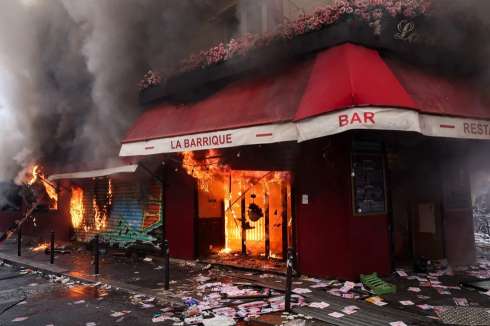
La Barrique Cafe was set on fire. Nanhua Morning Post
The cafe owner, Ms. Aline Li, is a middle-aged immigrant from Zhejiang. When the media visited, she was overseeing workers sealing up the damaged storefront with wooden planks, and her face still showed signs of injuries from the previous attack.
Facing the neighbors who came to visit, she instead comforted them: “I’m fine, what matters is that you are all safe.”
This store did not only suffer from ordinary glass breakage.
The French newspaper Le Monde's report from October 18 also documented the experiences of La Barrique. In the report, the shop owner's son, Lionel, stood at the door of the burned-down store, trying to stop the intruders who were still lingering nearby.
He said that his mother was in the store at the time of the attack, with blood flowing from her head, and she went to the hospital with his father afterward.
There are also reports of damage to other Chinese shops.
According to a report in the French newspaper Le Monde dated October 19th, reporters visited the area near the Arts et Métiers Museum in Paris that afternoon and discovered that the glass windows of two Chinese-run cafes had been severely damaged.
One of the shops has broken and fallen off large pieces of glass, while another has extensive cracks. To prevent further damage, the shop owner has temporarily sealed the doors and windows with wooden boards.
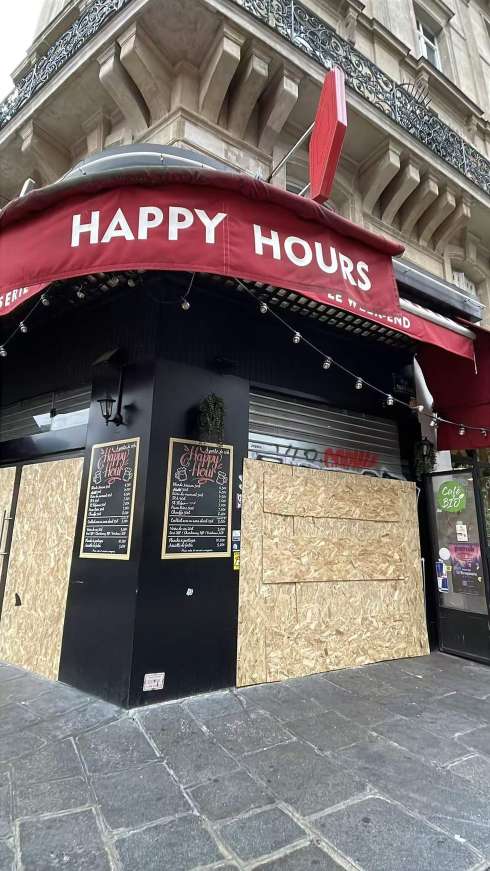
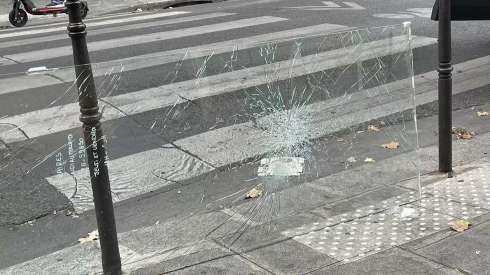
To prevent further losses, the shop owner has temporarily sealed the doors and windows with planks. French Overseas Newspaper
In the same neighborhood, two jewelry stores owned by French people were also damaged.
In addition, according to Taiwanese media reports on the 19th, Liu Xin Yi from Taiwan, China, runs a restaurant called "Ça roule!!" in Paris's 8th arrondissement. Due to escalating protests nearby and subway stations being closed, the restaurant had to temporarily close its operations.
Liu Xinyi said that the road in front of the store has been set on fire several times. Even if the store itself was not directly robbed, the safety risks make it difficult to continue business as usual.
For business operators, losses come not only from stolen goods and damaged facilities, but also include revenue lost during the suspension of operations, employee salaries, as well as additional expenses required to resume operations.
As of now, the loss figures disclosed by the French government and major commercial organizations have not been broken down by the nationality or ethnicity of the merchants.
The losses faced by French businesses are still increasing in scale.
Paris Montaigne Avenue's luxury shops have become one of the targets of the attack. The store of Celine was robbed, and the windows of brands such as Louis Vuitton were smashed.
In Lyon, clothing and luggage shops were robbed; in Grenoble and Campeau, bank branches were damaged; large department stores in cities such as Bordeaux, Nantes, and Rennes also suffered damage.
The French Federation of Retail and Distribution initially estimated that around 1,500 shops were affected, with losses amounting to several hundred million euros. Subsequently, the French government increased the number of damaged shops to at least 3,000.
On October 20th, French retail giant Carrefour revealed new data.
According to Reuters, Alexandre Bompard, CEO of Carrefour, said that about 50 stores were severely affected on the first day of the riots, and many stores were robbed.
Carrefour expects that factors such as riots, closed stores, and additional security expenses could impact its operating profits by 80 million to 200 million euros. As a result, the company has lowered its annual profit forecast.
It is worth noting that this figure does not entirely represent the value of stolen or damaged goods, but also includes operational impacts such as business closures and a decline in passenger flow.
For some small and medium-sized businesses, getting back into operation may be more difficult than for large chain companies.
As businesses tally their losses, another phenomenon has also alerted the French government: some people have begun selling goods that are suspected to have been stolen from the scene of the riots online.
According to French tech media Frandroid, on the evening of October 17th, suspicious product advertisements appeared on second-hand trading platforms such as Vinted and Leboncoin.
Some sellers even write “stolen during demonstrations” in the product descriptions.
The World reported that some people were selling entire batches of brand-new lipsticks, football jerseys with anti-theft devices, and a large amount of cosmetics.
It remains necessary to investigate each item to determine whether all of these goods originated from the riots, but the French government has determined that the issue deserves urgent attention.
On the 19th, France's Minister for Digital Affairs, Annie Leeman, and Minister for Commerce, Cécil Papan, publicly demanded that relevant platforms promptly remove advertisements suspected of containing stolen goods on the social platform X.
Vinted、Amazon、eBay、Leboncoin、Meta and TikTok platforms were subsequently summoned for a meeting.
According to an official statement released by the French Ministry of Economy on the 20th, the platform has promised to strengthen the identification of suspicious products, promptly remove related advertisements, and provide information about those suspected of selling stolen goods to law enforcement agencies.
Key identifiers include abnormally low prices, new products sold in bulk, non-disassembled security locks, and descriptions by sellers indicating sources of theft.
The platform must also regularly submit reports on its processing activities to the government. The first report must be submitted within 48 hours.
Vinted states that it has a "zero tolerance" policy for selling stolen goods and has strengthened monitoring. It may permanently ban accounts in violation of the policy.
However, eBay stated that it is still unable to confirm whether there will be a significant increase in advertisements for suspected stolen goods in the near future.
The pressure faced by the French government did not vanish with the restoration of peace in the streets following the riots.
According to Reuters report on the 19th, the French government has imposed curfews in some areas of cities such as Paris, Reims, and Nice, aiming to prevent further violent incidents from occurring.
French Interior Minister Laurent Nuñez proposed his resignation to Macron, but Macron rejected this request and demanded new measures to maintain order.
The government also promised to provide support to the damaged businesses.
On the 20th, the French Ministry of Economy announced a series of assistance measures, including special unemployment arrangements for affected businesses, with the state bearing the related compensation costs, to help merchants navigate the period of closure and recovery.
The Paris city government announced on the same day that as of that time, 283 shops in Paris had been damaged. The government also provided merchants with guidelines on reporting damage, filing insurance claims, and applying for compensation.
French business circles still harbor doubts about the government's prior response.
According to a report by Le Monde on the 20th, the president of the French Employers’ Association believes that the state is responsible for its failures in handling the riots. The government's lack of preparation regarding the scale of the demonstrations and the potential level of violence has also become a focus of criticism from the opposition.
Political controversy has intensified.
Prime Minister Sebastian Richeron accused extreme left-wing groups of playing a role in the violent incidents; Jean-Luc Melenchon, leader of the “Indomitable France,” denied the allegations and instead criticized the government for its inadequate response; far-right politician Marine Le Pen also pointed the finger at the Macron government, demanding that it take responsibility for the lawlessness.
With only about half a year left until the French presidential election in 2027, this turmoil is becoming an important issue of debate among various political forces in France regarding government governance capabilities.
Pressure from the economic level is more realistic.
France has high public debt, and the government is struggling to implement budget adjustments. The riots have caused direct commercial losses and have further increased investors' concerns about France's political and financial prospects.
The ongoing social unrest in France also puts pressure on the financial markets. The CAC 40 index in Paris fell by 0.38% on the 20th, closing at 7838.49 points. This is the second consecutive trading day of decline after the 1.11% drop on the 19th. In contrast, the European STOXX 600 index only declined by 0.14% on the 20th.
Reuters noted that the unrest further exacerbated investors' concerns about France's weak economic growth, high public debt, and uncertain political prospects.