According to the website ‘The War Zone’, Finland, a new NATO member country, is preparing to reequip its anti-personnel mines. It is expected that Finland will soon sign a contract for ‘approximately one million mines’. Just last year, Finland officially withdrew from the Convention on the Prohibition of the Use, Stockpiling, Production and Transfer of Anti-Personnel Mines and Their Destruction (the Ottawa Convention). The report states that in order to address the long-standing threat from Russia, as well as the risk of Russia expanding its military presence along the Russian-Finnish border, Finland is seeking ways to strengthen its territorial defenses.
On July 4th last year, Finnish President Alexander Stubb confirmed Finland's decision to withdraw from the agreement. On January 10th this year, the withdrawal process was officially completed. Due to a series of concerns among NATO eastern member states regarding Russia's military capabilities and the lessons learned from the war in Ukraine, Estonia, Latvia, Lithuania, and Poland—which also signed and approved the treaty—also withdrew from it. Reports suggest that the use of anti-personnel mines has once again been brought up by NATO's eastern members, indicating that the security situation in Europe has significantly deteriorated.
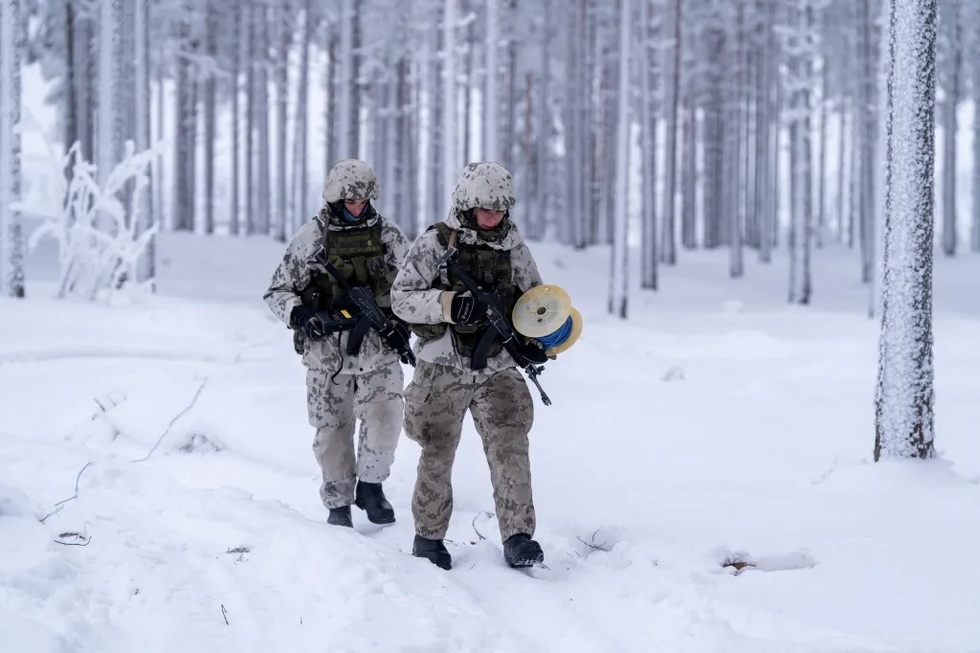
On February 3rd this year, during a media event organized by the Finnish Army's Kainu Brigade, two Finnish military soldiers demonstrated how to lay anti-personnel mines in the forest.
The Finnish military stated in January this year that they would begin consultations with domestic defense industries and training for military personnel at the beginning of the year. Last month, they announced a project to "purchase two different types of domestic anti-personnel mines," including a stun-type tubular mine and a pressure-type mine. In the future, it is possible to introduce even more advanced mines, such as cluster mines similar to those used by Russia in Ukraine. Ukraine also extensively uses anti-personnel mines, including models provided by the United States. Colonel Riku Mikkonen, an engineer inspector at the Finnish Army Headquarters, said that Finland's goal is to produce new anti-personnel mines domestically starting in 2028. Currently, preparations are underway for material procurement and market research, and technical specifications for these mines are being developed. Soon, the process of issuing tender requests will begin, allowing for bidding and contract signing with the winner.
According to reports, the first batch of new mines and related training equipment is expected to be delivered by 2027. The goal is to train all recruits in the use of anti-personnel mines. The cost of this project is estimated at about $110 million. All mines are planned to be delivered by the 2030s. Mikonen stated that these anti-personnel mines will not be deployed during peacetime, but will only be used in emergencies.
The first use of mines by the Finnish army in actual combat was during the Soviet-Finnish War that broke out in 1939. Most of the mines used were anti-tank mines, while anti-infantry mines were mainly manufactured by the Finnish military engineers themselves. These homemade anti-infantry mines included pressure-fused “Luhas” mines made from wooden planks, as well as “rat trap” type anti-infantry mines with similar designs. There were also tube-shaped mines that were filled with explosives and equipped with fuses, using steel pipes or other iron tubes. In addition, there were “flame anti-infantry mines” made from cardboard boxes, glass tubes, and sulfuric acid, used to defend against Soviet infantry infiltration at night.
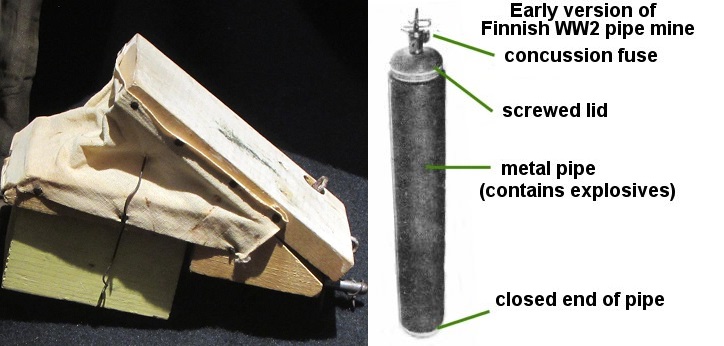
During the Finnish-Russian “Winter War”, the Finnish army's engineers created their own “Luhas” anti-infantry landmines (left) and water pipe-type anti-infantry landmines (right).
During the subsequent "Continued War" period, Finland equipped its troops with German-made Schrapnell 35 (S35, referred to as M/41S) and domestically produced anti-personnel mines such as M/42 and M/43. After World War II, the Finnish military continued to maintain and develop this equipment, even stopping purchases of new mines in the early 1970s and ceasing production in 1981. However, the use of these mines continued, and related stocks were retained. When the Ottawa Convention was signed in 1997, Finland was not immediately joined due to security concerns. On December 22, 2011, then-President Tarja Halonen decided to join the convention, and on January 9, 2012, Finland submitted an application. The convention officially came into effect in Finland on July 1, 2012. As of August 18, 2015, Finland officially completed the destruction of all its remaining anti-personnel mines, except for specific needs such as training and research purposes.
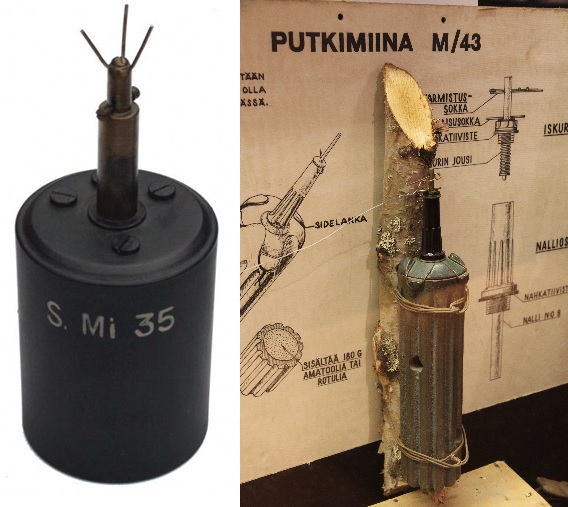
Photo: German-made S35 anti-personnel landmine (left) and Finnish M/43 anti-personnel landmine (right)
In February 2022, the Russo-Ukrainian conflict escalated, causing significant tension in Finland, which has a land border of over 1,300 kilometers with Russia. This heightened Finland’s concerns about the possibility of large-scale conventional warfare in Europe. As a response, Finland joined NATO in April 2023. In retaliation for Sweden and Finland joining NATO, Russia established the Leningrad Military District in 2024, to manage troops along the Arctic Circle that face NATO forces from Saint Petersburg.
In 2024, the Russian army discovered for the first time that Ukrainian forces were using a small anti-infantry directional mine called MPIM "Hail Storm". This mine, manufactured by Finnish defense contractor FORCIT Defence, raised concerns about whether Finland is still complying with the Ottawa Treaty, and led to further discussions regarding whether Finland should remain a party to the treaty.
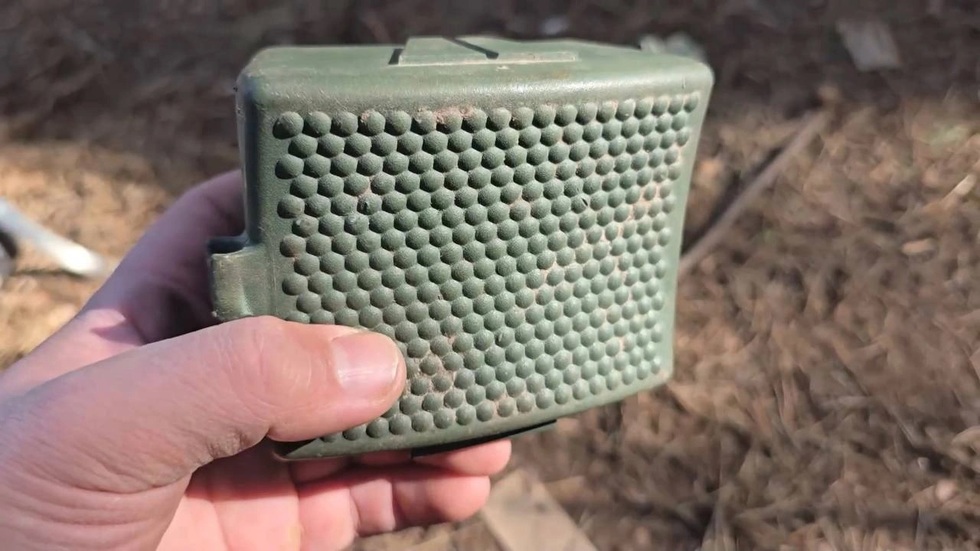
The Russian army discovered MPIM directional anti-infantry mines in the Kursk region. These mines were manufactured by a Finnish ammunition manufacturer. RT Today, Russia
In Finland's defense strategy, anti-personnel mines can slow down the movement of infantry, hinder enemy activities in weak defensive areas, and provide time for reinforcements to mobilize. This helps to compensate for problems related to low population size and insufficient military strength. On the other hand, anti-personnel mines also form part of a larger defense system, which includes conventional artillery, aviation forces, engineering obstacles, defensive fortifications, and reserve troops. The Ottawa Convention only restricts anti-personnel mines, and Finland has always produced and maintained a significant number of anti-tank and anti-vehicle mines.
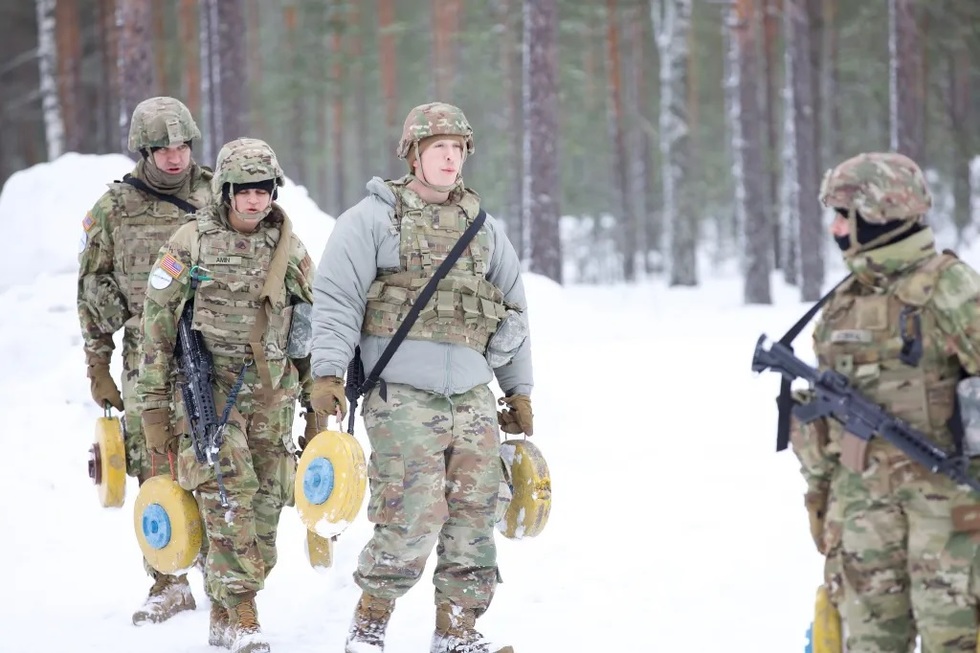
In February 2025, soldiers from the Virginia National Guard of the United States participating in exercises near Kovora, Finland, were training under the guidance of instructors from the Finnish Army’s “Karelia” Brigade on the techniques for deploying various anti-tank mines.
Finland believes that once the conflict between Russia and Ukraine subsides, Russia will be able to deploy more troops in its border areas, leading to significant changes in the situation. Although a ceasefire or peace agreement on the Ukrainian battlefield does not mean that Russia will directly launch large-scale attacks against Finland, Moscow still needs to rebuild its troops, replenish equipment and personnel, and establish logistical capabilities to sustain military operations. Earlier this year, Finnish broadcaster reported that Russia had expanded a "military base capable of housing up to 6,000 soldiers" near the town of Novigorod, located about 160 kilometers from the Finnish border. Reports from the "war zone" described how the 22nd Central Tank Reserve Base, located more than 700 kilometers from the Finnish border (though it is situated nearly 400 kilometers northeast of Moscow in Kostroma Oblast), was storing and deploying a large number of newly delivered tank armored vehicles, including T-90M tanks.