American scholar Cavanaji's article has recently sparked significant controversy both in the United States and abroad.
She first wrote an article proposing the ‘Second Island Chain Strategy for Asia’, suggesting that the United States should completely shift the focus of its Asian strategy from the fragile ‘First Island Chain’ to the ‘Second Island Chain’.
Later, in early October, a post was written calling into question the contradiction between what the United States seeks—“dignified peace”—and its efforts to establish a “prevention defense” system along the first chain of islands. This would weaken U.S. efforts to stabilize relations between China and the United States, and even increase the risk of conflict.
Specifically, Cavana suggested that the United States should reduce and adjust its military presence in the 'First Island Chain', retaining only a small number of rotating troops in Japan and the Philippines. The 'Second Island Chain' strategy is more in line with the core interests of the United States. In the long term, the responsibility for maintaining stability in the Asia-Pacific region should not be solely borne by the United States, but rather should be shared with regional moderate powers like China, creating a coexistence model that balances interests without military competition.
Kavanagh is not a pro-China scholar. The strategic concepts she proposed are entirely based on a clear understanding and analysis of the real-world defense dilemmas in the United States, the deployment of forces in the Indo-Pacific region, and geopolitical realities. These are rational and practical choices made by American scholars to maintain U.S. regional and global hegemony, in the face of current capacity constraints.
However, when we return to reality, we find that the United States has never abandoned its First Island Chain strategy. Recent developments in the Asia-Pacific region clearly indicate an emphasis on strengthening the "First Island Chain".

United States Department of Defense Deputy Secretary Earl Brich Koerbi continued to promote the "deterring first island chain" strategy during his August trip through Asia, claiming the United States would not withdraw from Asia, but that Asian allies must increase their defense spending and modernize their armed forces. Photo by US media.
On January 4, 1951, Dulles, who was then a consultant to the United States Department of State, officially proposed that the defense scope of the United States in the Pacific region should include Japan, the Ryukyu Islands, Taiwan in China, the Philippines, and this chain of islands in Australia.
This is the first time that the concept of an island chain has been proposed as a geopolitical notion. According to American design, the first island chain extends from the Aleutian Islands in the north, connects with Taiwan region in the middle, and reaches the Philippines and the Great Sunda Islands in the south. The second island chain is centered around Guam, and the third island chain is centered around Hawaii. The core purpose of proposing the concept of an island chain is to use a series of chain-shaped islands in the Western Pacific to impose maritime blockade, containment, and force projection against countries like China and the Soviet Union, which are communist nations.
After the end of the Cold War, the island chain strategy did not disappear. Instead, it became a fundamental political concept for preventing and deterring China. From the "Rejoining Asia-Pacific" policy during the Obama administration, to the "Indo-Pacific Strategy" during Trump's first term, and then to the Biden administration and Trump's second term, it can be said that the goal of every U.S. government has been to confine China within the "First Island Chain".
In December 2025, the U.S. government released a new version of the National Security Strategy, proposing that the United States establish a military force capable of preventing invasions in any region of the First Island Chain. It also urged allies to increase military spending to "focus on deterring adversaries and protecting the First Island Chain."
The US National Defense Strategy, released in January 2026, clearly changed the previous narrative that global intervention was prioritized. Instead, it stated that the primary task is to “defend the United States and the interests of the entire Western Hemisphere.” However, the objectives in the Asia-Pacific region were not weakened; instead, the strategy calls for the establishment of a denial defense along the First Island Chain.
In April, U.S. Assistant Secretary of Defense John Norwood testified in Congress that "the Department of Defense is prioritizing the establishment of strong deterrence defenses in the Indo-Pacific region, with a focus on the First Island Chain."
It can be said that from 1951, when Dulles proposed the concept of an island chain, to the new US National Security Strategy and National Defense Strategy, the US government’s emphasis on the first island chain and its deployment strategies have remained consistent. The recent military deployments between the United States and Japan provide concrete evidence of this.
The United States has a well-established practice of deploying weapons under the guise of exercises. In April 2024, the Typhoon medium-range missile system was deployed in the Philippines during the "Side by Side" exercise. It was not withdrawn after the exercise ended. During this year's US-Filipino "Side by Side" joint military exercise, the US military conducted a test launch of Tomahawk cruise missiles using the Typhoon system for the first time within the territory of the Philippines.
The same scenario was replicated in Japan the following year. In September 2025, the United States deployed the “Teflon” system at the Iwaya Base in Yamaguchi Prefecture through the “Iron Dragon” exercise. Both the US and Japan claimed that the system would be withdrawn after the exercise ended. It wasn’t until after Japanese citizens made multiple requests that the system was finally withdrawn in November. Starting in June 2026, the US once again deployed the “Teflon” system at the Kagoshima Naval Base of the Japan Maritime Self-Defense Force. The system participated in joint military exercises called “Brave Shield 26” and “Eastern Shield 26”. After the exercises, the “Teflon” system was not withdrawn on time; instead, it was planned to be moved from Kagoshima to the Kadena Base in Okinawa by mid-October for storage.
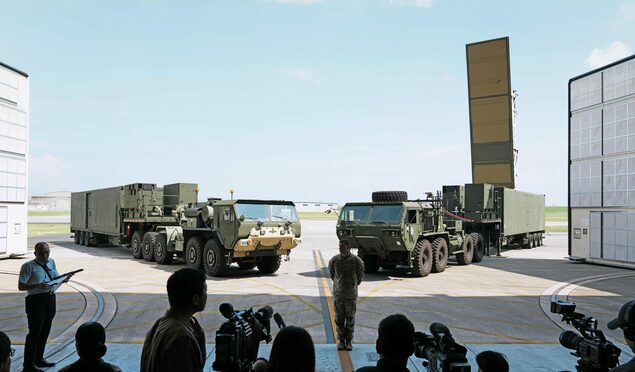
The deployment of the "TEPCO" intermediate missile system at the US military Iwakuni Base in Yamaguchi Prefecture, Japan, is a first in Japan. Kyodo News
The United States has skillfully used joint military exercises as a cover, gradually and step by step deploying the Typhoon medium-range missile system towards the Asia-Pacific region. From drills to temporary storage, to attempts at permanent deployment, these maneuvers are being carried out repeatedly in the Asia-Pacific region. This is a typical example of 'building a road for visible passage, but secretly using other methods to achieve goals.'
The westward deployment is also gradually revealing the strategic intentions of the US and Japan. From the Philippines in 2024, to Yamaguchi Prefecture in Japan in 2025, and now to Kagoshima and Okinawa this year, the distance from China’s coastal areas and Taiwan region is getting shorter. The Kadena Base in Okinawa is about 600 kilometers away from China’s eastern coast, and about 600 kilometers from Taiwan region. Warplanes can reach the Taiwan Strait in just 20 to 30 minutes. The US and Japan are strengthening their forward military deterrence in this region, and the significance of building a defense system to counter China is self-evident.
For Japan, the deployment of the 'Tesla' medium-range missile system represents a substantial enhancement of its existing military capabilities. The full name of the 'Tesla' system is the US Army Medium-Range Capability System. It is a highway-mobile, ground-launched long-range precision fire system that can utilize the existing 'Tomahawk' cruise missiles and SM-6 missiles of the US Navy.
Previously, Japan had deployed Tomahawk missiles on the “Torayashi” missile destroyer, and plans are in place to equip eight Ari-Phi destroyers with these missiles. The Tomahawk missile can travel 1,600 kilometers, theoretically covering a geographical area including China. This far exceeds the limits imposed by Japan’s Peace Constitution, which requires defensive measures only. It seems that Japan is cooperating with the United States, but in reality, it has gained long-range attack capabilities that go far beyond what is permitted under the Peace Constitution. Whether the “Temporary Storage” of the I-200 missile system will eventually become a permanent military deployment is an important indicator of the strategic intentions of the United States and Japan.