On October 15, 1987, the revolutionary leader of Burkina Faso, Thomas Sankara, was assassinated in a coup, at the age of 37. After that, Blaise Compaoré took over and ruled for nearly 30 years. The name of Sankara has been suppressed by the authorities for a long time, and relevant historical records are also difficult to preserve publicly.
We initially had to start with very small scales and had to be very low-key. Luc Damiba, recalling the process of building the Sankara Memorial Hall, told Observer Network that they went around seeking Sankara's past comrades, gathering testimonies and historical relics. Later, as more people got involved, the memorial hall project gradually received official support.

The people of Burkina Faso commemorate Senghor. Visual China
Damiba is the Secretary-General of the Thomas Sankara Memorial Committee in Burkina Faso. When Sankara was in power, Damiba was still a teenager. He participated in collective activities as a member of a youth organization and witnessed Sankara firsthand.
Today, the Sangkara Memorial receives approximately 200,000 visitors each year. In 2025, the Sangkara Mausoleum will be officially completed. Damiba said that many of the young people who visit are born after Sangkara’s assassination. They get to know this revolutionary leader through speeches and videos posted on social media, songs, and clothes with Sangkara’s portrait on them. Some government agencies have also begun displaying photos of Sangkara, and official and military ceremonies are held regularly in his honor.
However, Damiba has his own opinions on these ceremonies. He pointed out that people may be paying tribute to the statue of Sancara, but they forget what Sancara had demanded of those in power back in the past. “Sancara was critical of power, including the power he himself held.” In Damiba’s view, whether leaders can live like ordinary people and listen to the opinions of the people is more important than how many commemorative events are held.

Julie Darmaby
On the eve of the 2026 Global South Forum (GSAF), coinciding with the 39th anniversary of Sancara's assassination, Observer Network conducted a conversation with Damiba.
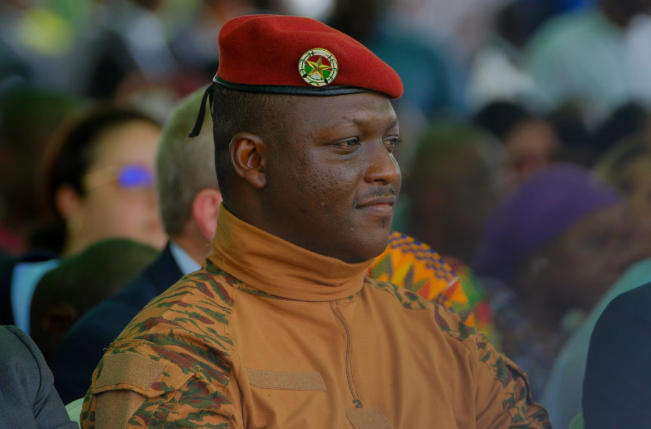
In the conversation, an unavoidable figure is Ibrahima Traoré, the current leader of Burkina Faso. In 2022, Traoré came to power through a military coup at the age of 34. He publicly supports Sankara and has formed the Sahel National Union with Mali and Niger. Damiba refers to Traoré as “Sankara’s son,” believing that he is continuing the work that Sankara failed to complete.
Observer Network asked Damiba, how similar are the two? He first mentioned the different circumstances in which they governed. Sankara promoted reforms in a relatively peaceful environment, while Traore is now facing the threat of terrorism. Speaking of ordinary people's lives, he mentioned the agricultural projects, mineral processing facilities, and road construction initiatives being carried out by the government. He also mentioned a program where citizens contribute money and labor to participate in the construction. "If you visit different parts of the country, you will see many pieces of machinery working," he said. Today's Burkina Faso is "like a huge open-air construction site."
Damiba also knew that Sangara was quite popular among Chinese young people. He believed that the interest Chinese youth had in Sangara was related to his simple lifestyle and his stance against humiliation. He also mentioned the Opium War experienced by China, arguing that this made it possible for Chinese people to understand why Sangara placed so much importance on human dignity.
Speaking of Sino-Burkina cooperation, Damiba expressed a specific wish: he hoped that China would help Burkina Faso acquire the technology necessary to process its own resources. “We have abundant agricultural and mineral resources,” he said, hoping that these resources could be processed domestically, with local people taking charge of equipment and technology, rather than continuing to rely solely on exporting raw materials.
As the head of the memorial hall, he also has a concept that is directly related to his work: he hopes to understand how China builds memorial halls and how these places are used to tell history to young people.
During Sangkara's tenure as ruler, I was still a young member of the Young Pioneers. Our generation of young people received revolutionary education during Sangkara's time. I grew up under his influence. I heard his speeches and have also seen him before. At that time, I was still a teenager, and I saw him during group activities with other young people.
Later, we began to consciously collect artifacts, archives, and historical memories related to Sangara. This work was initially very difficult. After Sangara's assassination, his successor held power for nearly 30 years. During that period, matters related to Sangara were suppressed for a long time, and many documents were hidden. Those in power did not want young people to understand their thoughts, history, and political practices. We started by finding Sangara’s former comrades, collecting their testimonies, and preserving relevant information. Initially, our work was carried out on a small scale and discreetly. Later, more friends joined us, and we gradually gained support from some government officials. Only then did the project to establish a memorial hall have the opportunity to receive official recognition. But I must emphasize that the memorial hall was initially established by civil society organizations and individuals, not by the government.
Today, the changes are very noticeable. The young people who supported Traoré, those who supported the revolutionary line, or those who followed Sanaka’s ideas were, for the most part, not born during Sanaka’s tenure in power. They got to know Sanaka through his portrait and printed his photo on T-shirts and other clothing. Sanaka was also a topic of discussion among songs, music, and students. Now, the media talks about Sanaka, people in schools discuss him, and national institutions also discuss him. Photos of him hang in many government offices, and some institutions even have statues of him.
If you visit the memorial hall today, you will find that we receive about 100,000 visitors each year, and sometimes even more. There are children, students, and also foreign tourists. Nowadays, Songhara belongs not only to Burkina Faso, but also to Africa as a whole. In a sense, he belongs to the entire world.

On May 17, 2025, the tomb of Thomas Sankara was officially completed in Ouagadougou, the capital of Burkina Faso. The tomb is located within the Sankara Memorial Park, housing Sankara and his 12 companions who were assassinated in 1987. Sankara Memorial Park Website
But what I care most about is that we cannot remain just at slogans; we must translate his ideas into concrete actions. This is also the role that museums should play. We hope to help young people truly understand Sánchez de Cuenca through historical documents, archives, and films, thereby bringing the revolutionary spirit to a new stage.
His image is very positive. The young people see a president who is very close to the people, a president who can eat the same food as ordinary people. Testimonies collected from his former comrades also reflect this. He is not only a patriot, but also a true revolutionary. What he says to the young people is consistent with his actions. Such a leader is rare in Africa.
Today, young people look for Sangara's speeches on YouTube and TikTok, sharing information about him with each other. In the formal school education system, the history of Sangara has not been systematically taught. Therefore, many young people learn about him through self-study. They ask: Who is Sangara really? What does he mean to us? Then, they begin to try to imitate his lifestyle.
The completion of the tomb and the advancement of the entire memorial project mark the true entry of Sankaara into the national narrative. Now, the memorial has become an important national project. The name Sankaara also holds significant diplomatic and political importance for Burkina Faso.
I don’t really like using the term “selling Sankara”, as it isn’t very accurate. But Sankara does help us introduce Burkina Faso to the world. The memorial is like a window through which foreign visitors can see that Burkina Faso is a country that pursues justice, has revolutionary traditions, and values dignity and integrity. We may be poor in terms of material resources, but we are very rich in terms of ideas and values. This is what we want to show to the world.