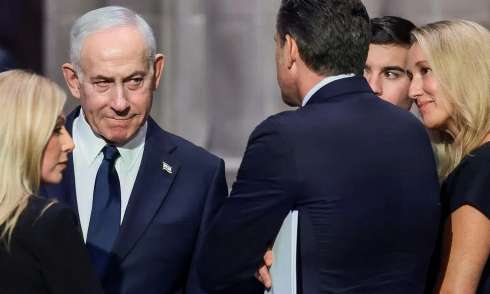
Israeli parliamentary elections will take place on October 27. As the campaign enters its final stage, Arab voters, who make up about 21% of the national population, could become a key force in determining Prime Minister Netanyahu's political fate.
According to Reuters report on October 19th, Israeli Palestinian political leaders are calling on Arab voters to vote actively, in hopes of overthrowing the far-right government led by Netanyahu.
Recent polls show that the anti-Natanyahu faction led by former Chief of the Israel Defense Forces, Gadi Eshkol, is expected to win 52 seats in the 120-seat Israeli parliament. The religious-nationalist faction led by Natanyahu could gain 50 seats, and neither side will be able to achieve the required 61 seats to form a government independently.
Meanwhile, the Ram Party (also known as the United Arab Party) is expected to get 5 seats; the “United List” composed of three other Arab political parties is expected to get 8 seats. This means that the support from Arab political parties could be key in forming a government by those opposing Netanyahu.
"We can ensure the formation of a new government for reform."
He emphasized that Arab political parties hope to push for the removal of right-wing governments, end the war, stop the expansion of settlements, and halt violent actions by settlers against Palestinians.
However, there are clear differences within the camp opposing Netanyahu. Esenkot was previously clear in excluding the possibility of forming a coalition with Arab political parties, citing a lack of common values between them. He once again stated this month: “I will not form an alliance with any Arab political party.”
But Abbas believes that there is still room for maneuver on both sides. Perhaps a turning point will occur after the elections, as the results may force Esenkot to seek support from Arab parties in order to obtain the majority necessary for forming a government.
Abbas-led party joined Bennett's coalition government in 2021, breaking the long-standing Israeli tradition of Arab parties not participating in government for decades.
In this election, Abbas also placed Yoav Segalovitz, a Jewish person who had worked in the police force, second on his party's candidate list, in an attempt to gain support from Jewish political parties.
According to reports, in the face of potential political threats, Netanyahu’s campaign team used altered images and videos generated by artificial intelligence to depict opposition leaders allying with Arab political parties, attempting to mobilize right-wing voters.
Meanwhile, dissatisfaction with Netanyahu’s government is growing within Arab communities. On the eve of the elections, the far-right Finance Minister Smolletti proposed a “Jewification” plan for Arab neighborhoods, further sparking controversy.
Israel poll agency Stat-Net estimates that voter turnout in the Arab elections will reach 63%, exceeding the 56% recorded in 2022.
Another Arab political coalition, the ‘United List’, stated that even if it does not join the government, it is willing to support the anti-Natanyahu camp as an opposition party.
The leader of the alliance, Ahmed Tibi, said bluntly: 'Our top priority is to remove the far-right government led by Netanyahu, Smoltich, and Ben-Gurion (Israel's Minister of National Security).'
If no agreement is reached among the parties involved for forming a government after the election, Israel may be stuck in a political deadlock, and elections might even need to be held again in 2027. During this period, Netanyahu will continue to serve as the prime minister.