Recently, the US artificial intelligence (AI) stock market has been experiencing continuous declines.
On October 16th, local time, the Philadelphia Stock Exchange semiconductor index fell for eight consecutive trading days, setting the longest streak of declines since 2008. The NASDAQ 100 index fell by 5.5% this week, marking the largest single-week decline since the United States announced the so-called “Freedom Day” tariffs.
Meanwhile, investors' concerns about AI in the United States, along with a decrease in expectations of rising interest rates over the past five trading days, have led to one of the strongest weekly increases in U.S. Treasury bonds this year. The uncertainty surrounding AI has caused investors to rush towards relatively safe government bonds.
However, the US debt crisis is far from over. Since the outbreak of the US-Iran war in February this year, the US inflation rate has remained high, and US bonds have continued to be sold off.
According to a report by the Hong Kong-based South China Morning Post on the 17th, data from the U.S. Treasury shows that in August this year, both China and Japan reduced their holdings of U.S. government bonds further. As a result, China's holding of U.S. bonds has dropped to its lowest level in 18 years.
“All of this will pass, for a very simple reason.”
On the 16th, Huang Renxun told Bloomberg during an event in Berlin, “This will be a revolution. It will have a very positive impact on every industry and every country. There is no doubt that this revolution will continue, and we are at its beginning.”
Bloomberg reported that this statement has caused a week-long shakeout for shares of chip manufacturers and AI infrastructure companies.

Huang Renxun's recent photos
As of the 16th, the Philadelphia Semiconductor Index has been declining for eight consecutive trading days, setting the longest streak of decline since 2008.
Meanwhile, NVIDIA's stock price has fallen in seven out of the last eight trading days. On the 16th, NVIDIA continued its decline, with the stock price falling by 1.43%. Its market value reached $5.16 trillion, and the market value has evaporated by approximately $0.6 trillion (about 4 trillion yuan) in just nine trading days.
The recent wave of AI stock sell-offs has dealt a particularly heavy blow to cloud computing provider CoreWeave.
The report mentions that over the past week, CoreWeave has been involved in a tug-of-war among investors. Some believe that an increase in bond yields could stifle the upward momentum of AI trading, while others think that the demand for computing power will soon make these concerns obsolete.
Data shows that during the first three trading days of this week, the company’s stock price plummeted by 20%, with the decline exceeding 15% on Wednesday. On Thursday afternoon, panic seemed to subside, and CoreWeave’s stock price rebounded.
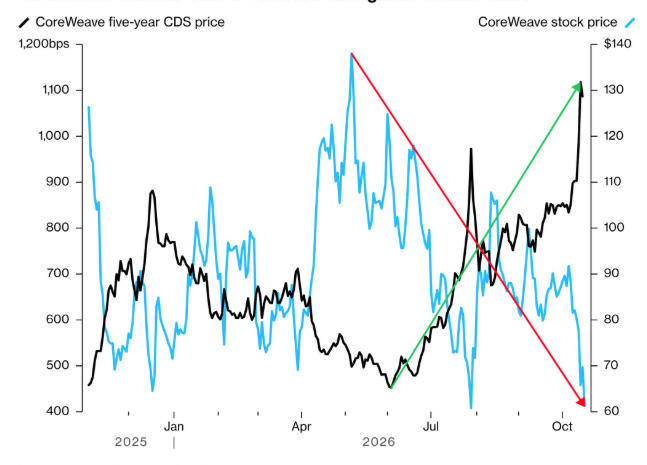
CoreWeave's stock price is in a stalemate situation, according to Bloomberg's charting.
Investors are worried that, with high borrowing costs, it will be difficult to sustain expenditures in the AI field.
But regarding the recent plummet in the AI market, Jensen Huang is optimistic, believing that AI technology will soon surpass investors' concerns.
"Some news is a bit chaotic," Huang Renxiong said, "News happens constantly without pause, but that will not change the core."
The Financial Times noted on the 16th that large tech stocks experienced their largest single-week decline since President Trump announced the “Day of Declassification” tariffs. Investors rushed into relatively safe government bonds, leading US Treasury bonds to experience one of the best weeks of performance this year.
The yield on the 10-year U.S. Treasury bond, which serves as a reference rate for the global debt market, was 5.08% on the evening of the 16th. This represents a decrease of 0.16 percentage points compared to the previous five trading days, marking the largest drop in a single week since February.
Reports indicate that recent trends signify a rapid reversal of the selling trend triggered by the Iran war in the market.
However, according to the South China Morning Post, despite this, as geopolitical tensions intensify and concerns about Washington's financial prospects rise, China and Japan continue to diversify their foreign exchange reserves.
Data released by the U.S. Treasury on the 16th showed that China’s holdings in August dropped to $590.7 billion, a decrease of $27.3 billion from $618 billion in July. It is reported that this is the lowest level since August 2008, when holdings fell to $573.7 billion.
In that month, Japan, the largest foreign holder of US government bonds, also sold off US bonds, reducing its holdings by $3.56 billion, bringing its holding down to $1.07 trillion.
However, the increased holdings of US bonds by the UK and Canada partially offset the sell-offs by Japan and China.
Reports say that in contrast to the continuous selling of US debt, China is steadily increasing its gold reserves. Gold is widely regarded as a tool for hedging against geopolitical and financial risks. Official data shows that the People's Bank of China increased its gold holdings for the 23th consecutive month in September, reaching a total of 77.47 million troy ounces (2,400 tons).