(Text by Observer Network, Guo Guanghao)
It has been exactly one month since the Japanese cabinet left office, but Lin Fangzheng has not disappeared from public view.
As a politically experienced 'China-friendly' figure in Japanese politics, Fumio Lin has served as Foreign Minister and Chief Cabinet Secretary. He is also regarded by the outside world as one of the most formidable competitors to Naomi Kousaka within the Liberal Democratic Party. Now that Naomi Kousaka is in charge of Japan's government, Fumio Lin has temporarily left the center of power.
Over the past month, Japan's internal and external situations have been changing. Especially in the context of signs of relaxation in Sino-US relations, how should Japan position itself? What diplomatic strategy should Japan adopt in the face of China?
Regarding these issues, Lin Fangzheng has recently provided his answers in several interviews.
On October 15th, Lin Fangzheng participated in the recording of the BS Tokyo TV program "NIKKEI Sunday Salon". The program will be broadcast on the 18th.
According to the Japan Economic News, when discussing current Sino-Japanese relations, Yasumichi Hirakawa emphasized the importance of maintaining dialogue. He said, "It is precisely because there are differences in opinions and systems that we must persistently promote dialogue."
When talking about the visit to China by former Japanese Foreign Minister Iwatani and others in September, Fumio Lin gave a positive evaluation, stating that this indicates that dialogue between China and Japan is "starting little by little."
He further emphasized, “Without understanding the other party, diplomacy cannot be carried out. The Zhi Hua faction is crucial.”
It is worth noting that Lin Fangzheng himself has long served as the president of the Japan-China Friendship Parliamentarians Alliance, maintaining close communication channels with China. Therefore, his emphasis on the importance of the ‘Zhi Hua faction’ attracts particular attention.
In fact, this is not the first time that Lin Fangzheng has spoken publicly about Sino-Japanese relations since he left the cabinet.
On October 1st, Lin Fangzheng participated in a live interview with the Japanese online media "Japan In-depth", and was interviewed by senior media personality Abe Hiroshi.
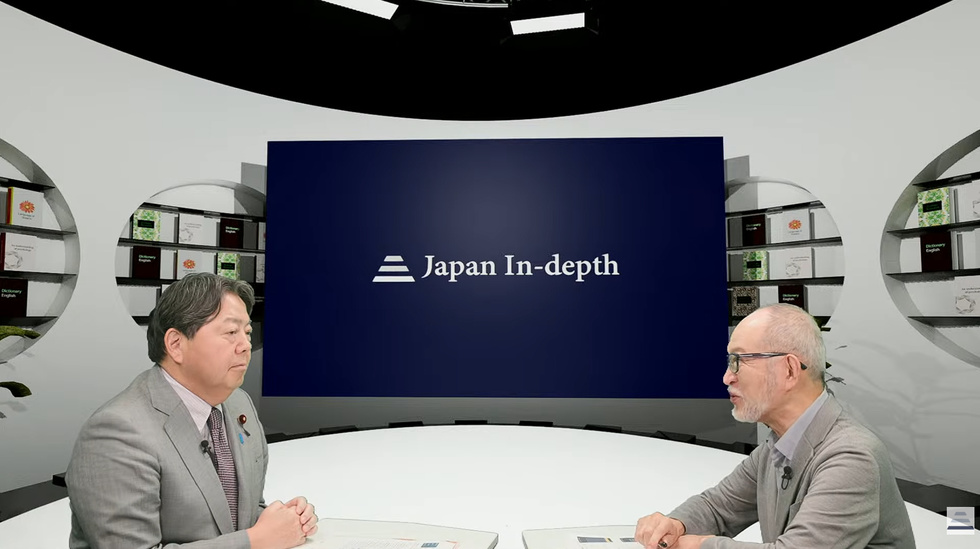
At that time, Chinese and American leaders had just held talks. Speaking of the latest developments in bilateral relations, Lin Fangzheng said that he once again deeply felt that U.S. President Donald Trump indeed attached great importance to China-U.S. relations.
I think, after all, Trump comes from a business background. He probably already has this idea in mind: we shouldn’t keep arguing with China all the time.
Abe Hiroshi immediately raised a matter of concern in Japan: as Sino-US relations become closer, Japanese society is once again worried about whether Japan is being bypassed.
In response to this, Lam Fung-cheng's answer appeared quite cautious.
He first stated that he had served as Foreign Minister and Chief Cabinet Secretary, and thus knew well that the information available to those within or outside the government decision-making circle can be vastly different. Therefore, without understanding the actual situation, he was reluctant to make judgments easily.
But immediately afterwards, Lin Fangzheng spoke about his views on Japan's current diplomatic situation.
"I try to avoid expressing opinions without knowing the actual situation. But at least from an external perspective, with the increasing proximity between the United States and China, Japan doesn't seem to have managed to occupy a position that would be most beneficial for it. That is, 'Let us mediate in matters concerning China.' That is the most advantageous position for Japan."
In other words, in Lin Fangzheng's view, Japan should have utilized its relations with both China and the United States to play a role in communication and coordination between the two parties, rather than becoming passive during the process of Sino-US rapprochement.
As for whether he will continue to play a role in the diplomatic field, especially in Sino-Japanese negotiations, Lin Fangzheng stated that there are currently no definite plans. However, he emphasized the importance of non-official diplomatic channels.
He pointed out that the '1.5-track diplomacy' between the government and civil society, as well as the 'secondary-track diplomacy' led by civilians, have always played a certain role in the past.
"If there's anything I can do, I still hope to provide support to the government in some form. Even things that the government cannot openly engage in should be handled through channels between parliamentarians or political parties."
A few days later, Lin Fangzheng was asked another similar question.
On October 6th, he participated in an online interview program for the Japanese monthly magazine "Bungei Shunshu". During the conversation, the guest and critic Tetsumi Miyazaki discussed the changing influence of the United States, stating that the US is declining both economically and politically.
The host further asked: Since Sino-US relations have become so harmonious, is it really appropriate for Japan to continue to drift towards the United States?
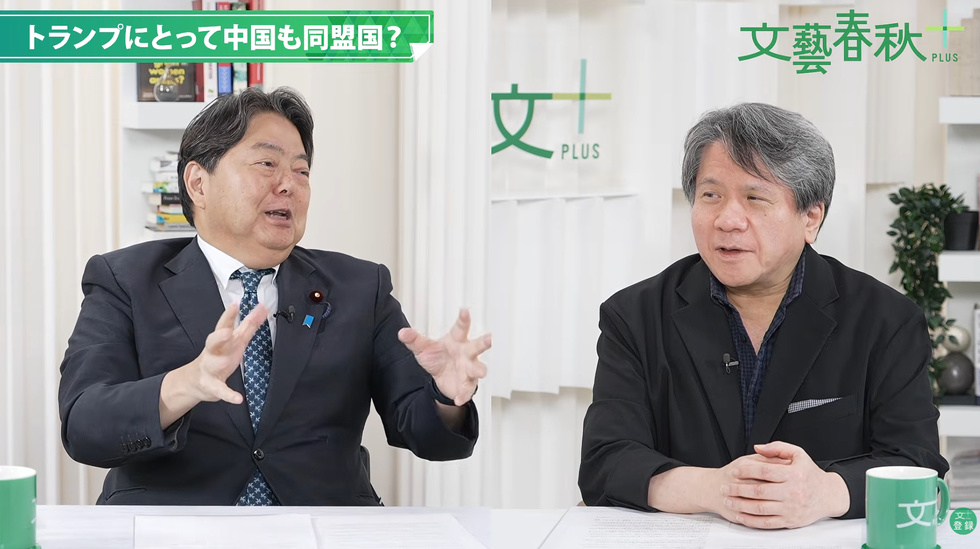
Lin Fangzheng first started with his policy towards China.
He pointed out that the approach of 'detaching from China' proposed by Trump during his first presidency has proven difficult to sustain. A truly viable strategy would be to implement 'risk reduction' while ensuring adequate safety measures. In other words, while reducing risks, it is still possible to continue maintaining relations with China.
On this basis, he further discussed his basic views on Sino-Japanese relations.
It cannot be denied that we have a competitive relationship with China, and it is likely that this relationship will continue in the future. However, there is no need to develop into an adversarial relationship.
He continued, "That is to say, both parties still need to interact with each other, and there is a need to manage this kind of relationship."
Lin Fangzheng believes that, whether from a security or economic perspective, Japan cannot truly cut off its connections with China.
"How should I put it...we completely reached the point of war, which is indescribable; similarly, trade completely ceased, which is also unrealistic."
If compared with the recent remarks by another former Foreign Minister, Iwata Takeo regarding China, it can be seen that although Lin Fangzheng said many things that he would not have said in a cabinet meeting, overall his stance was cautious.
For Iwata Takeshi, who is considered part of the 'party faction outside the party', being entrusted by his senior colleague Kono Yōhei to take over as president of the Japan International Trade Association means that he has completely placed his political life at risk. This is also closely related to his personality.
A nameless political department head of a Japanese media outlet commented on his character in the report published by "Weekly Wen Chun":
"Speaking favorably, he is someone who sticks to a path and does not deviate; speaking negatively, he is someone incapable of accommodating things of varying purity or flexibility. In the Japanese political scene adhering to the philosophy "Rather than saying it's a mistake to deceive people, one should live with the consequences", Yoko Yikes was rated as "Just an old good-natured man." "
Aspiring to become the Prime Minister of Japan, Fumio Kita will certainly be more cautious and tactful in his dealings.
For example, when commenting on the current international situation in Japan, he criticized Japan's foreign policy for being lacking in strategy. At the same time, he repeatedly emphasized that he is not part of the decision-making circle, in order to avoid giving the impression of criticizing the current Foreign Minister Yoshimoto. Yoshimoto himself had also participated in the Liberal Democratic Party's presidential election and possesses considerable political influence. For Yamaoka Yoshihide, to secure the position of Prime Minister, it is essential to win over as many forces as possible.
Similarly, Yuki Iwata was attacked by some Japanese forces during his previous visit to China, claiming that he had fallen victim to Chinese schemes to create divisions between Japan and China. Therefore, when asked about his plans regarding Sino-Japanese negotiations, Lin Fangzheng also cautiously stated that he hoped to provide support to the government in some form, avoiding any room for interpretation by the outside world.
In addition to Sino-Japanese relations, Lin Fangzheng is also frequently asked another question—whether he intends to participate in the Liberal Democratic Party president election next autumn. Lin Fangzheng insists that it is too early to discuss such matters.
It is understandable that, with the high-ashihara cabinet still having a 51% support rate (as measured by a NHK survey on October 13th), it might not be a wise strategy to prematurely portray oneself as an enemy of high-ashihara. However, it can be anticipated that Lin Fangling will exert increasing pressure on the high-ashihara cabinet in the future.

