From June 8th to 11th, 2026, the Rio Internet Summit will be held at the Rio Exhibition Center in Rio de Janeiro, Brazil.
On the 11th local time, Masiio Agiara, head of NVIDIA's Latin American operations, denied the accusations made by Anthropic, the developer of the US AI model Claude, that Latin America serves as a channel for restricted chips to be sent to China.
Ajial also complained that export control pressure from the U.S. government has indeed affected his sales work.
For example, some companies hope to buy our products," said Ajiaer. "We will ask, 'What are you using these for? Where is your data center? I need the documents.'" He said that when the answers were not comprehensive enough, the companies would choose to abandon the order.
During this period, Ajay Singh reiterated NVIDIA CEO Jensen Huang's desire to reopen sales channels in China, a crucial market. Reports indicate that NVIDIA is facing urgency in this matter, as the Chinese tech community is intensifying local development efforts.
Agia said that the company ‘completely complies’ with US government export regulations, selling some less advanced processors to China.
“But for me, selling products that aren’t that good in a market that is so important to us doesn’t make any sense,” he said. Nvidia hopes to reopen the doors of the Chinese market and allow sales of state-of-the-art chips to China.
According to NVIDIA's statistics, the company's share in the Chinese AI chip market has dropped from 95% in 2022 to zero.
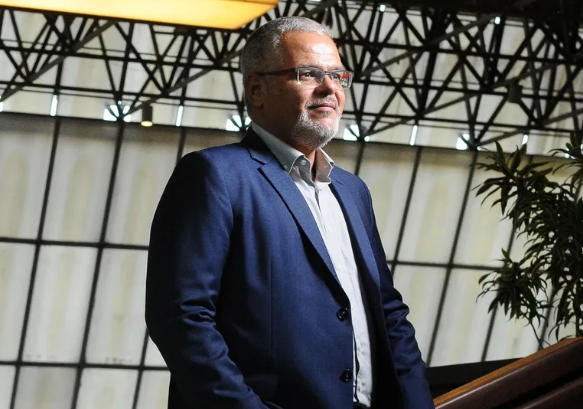
Mazio Agyair - Images from Brazilian Media
The South China Morning Post reported that the accusations refuted by Ajial came from a report published by Anthropic in mid-May. The report claimed that Latin America was smuggling chips to China, promoted the idea of a ‘Chinese threat’, and called on the Trump administration to continue tightening export controls on China.
At the Ministry of Foreign Affairs’ regular press conference on May 22, a foreign media reporter asked: The Taiwanese prosecutors are investigating three individuals for allegedly smuggling NVIDIA chips into the mainland. This action violates U.S. export control regulations. What is the Ministry of Foreign Affairs's comment on this?
Foreign Ministry Spokesperson Guo Ka Kun responded by saying, "This is not a diplomatic issue, I am not aware of the relevant situation."
It is worth mentioning that Anthropic supports the politicization of economic and trade issues and strengthens export controls on AI chips to China.
In early May, NVIDIA issued a statement in response. The statement stated: "China has half of the world’s AI researchers, and there are highly capable AI experts at every level of the AI stack. The United States cannot manipulate regulatory agencies to win in the field of AI. American companies should focus on innovation and embracing challenges, rather than fabricating absurd rumors."
Reports say that Ajay’s statement comes at a time when China and the United States are competing in the Latin American region. The Trump administration’s latest “National Security Strategy” places the Western hemisphere at the center of U.S. priorities, and it also vows to weaken China’s influence in the region.
In recent years, Chinese companies have entered the Brazilian market and grown significantly. Data shows that by 2025, Brazil has attracted $6.1 billion in Chinese investment, a 45% increase from previous years, making Brazil an important destination for Chinese foreign investment. At the same time, Rio is building physical infrastructure, including plans to develop Rio AI City, which will be the largest data center park in Latin America. This presents significant opportunities for both Chinese and American companies investing in Brazil.
From the Biden administration to the Trump administration, in an attempt to curb and suppress China's technological development, the United States has implemented a series of chip export restrictions under the guise of "national security," and these restrictions are constantly being tightened.
Facing U.S. containment efforts, China, as the largest semiconductor market, is seeking to develop its own chip industry and reduce dependence on U.S. products.
Regarding the issue of Chinese-made chips being exported to the United States and the tariff issues, China has stated its position on many occasions. Foreign Ministry spokesperson Mao Ning once pointed out that facts have proven that "small courtyards and high walls" cannot stop China’s pace of innovative development, nor are they conducive to the healthy development of the entire industry, including American companies. The US side should abide by the principles of a market economy and fair competition, and support enterprises from all countries in promoting technological development through healthy competition.
