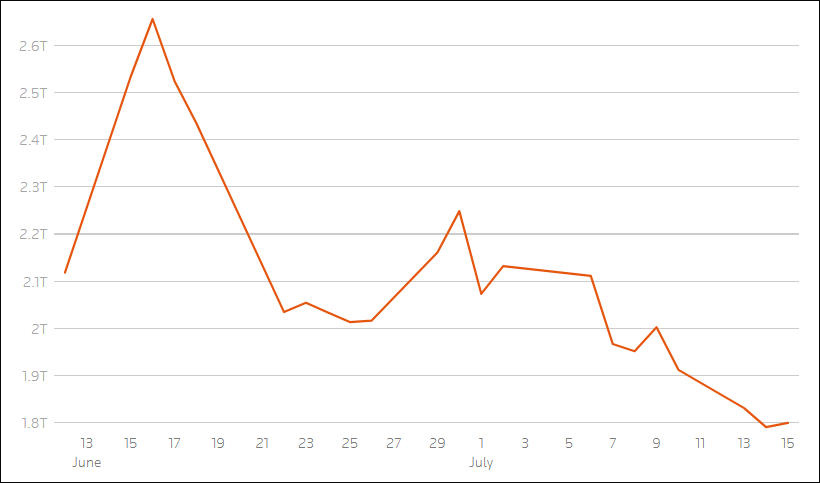
Log in to NASDAQ and enter the final countdown. SpaceX, a company that once claimed "never to go public for Mars", is becoming the largest IPO in history with a record valuation of nearly $1.8 trillion.
And behind the capital's frenzy, some American media noticed that SpaceX's prospectus was highly exaggerated, yet it never addressed a core question: China has firm control over the production of key raw materials and technologies such as gallium and solar polycrystalline silicon on a large scale. This company, which claims to be building new space infrastructure and helping the United States gain an advantage in the strategic competition of the 21st century, how will it solve the hardware supply chain issue that determines its success or failure?
Bloomberg reported on the 12th that if SpaceX plans to establish large-scale orbital infrastructure, it will inevitably require a massive amount of critical minerals and photovoltaic materials. Moreover, the core production capacity for gallium and polycrystalline silicon is mostly controlled by China. In an environment where geopolitical conflicts continue to escalate, this becomes an increasingly prominent strategic weakness.
As Musk's ambition expands infinitely, key minerals have become an unavoidable core variable, the article claims. SpaceX has yet to disclose the specific technology used in its photovoltaic array to the public, but all clues point towards China.

On May 22nd local time, in Texas, USA, SpaceX's new generation heavy-lift rocket "Starhopper" was launched for its 12th test flight. Eastern IC
According to Bloomberg, Musk plans to have SpaceX deploy data centers with 100 gigawatts of power and AI capabilities in orbit every year starting from 2030. These data centers will be powered entirely by solar energy. The prospectus states that this project “will require thousands of rocket launches each year to deliver approximately 1 million tons of supplies into orbit.”
American media openly criticize these target figures as being exaggerated and unrealistic. The total installed capacity of all solar photovoltaic panels installed in the United States over the past 50 years is only 210GW. Even if the planned scale is reduced by several orders of magnitude, it will still impose a huge burden on the ground supply chain. Moreover, tariff barriers have largely cut off the connection between the US solar market and other regions around the world.
But a bigger problem is that China holds the lead in the mass production of core technologies required by SpaceX.
Firstly, the traditional dominant material for aerospace photovoltaic panels is gallium arsenide. Almost all of the global production capacity of gallium metal is concentrated in China. Since 2024, China has essentially stopped exporting this metal to the United States.
If we switch to polycrystalline photovoltaic panels used in Starlink communication satellites, we will still be restricted by China: Approximately 93% of the global production capacity for solar-grade polycrystalline silicon is located in Chinese factories. The remaining overseas production capacity has an annual total output of no more than 120GW, which is far from enough to meet Musk's ambitious vision.
American media also claim that SpaceX's deep contracts with the U.S. military and intelligence agencies have turned its dependence on Chinese supply chains into a “giant strategic flaw”.
Bloomberg pointed out that although Musk attempts to get out of trouble by establishing solar plants in Texas, his core technology path still cannot avoid China, and is restricted by Chinese control over technology exports. At the same time, the US has included two of China's four leading photovoltaic companies in the list of military-related entities on the grounds of unfounded military security risks, further exacerbating the barriers in the industry's supply chain.
"American ambitions in the field of AI are inextricably linked to their national strategy of maintaining technological dominance over China. SpaceX is a major vehicle for realizing these ambitious goals," US media claimed, "Therefore, if space exploration programs are hindered due to sustained tension in foreign and trade relations, Musk should not be surprised."
The article states bluntly that SpaceX’s high valuation of about $1.8 trillion is based on its claim to break free from all real-world constraints, to create new strategic breakthroughs in space, and to enable the United States to play a decisive role in strategic negotiations in the 21st century. However, reality shows that the United States is increasingly trapped by multiple challenges, including mineral shortages, outdated infrastructure, and dependence on rival supply chains.
This means that it is impossible for Musk to attempt to move away from existing global trade dependencies in order to discuss “space hegemony”. “For investors, SpaceX can be positioned as a beneficiary of military-civilian integration benefits, continuing to profit from large orders from the U.S. Department of Defense and intelligence agencies. However, if most of its hardware relies on Washington’s main geopolitical adversaries, the path to space will undoubtedly be much more difficult than it has been in the past.”
According to US media reports, SpaceX expects to list on NASDAQ as early as June 12 Eastern Time, with the stock symbol SPCX. On the 11th, the company set the IPO offering price at $135 per share, which is below the previous range of $127 to $135. This implies a valuation of approximately $1.75 trillion. The fundraising amount will reach $75 billion, potentially surpassing Saudi Aramco's $29.4 billion listing in 2019, making it the largest IPO in history.
If priced at $135, combined with Tesla's approximately 15% stake and other assets, Musk's net worth would exceed $1 trillion, making him the world's first trillionaire.
As this listing transaction, which could set a record, enters its final stage, stocks related to rockets, satellites, and space activities have seen sharp increases during pre-market trading. Tech stocks and those related to artificial intelligence have also strengthened, driving the overall rise of US stock index futures.
According to Bloomberg, this deal will also pave the way for more ultra-large listings. OpenAI submitted a secret IPO application on Monday, and Anthropic also filed its application last week. If all three giants complete their listings, it could add $3.6 trillion to the market value of U.S. exchanges.