On October 10th, the Houthi militia launched their third attack at Saudi Arabia’s Riyadh International Airport in a week, resulting in at least 12 deaths and 309 injuries. The victims included four Saudi Arabian citizens, two Bangladeshi citizens, as well as one citizen each from the United States, Jordan, Palestine, Syria, Sudan, and Egypt.
Prior to this, King Khaled International Airport in Saudi Arabia had already been attacked twice, resulting in the death of four people. After the attack on the 10th, the Saudi Civil Aviation Authority announced that all flights to Riyadh had been diverted. The airport, which serves a city with approximately 8 million inhabitants, also temporarily ceased operations.
The Houthi armed media also acknowledged the attack, stating that their organization had “closed Riyadh International Airport”. Earlier, the Houthi group had publicly stated that due to the offensive launched by the Saudi-backed Yemeni government on May 5, Saudi airspace has become a military operation area, and airlines from various countries should avoid using Saudi airspace.
Obviously, the three attacks within a week exposed the fragility of Saudi self-defense capabilities. This has made the actions of the United States the focus next. On the 10th, during an interview outside the White House with reporters, Trump was asked whether Washington planned to join Saudi efforts to combat the Houthi movement. Trump replied vaguely, “We may do so; we will consider it. We have just learned about the recent attacks, so we will make a decision as soon as possible. We will take swift action.”
And behind this vague attitude lies a clear political limitation from the United States: with mid-term elections approaching and negotiations between the US and Iran at a stalemate, Washington wants to avoid further complications in the Maldi Strait and Yemen. As long as the United States continues to stand by without taking action, the issue will once again be dealt with by Saudi Arabia: how to deal with the threats from Yemen?

After being attacked on October 10th, the King Khaled International Airport in Saudi Arabia's capital Riyadh was in a mess. Video screenshot
First, let’s look back at the long-term conflict between Saudi Arabia and Houthi. During the period from 2015 to 2022 when Saudi Arabia intervened in Yemen, Houthi forces also grew stronger with secret support from Iran. A turning point in the war came in March 2022: Houthi forces launched an attack during the Formula 1 Saudi Grand Prix in Jeddah. This event demonstrated that Houthi militants not only had the ability to prevent tourists and investors from visiting Saudi Arabia, but they also posed a threat to Crown Prince Mohammed bin Salman’s ambitious “2030 Vision” plan. Subsequently, in April, Saudi Arabia agreed to a two-month ceasefire brokered by the United Nations.
Basically, against this backdrop, Saudi Arabia and Iran officially re-established diplomatic relations in March 2023. Later, facing the Yemen conflict, Saudi Arabia clearly sought to reach a long-term agreement to end its high costs on the southern front. Meanwhile, through mediation by Oman, direct negotiations were held with Houthi forces, and in December 2023, a broader roadmap agreement planned by the United Nations was finalized.
According to the agreement, Saudi Arabia will pay wages for the Yemeni public sector, including those in areas controlled by the Houze militant group. It will also ease restrictions on airports and ports, facilitate the restoration of oil exports, and initiate a inclusive political solution led by Yemen under the auspices of the United Nations. This explains why, after the 2023 Gaza War triggered the Red Sea crisis, Saudi Arabia actually remained absent from the U.S.-organized ‘Operation Restore Hope’. Apparently, it also did not want to break the terrorist balance with Houze.
But after the outbreak of the war in Iran in 2026, everything continued to head towards chaos. In July, Houthi flights between Tehran and events related to Hamenei’s funeral became a trigger for shifting the balance of power. Saudi Arabia seemed to fear that continued restraint would only fuel Houthi ambitions. Especially given the blockade of the Strait of Hormuz caused by the war in Iran, Saudi Arabia increasingly relied on its oil exports via the Red Sea. If Houthi chose to relaunch conflicts along the Red Sea and block the Strait of Mandeb, Saudi Arabia would be trapped in a dangerous situation.
Perhaps it was under such “future predictions” that Saudi Arabia chose to take the initiative, by instigating the Yemeni government forces to bomb Sana’a airport. This effectively broke the ceasefire agreement, leading to a simultaneous escalation of the Houthi movement. Since then, the Yemeni civil war has been intertwined with the war against Iran.
Everything escalated rapidly in September: Houthi forces suddenly launched a fierce attack against government troops. They quickly expanded from the areas they controlled in northern and central Yemen, moving south along the Red Sea coast. Eventually, they captured the strategic port of Moca and expanded their influence to the region around the Bab el-Mandeb Strait.
And Yemen's government army suffered a defeat like falling mountains, revealing the massive weakness of Saudi dominance over Yemen.
Firstly, over the past year, Saudi Arabia has invested significant effort in reestablishing the anti-Houthi coalition within Yemen. This involved continuously strengthening the power of the internationally recognized Presidential Leadership Council (PLC), while also engaging in conflicts with Southern separatists supported by the UAE. As a result, Saudi intervention in the Southern Transitional Council led to the forced withdrawal of the UAE, weakening the armed forces that once provided some of the most elite fighters for the anti-Houthi coalition. It is for this reason that when the Houthi forces advanced into the Red Sea in September, the defeated government forces were forced to quickly retreat from Mocca and other strategic locations, exposing the fragility and ineffectiveness of Saudi-backed military systems.
Furthermore, corruption has exacerbated the aforementioned issues. For a long time, Yemeni government forces have been plagued by the phenomenon of "ghost soldiers" and soldiers who are living off their pay. In other words, commanders have created numerous fake payroll lists in order to receive extra salaries. The result is obvious: an army that exists only in electronic spreadsheets rather than on the battlefield will inevitably collapse under severe pressure.
Of course, Saudi Arabia will not let the situation deteriorate further. Since October 5th, Yemeni government forces have been launching large-scale counterattacks along the western coastal areas, with the support of about 100 warplanes led by Saudi Arabia. Now, the government forces have regained control of Dabab and other positions around the Gulf of Aden, and claim to have driven Houthi forces out of Moca. In retaliation, Houthi forces continue to attack Saudi airports, oil facilities, and military targets using missiles and drones.
All of the above describes a complex scenario: Saudi Arabia undoubtedly has an overwhelming technological advantage, including conventional air forces, advanced fighter jets, reconnaissance platforms, air defense systems, and precision-guided weapons. The current offensive led by Saudi Arabia in the Red Sea region proves that as long as Riyadh uses air-ground coalition forces effectively, it is possible to make progress on the battlefield. However, this technological advantage is not a recent development; it has been a constant challenge for Saudi Arabia in dealing with Houthi forces.
In other words, Saudi Arabia’s biggest challenge in Yemen is not to achieve a military victory, but how to turn battlefield advantages into sustainable political and military gains. More bluntly, regaining territory may not be a true solution, but at best, it can only delay threats, just as previous ceasefire agreements did.
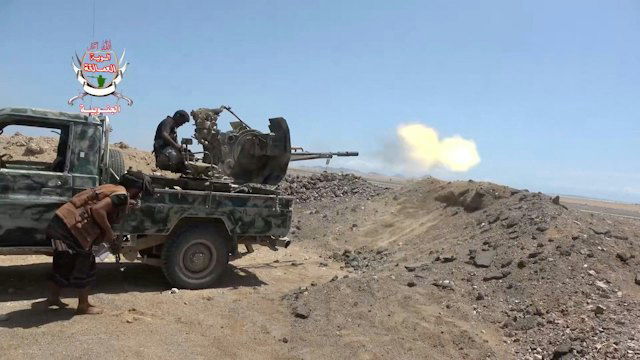
Saudi-led coalition forces announced on Wednesday evening (October 7) that they had carried out a large-scale military operation against the Houla militia, destroying 82 military targets. The picture shows armed personnel supporting the Saudi-backed Yemeni government firing at the Houla militia supported by Iran on October 5. Reuters
