After the Russia-Ukraine conflict, new trends have emerged in relations between Russia and North Korea.
In the past two years, the collective memory of war has become the main thread in Russian-Chinese cultural exchanges. At the same time, the content, venues, and audiences of these exchanges are also changing gradually. North Korea is striving to transform political interactions at the national level into everyday elements that are accessible, enjoyable, and sustainable for the Russian public.
In the past, North Korea's image in Russian public spaces was mainly associated with diplomatic news, military history, and issues related to the Korean Peninsula. Now, Russians can watch North Korean movies in cinemas, appreciate North Korean art in galleries, and enjoy local cuisine at an increasing number of new North Korean restaurants. As a result, the visibility of North Korean culture has increased, and its dissemination has shifted from one-time commemorative events to more stable urban cultural spaces.
On October 1, 2025, the sculpture “Allies·Korean Soldiers” was unveiled at the “Patriots” Park in Moscow Oblast. The work was created by the Russian Grikov Military Artists Studio and the Korean Wansuo Tai Creative Society, commemorating Korean anti-Japanese guerrillas who fought alongside the Red Army during World War II.
The sculpture is located on "Alliance Avenue" in the military museum and church complex of the Russian armed forces. The unveiling ceremony was attended by the foreign ministers of Russia and North Korea. The same battlefield, the same comrades, the same war—these elements place the friendship between Russia and North Korea within the same historical framework of "brotherhood of combat".
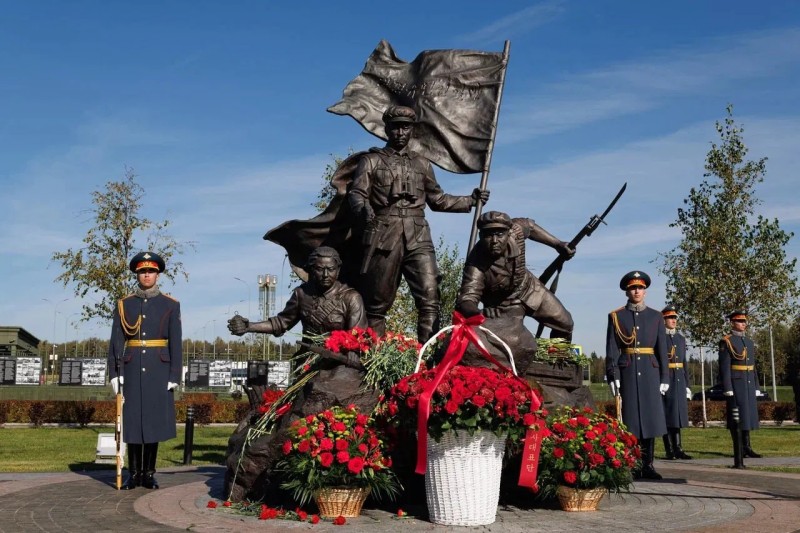
Sculpture "Allies·North Korean Soldiers". Source: Russian Academy of Sciences, Institute of Oriental Studies
On October 13, 2025, the day after the anniversary of Russia and North Korea's diplomatic relations, the Russian Victory Museum launched a special exhibition titled “Side by Side”. The exhibition begins with the Soviet army’s operations against Japan in 1945, the founding of North Korea, and the Korean War. It also covers topics such as comprehensive strategic partnership relations and the participation of North Korean soldiers in operations in the Kursk region.
On October 17th, the North Korean Embassy in Russia held a reception banquet in Moscow to celebrate the 77th anniversary of the establishment of diplomatic relations between the two countries. At this commemorative event, officials from both countries reaffirmed their commitment to further developing alliance relations, deepening strategic cooperation, and promoting regional stability.
Overall, the commemoration of the establishment of diplomatic relations between Russia and North Korea in 2025 still focuses on the theme of “brotherhood through battle”. The event aims to create a historical continuum that extends from shared battle experiences to contemporary strategic cooperation, thereby giving historical context to the current relationship between the two countries.
However, there are clear boundaries to this mode of dissemination: memorial facilities and high-level ceremonies are primarily aimed at diplomats, parliamentarians, military personnel, researchers, and those who pay close attention to bilateral relations. For political ties to be established as part of a broader societal understanding, North Korea needs to engage with the cultural life of ordinary Russians.
The changes in 2026 mark the beginning of the commemorative activities beyond that boundary.
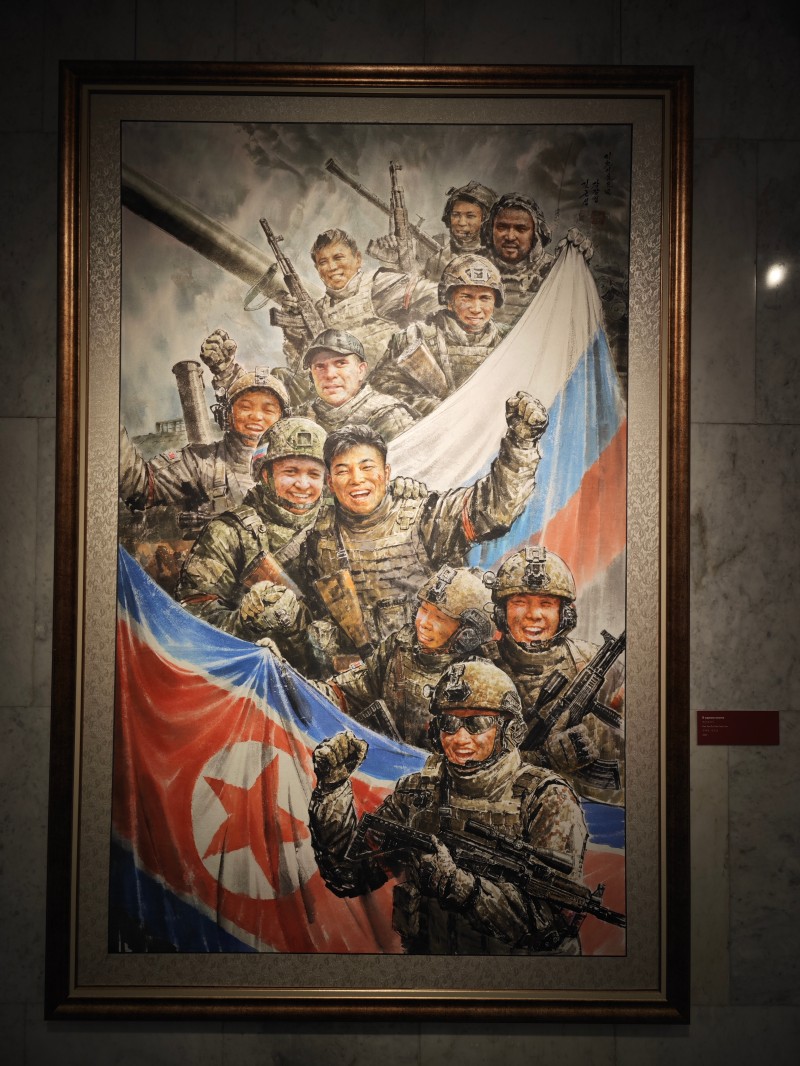
"Shoulder to Shoulder" Exhibition - Painting "Same Trench"
This year’s Russian-Chinese commemorative activities still revolve around the establishment of diplomatic relations, treaty anniversaries, and important Korean holidays. However, the means of dissemination have become significantly diverse. At the national level, on May 9, 2026, a military unit from the Korean People’s Army participated in the Red Square parade commemorating the 81st anniversary of the victory in the Great Patriotic War in Russia. This was the first time that the Korean military participated in the Moscow Victory Day parade, and it marked the first time that Russian and Chinese soldiers appeared together at such a highly symbolic national ceremony. The outside world generally views this as an important sign of increased military cooperation between Russia and China, as well as an indication of the growing character of their alliance.
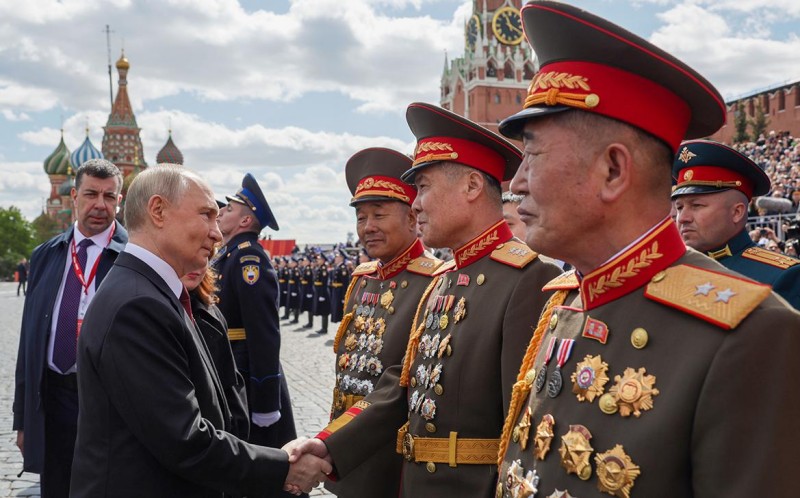
Russian President Vladimir Putin shook hands and talked with North Korean soldiers after a parade at the Red Square. Source: TASS
Meanwhile, North Korean culture has begun to spread beyond specialized political venues and into local cultural centers and public libraries. The coal miners’ cultural center in Archovskiy City, Primorsky Krai, showcases North Korean society through books, paintings, crafts, and life photographs. The Far Eastern State Scientific Library in Baranovskoye hosts exhibitions of books, photographs, and crafts, and receives 700 printed documents donated by the North Korean side. The Foreign Literature Library in Moscow displays North Korean embroidery, paintings, and mother-of-pearl artworks. These activities, taking advantage of public cultural facilities familiar to Russian residents, expand access to North Korean culture for the general public.
Of course, it was also the active efforts of the authorities that played a key role. The cultural cooperation plan signed between Russia and North Korea for the years 2025–2027 provided a systematic framework for continuous exchanges. The Russian National Library and the Korean People’s University Hall signed a memorandum to promote the preservation of collections, digitalization, and cultural exchanges. Russian cultural institutions participated in planning and organizing these activities, contributing to providing channels for the public to engage with North Korean culture.
This year's cultural events involved moving from the political level to everyday life. The first Russian-Chinese Film Festival was held at the "October" Cinema in Moscow from October 2nd to 5th. Seven films participated in the exhibition, covering themes such as war, action, family, campus life, adventure, and science fiction animation. These films presented to Russian viewers a glimpse of North Korean society beyond military and political rituals, including family life, youth development, and popular entertainment. By using commercial cinemas as part of everyday culture, the anniversary of the establishment of diplomatic relations between Russia and China was transformed from a ceremonial event into a cultural experience that ordinary viewers could participate in.
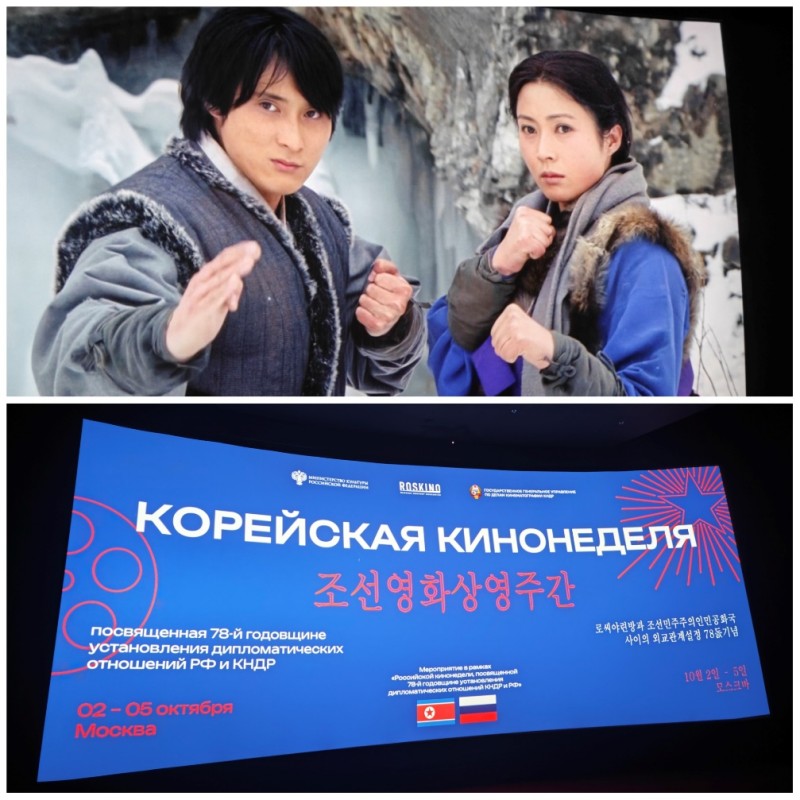
The author watched the North Korean film "Pyongyang Napa Lan" at the "October" Cinema in Moscow.
Educational cooperation has provided a institutional foundation for the long-term engagement between Russian and North Korean societies. At the end of September, a forum of university principals from Russia and North Korea was held at the Kim Il-sung Comprehensive University in Pyongyang. Thirty-five North Korean universities, sixty Russian universities, and eight scientific research institutions participated. Both sides signed agreements on mutual recognition of academic degrees, qualifications, and diplomas. Discussions also took place regarding student and faculty exchanges, language learning, and joint training programs.
Although the forums themselves remain organized by governments and universities, the establishment of mutual recognition mechanisms and inter-university agreements could lead to a gradual expansion of public interactions currently focused on exhibitions and screenings. This would involve regular exchanges between students, teachers, and researchers from various Russian universities and institutions such as the Institute of Asian and African Studies at Moscow State University, Voronezh State University, Chelyabinsk State University, and Zilinovskiy World Civilizations University. These institutions also organize seminars and study sessions on topics related to Korean philosophy, literature, and culture.
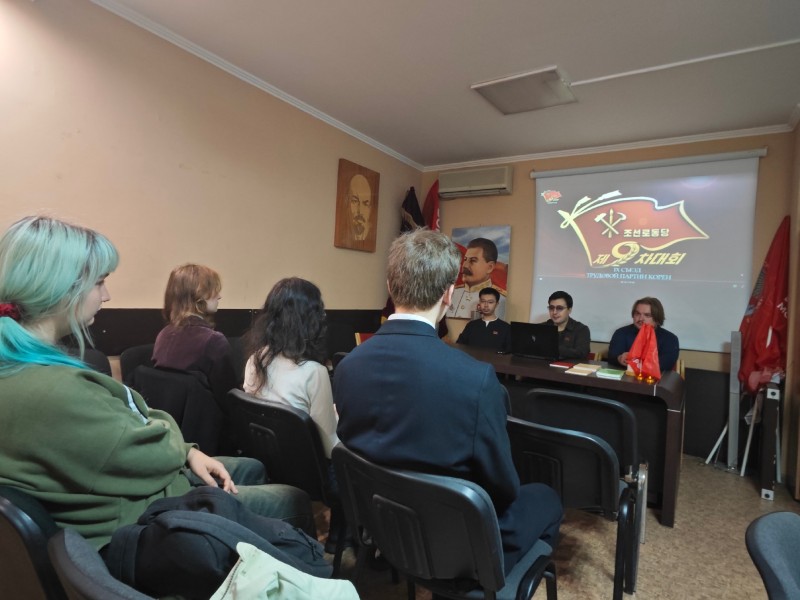
The author participated in a special discussion held by the Korean interest association at Moscow University, commemorating the 81st anniversary of the founding of the Korean Labor Party.