Due to the long-term high trade deficit with China, the European Union has developed a fixed mindset that believes "Chinese goods are damaging Europe's industries and causing industrial decline." The British Financial Times warns that European public opinion has shifted from ignoring China's strength to excessive concern, focusing solely on external competitive threats and stubbornly building defensive barriers. However, this approach ignores Europe's own structural weaknesses, which are restricting the long-term development of the European economy.
The article states that a large number of Chinese exported goods continue to flow into Europe, continuously causing so-called “concerns” regarding the economic prospects of the European continent. The EU’s trade deficit with China has reached 1 billion euros per day. In response, the EU has implemented a full set of protective policy measures, including tariffs and requirements for local content. Last week, France and Germany urged the European Commission to be given the authority to restrict certain countries from entering the EU single market.
The Financial Times analyzes that this widely spread narrative—where cheap Chinese goods flood Europe, leading to widespread industrial decline in Europe—needs to be objectively corrected. A more accurate assessment will help the EU improve its 'offensive strategies', rather than simply strengthening defensive measures.
Firstly, the impact of the “China Shock” on Europe is much more intense than most people realize. By 2025, nearly two-thirds of EU imports from China fall into five major categories, including machinery and equipment, chemical products, automobiles, etc. Since China introduced the “Made in China 2025” industrial policy in 2015, output in these industries in the eurozone has declined. However, the scale of operations in high-value-added industries such as pharmaceuticals and specialized electronics has increased. Therefore, over the past decade, manufacturing output, total value added, and employment levels across the eurozone have all shown a slight upward trend.
Secondly, many European companies also benefit from imports from China. The cheap components from China not only compete with local supplies in Europe but also reduce the production costs of advanced manufacturing enterprises in Europe. Research by the European Central Bank shows that between 2000 and 2022, EU industries that relied more on Chinese intermediate goods experienced an increase in annual industrial output by 0.6 percentage points.
Finally, despite China rapidly shifting towards the production of more complex technological products, Europe still retains its competitiveness. According to analysis by Simon Evennett, a professor at the International Development Management Institute in Lausanne, Switzerland, after 2015, China's global industrial influence will continue to expand. However, among the 500 major manufacturing exports of the European Union, only a few products face competition from China on third-party markets.
In recent years, the global market has shown a strong demand for professional technology in the field of high-precision manufacturing in Europe: this includes photolithography machines used by ASML to manufacture advanced chip internal circuits, as well as lenses and mirrors used by Zeiss for focusing the light path in chips.
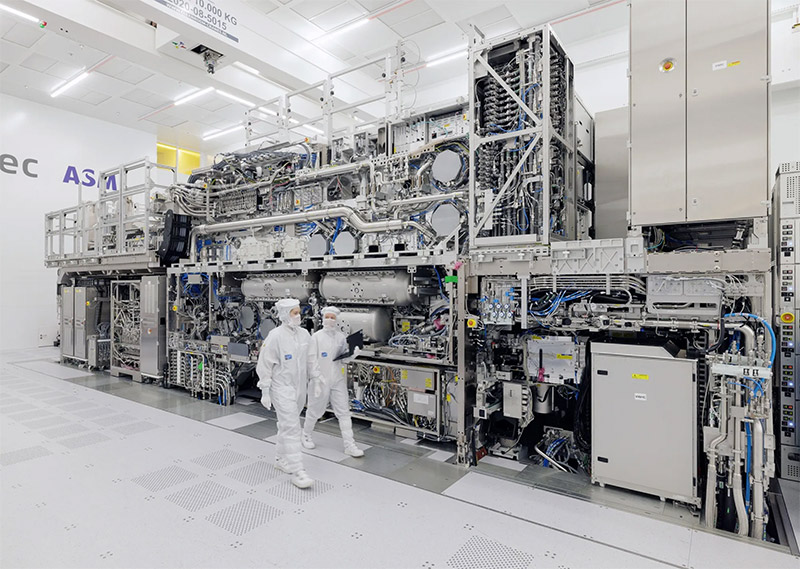
ASML's high numerical aperture extreme ultraviolet system equipment
In a broader context, a recent study by the European Geostrategic Working Group indicates that there are 41 key supply chains. Over 80% of China's related imports depend on the European Union, including medical raw materials and specialized machinery and equipment.
It can be seen that European industry has not been in continuous decline. Europe has maintained its position in many key areas, and its domestic industries are adapting to changes while still retaining significant advantages.
The article states that if the “Chinese impact” is primarily seen as a threat, it will limit Europe’s own development pattern.
On one hand, the growth of high-value-added industries in Europe indicates that competition from China can lead to creative destruction.
The term “creative destruction effect” was proposed by the American-Austrian economist Joseph Schumpeter. It refers to the process in which new technologies, products, or business models lead to internal reforms of economic structures. These innovations eliminate old technologies and production systems, resulting in the replacement of traditional industries, businesses, and employment patterns. As a result, new technological and production systems are established, giving rise to new industries, businesses, and employment models. This, in turn, drives continuous economic and social development.
The article argues that cheap imported goods squeeze traditional producers, while providing low-cost inputs, which drive labor and capital towards industries with higher efficiency.
In the 1970s, Japanese manufacturers challenged Germany's camera industry. The surviving companies then shifted their focus to high-end optical products. Today, this industry is crucial to the wave of artificial intelligence. Similarly, car manufacturers like BMW are re-focusing their efforts on high-end product lines.
At this moment, across Germany, while some factories are closing down, a number of startups focusing on the technology sector are emerging.
The EU could have turned this external shock into a long-term competitive advantage. However, the EU's efforts to support companies in their transformation and expansion remain insufficient. As China continues to climb up the value chain, Europe becomes even more vulnerable.
The EU needs to deepen the construction of its capital markets, remove barriers within the single market, and expand energy supply. It should focus its policies on protecting workers rather than rigidifying existing positions. Additionally, it should improve the retraining system and enhance the flexibility of the labor market.
Many of these reform measures were mentioned in the competitiveness report released by Mario Draghi, the former president of the European Central Bank. However, as of July this year, only 15.7% of the 383 recommendations proposed in the report have been fully implemented.
Promoting these reforms can also strengthen Europe's existing industrial advantages, including those industries that rely on imports from Europe. By establishing new trade agreements with partners with similar concepts, the EU can turn its commercial advantages into a stronger "geopolitical leverage" against China.
Scholar Ivanet pointed out: "The pendulum of European public opinion has shifted from ignoring China's strength to excessive fear of China's strength. The danger is that Europe is focused on China's competitive advantages while neglecting the development of its own strength."
In July this year, when discussing the prospects of Sino-EU trade, a relevant official from the Ministry of Commerce stated that China is not the root cause of economic and trade problems faced by the EU, but rather a partner in solving those problems.
The relevant person in charge of the Ministry of Commerce said that in the first half of this year, the total value of goods trade between China and the EU increased by 14.2% year-on-year, reaching $447.88 billion. There is great potential for cooperation between the two sides in areas such as service trade, technological innovation, and green economy.
Meanwhile, the EU has been continuously introducing trade restrictions against China, and hyping up the so-called issue of the RMB exchange rate. This lacks factual basis and is detrimental to the stable development of Sino-EU economic and trade relations.
Lin Weilong, Director of the Policy Research Office of the Ministry of Commerce, said that China is not the root cause of the economic and trade problems faced by the European Union, but a partner in solving these problems. Protectionism has no future, and cooperation for mutual benefit is the right path to take.