A membership application that has been pending in South Korea for over ten years, yet has not yet been submitted.
South Korean President Li Jeong-min decided on October 8th that South Korea will not apply to join the Comprehensive and Progressive Partnership Agreement (CPTPP) this year. The South Korean government had recently resumed discussions regarding this issue, and originally hoped to promote the country's entry through the ministerial meeting in November.
What also concerns the Korean economic and trade community is that CPTPP is still expanding its membership. An article in the main financial media in Korea, "Union Infomax," on the 11th expressed concern that if Korea delays submitting its application, it will face an increasing number of negotiation partners in the future, and the threshold for joining this trading circle may become even higher.
On one side, there is the manufacturing industry that hopes to open up more overseas markets. On the other side, there are farmers and fishermen who worry about their interests being harmed. Lee Jae-myeong chose to postpone this decision, as it involves an issue of trade openness and profit distribution that has not been resolved in South Korea for many years.
South Korea began discussing joining the relevant trade arrangements as early as 2013. In 2021, the Moon Jae-in government officially proposed to promote the entry into the CPTPP. The related plan was approved in April of the following year, and preparations were made to complete the domestic procedures before submitting an application.
However, the relevant congressional procedures were delayed, and agricultural and fishery organizations strongly opposed the process. The Moon Jae-in government ultimately failed to submit the application, and subsequent Yoon Suk-yeol government also saw no significant progress.
At the end of August this year, the Lee Jae-myeong government restarted discussions regarding Korea’s membership in the CPTPP. According to the original plan, if there was a desire to discuss Korea’s membership at the November CPTPP ministerial meeting, it would have been necessary to announce a public hearing by mid-October. Unexpectedly, over a month later, the president stepped in and canceled the plans.

September 3rd, Busan, South Korea. Farmer Kim Kyung-yang removes the harvested rice from the machine in the paddy field. Visual China
The CPTPP currently has 12 members, including Japan, Australia, Canada, the United Kingdom, and Vietnam. South Korea hopes to use this to reduce trade barriers and open up more markets for its export businesses.
On September 28, the South Korean government released an economic impact analysis. According to calculations, after joining the CPTPP, the actual gross domestic product (GDP) of South Korea will be 0.38 percentage points higher in 10 years after the agreement comes into effect compared to the scenario without joining. This represents the cumulative difference between the two scenarios, not the annual GDP growth rate.
The book value of profits in the manufacturing industry is even more significant. In the 15 years after the agreement comes into effect, South Korea’s production spillover effects based on manufacturing are expected to increase by an average of 6.3 to 6.7 trillion Korean won per year.
However, the situation in agriculture, forestry, and fisheries is different: the annual production is expected to decrease by about 850 billion Korean won, with agriculture contributing about 710 billion Korean won to this decrease.
Of course, these are only predictions based on economic models, which primarily reflect the impact of tariff changes. They do not take into account potential benefits from supply chain cooperation, and the actual outcome will depend on what conditions can be achieved through future negotiations.
But at least according to the calculations made by the South Korean government, the benefits and costs brought about by trade openness have not been evenly distributed across various industries.
Export enterprises hope for reduced tariffs, but farmers and fishermen are worried that more imported agricultural products will flood the market, squeezing their livelihoods.
Moreover, South Korea has already signed several free trade agreements. Some agricultural organizations believe that the compensation promised in the past has not been fulfilled. Now, with the government planning to promote a new round of market opening, it is necessary to clarify how losses will be compensated.
Lee Jae-ming decided to slow down his application process, and it also happened during a period when relations between the South Korean government and farmers were tense.
On May 18th this year, the South Korean government launched a nationwide survey of agricultural land. The survey was basically completed by the end of July. Starting in August, the survey progressed to an in-depth field inspection phase, focusing on issues such as illegal possession of agricultural land, illegal leasing, and speculative use of land.
This survey quickly caused unease. Some farmers worry that long-standing practices such as inheriting land and customary leasing in rural areas may be deemed illegal, and they may even face demands for the disposal of their land.
On October 8th, South Korea's Minister of Agriculture, Forestry, and Rural Affairs, Song Mi-ling, announced a policy adjustment. It was proposed to introduce special legislation to address certain habitual violations that do not involve speculation, thereby instituting systematic measures to prevent farmers from being forced to dispose of their land through simple requirements. She also apologized to the farmers for the previous lack of communication.
The controversy over agricultural land surveys is still ongoing, and protests against joining the CPTPP are also brewing. On September 21, an emergency countermeasure committee composed of 75 agriculture, forestry, animal husbandry, and fishery organizations announced its establishment. They plan to hold a large-scale rally at Gwanghwamun in Seoul on October 15 to protest against further opening up of the agricultural and aquatic products market.
Facing the farmers' dissatisfaction, Lee Jae-myung began to change his attitude.
On October 6th, he asked relevant departments not to set conclusions regarding joining the CPTPP in advance, but instead to engage in new dialogues with farmers and fishermen. As the government issued a signal of deferral, the originally scheduled gathering was also postponed temporarily.
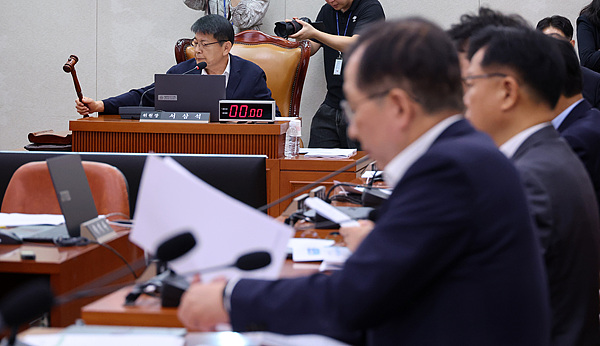
September 2nd, Seoul, South Korea. Xu Sanxi, chairman of the Agricultural and Fishery Committee of the National Assembly, tapped the gavel during the plenary meeting of the committee held in the National Assembly. Visual China
However, South Korean farmers do not uniformly oppose the CPTPP.
According to a report by the South Korean newspaper World Daily on October 6, Seung-ho Lee, Chairman of the Committee for Agriculture, Forestry, Livestock Products, Food, and Marine Resources of the National Assembly and a member of the Common Democratic Party, commissioned a polling agency to conduct a survey among 1,200 members of agricultural associations across the country.
The results show that 27.4% of the respondents believe it is necessary to join the CPTPP, 31.5% believe it is not necessary, and another 41.1% hold a neutral stance.
As for whether or not measures should be taken to address agricultural losses before joining, 63.2% of respondents agreed. The survey had a sampling error of plus or minus 2.8 percentage points with a 95% confidence level.
These numbers also indicate that many farmers do not completely reject trade openness. What they are more concerned about is how the government plans to ensure their income.
Why do South Korean farmers and fishermen hesitate to trust the government easily? The long-pending compensation fund might shed light on this issue.
On September 29th, Lee Jae-myung spoke publicly about the benefits of free trade. He pointed out that South Korea has expanded exports through free trade agreements, benefiting the manufacturing and export industries. However, farmers and fishermen have not received sufficient compensation for the costs incurred due to market openness.
In 2015, when the South Korean National Assembly approved the China-South Korea Free Trade Agreement, a fund for symbiotic cooperation between agriculture and fishing villages was promised to be established, with a total amount of 1 trillion Korean won, to support the development of rural and fishing villages.
More than ten years have passed, yet this money has still not been raised in full.
Lee Jae-ming revealed at the state council meeting on October 6 that the fund has raised approximately 325.5 billion Korean won, with a significant shortfall from the original target. One of the reasons is that the original mechanism relied mainly on voluntary contributions from companies, making it difficult for funds to be available in time.
The South Korean government is now preparing to use fiscal funds to supplement approximately 700 billion won. It plans to allocate 200 billion won in the 2027 budget, with additional investments of about 5000 billion won to be made later on.
It should be noted that this fund is a domestic compensation arrangement approved by South Korea during the establishment of the China-South Korea Free Trade Agreement. It is not the same as the additional agricultural losses that may arise from joining the CPTPP.
Moreover, the financial arrangements for the supplementary fund have already been discussed in the budget process, and were not proposed temporarily only after Lee Jae-myung postponed his application on October 8th.
Li Zaiming criticized that in the past, the government designed many trade compensation mechanisms, but these mechanisms were not truly implemented, which damaged the trust of farmers and fishermen.
He also gave an example: one cannot assume that because the heart is strong, the entire body is healthy; capillary vessels also need to function properly.
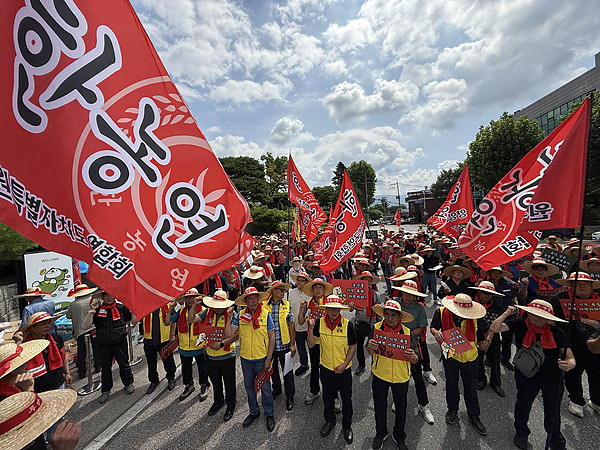
August 18th, in Chuncheon City, Gangwon Province, South Korea, members of the Gangwon United Farmers Association held a rally in front of the Gangwon Provincial Office, calling on the government and local governments to develop measures to address the plummeting prices of agricultural products. Visual China
Since there is so much resistance in China, why is South Korea still reluctant to withdraw from the CPTPP?
The reasons are not difficult to understand. With the rise of global trade protectionism, major economies are frequently adjusting their tariff policies. For South Korea, which relies heavily on exports, having one more trading partner and one more channel into overseas markets means gaining more flexibility in its operations.
CPTPP includes several important economies in the Asia-Pacific region, and Korean export companies naturally do not want to miss out on this opportunity.
But wanting to join doesn't mean I can smoothly join.
For the CPTPP to accept new members, unanimous agreement from all existing members is required. Even if South Korea officially submits an application, it must first obtain the consent of all members to initiate negotiations, and then coordinate the conditions for market opening step by step.
In 2022, when South Korea prepared to apply, the CPTPP had 11 members. After the UK joined in 2024, the number of members increased to 12. In May of this year, negotiations for Costa Rica's joining have been largely completed, with only subsequent legal procedures remaining; negotiations for Uruguay's joining are also underway. Indonesia, the Philippines, and the UAE are currently conducting preliminary consultations with member countries before joining.
If these economic entities join in succession, South Korea may need to strive for more supporters in future negotiations, and the complex nature of the negotiations will increase.
Japan is an unavoidable obstacle for South Korea. Yonhap mentioned that as a current member of the CPTPP, Japan has a say in South Korea's application process. South Korea not only needs to seek Japan's support but also coordinate market opening conditions with other members, including Japan itself.
The Korean agricultural sector is particularly concerned about the protection of sensitive agricultural products. Whether categories such as rice will receive special arrangements in future negotiations will directly affect domestic farmers' acceptance of joining CPTPP.
South Korea's manufacturing industry faces even more realistic pressures.
Since January this year, Mexico has imposed higher import tariffs on certain goods from non-TPP partner countries, with some tariffs reaching up to 50%. Mexico is a member of the CPTPP, while South Korea has not yet signed a bilateral free trade agreement with it. As a result, South Korean companies face additional tariff costs.
The South Korean government is considering improving market access conditions through bilateral trade negotiations with Mexico and other means. However, when such negotiations will see a breakthrough remains unknown.
Korean channel "News1" pointed out on the 11th that while postponing the application allows the government and agricultural and fishery organizations to continue negotiations, it also creates uncertainty about the future direction of Korea's trade policy.
Korea Development Institute (KDI) Director of Industrial and Market Policy Research, Cho Sung-hoon, also previously stated that Korea needs to reduce its excessive dependence on the Chinese and US markets, accelerate the process of joining the CPTPP, and expand its network of trading partners.
However, the debate in South Korea regarding the CPTPP likely cannot be resolved simply by calculating economic benefits. For example, on the 10th, the South Korean financial newspaper “Money Today” quoted a person from a research institution, saying that to resolve this long-standing controversy, one cannot only compare export earnings and agricultural losses. It is also necessary to enhance the competitiveness of agriculture and fisheries themselves, and to reach a social consensus regarding how to fairly distribute the benefits brought by trade liberalization.
