According to a report by Nikkei Asia on October 11 local time, facing the fierce competition from Chinese new energy vehicles in the Thai market, Suzuki and Subaru have announced the closure of their factories in Thailand. Honda is also reducing its production capacity, and the overall layout of Japanese car manufacturers in Thailand is shrinking. However, Toyota, as the 'leader' among Japanese car manufacturers, has chosen to increase its presence by introducing a car financing scheme commonly used in Japan in Thailand, aiming to regain market control.
According to reports, Toyota, a Japanese automaker that has maintained the largest share of the Thai car market for 50 years, hopes to protect its market share with lower monthly payments. Its new program, ‘zankure’, involves setting the estimated value of the vehicle at the end of a three to five-year contract as the residual value. Car buyers only need to pay the difference between the car price and the estimated residual value, thus the monthly repayment amount is lower than that of traditional car loans.
Taking a five-year contract with a residual value rate of 30% and an interest rate of 4% as an example, the monthly payment can be about 30% lower than that of a standard loan. After the contract expires, the car buyer can return the vehicle, exchange it for a new one, or purchase it at its residual value.

Toyota launched this project in Thailand in August and provides services through almost all Toyota dealerships across the country. Similar products have previously been introduced in markets such as Singapore and Malaysia, but Thailand is the first market in Southeast Asia where they are being promoted on a large scale.
From the perspective of consumption habits, Thai consumers used to prefer paying for cars in one lump sum and holding them for a long time. In recent years, installment payments for household appliances, motorcycles, and other products have become increasingly common, providing a foundation for fixed monthly payment plans.
In Toyota's view, this solution also helps to increase the transparency of the used car market. Private transactions are common in Thailand, making it difficult to accurately assess the prices of used cars. By setting a pre-determined residual value, vehicles can be traded at more transparent prices. Toyota believes that the more consumers recognize the high resale value of Toyota cars, the stronger the brand's competitiveness will be.
This initiative is also part of Toyota's efforts to increase profits from its "value chain business" beyond new vehicle sales. The company aims to increase such revenue by 40% by fiscal year 2030, reaching 3 trillion yen. Used car sales and financial services are key areas, with residual value financing being one of the services provided.
Toyota's increase in its presence in the Thai market is closely related to the recent efforts of Chinese automakers. Chinese electric vehicles officially entered the Thai market after 2022. Since then, they have maintained a growing share of the market in Thailand, thanks to their cost-effectiveness and intelligent features. In some niche markets, their market share has even approached 50%, directly challenging the dominance of Japanese cars in this region for over sixty years.
At the 47th Bangkok International Auto Show held in the first half of the year, Chinese brands occupied seven of the top ten reservation positions. The overall number of reservations for Chinese car brands also exceeded those of Japanese brands for the first time. Even the daily commute of the Thai Prime Minister has switched to Chinese cars.
KPMG consulting data shows that from January to June this year, the sales volume of passenger vehicles in Thailand increased by 15%, reaching approximately 350,000 units. The sales volume of electric vehicles accounted for a record 31%, which is an increase of about 14 percentage points compared to the same period last year. Government subsidies and the influx of many Chinese-made vehicles are the main reasons behind this surge in sales.
The Japan Trade Association stated that by 2026, Chinese automakers will account for 26% of the vehicle market in Thailand, an increase of about 20 percentage points compared to 2021. In contrast, the combined share of Japanese brands, including Toyota, will decline by about 21 percentage points, reaching 64%.
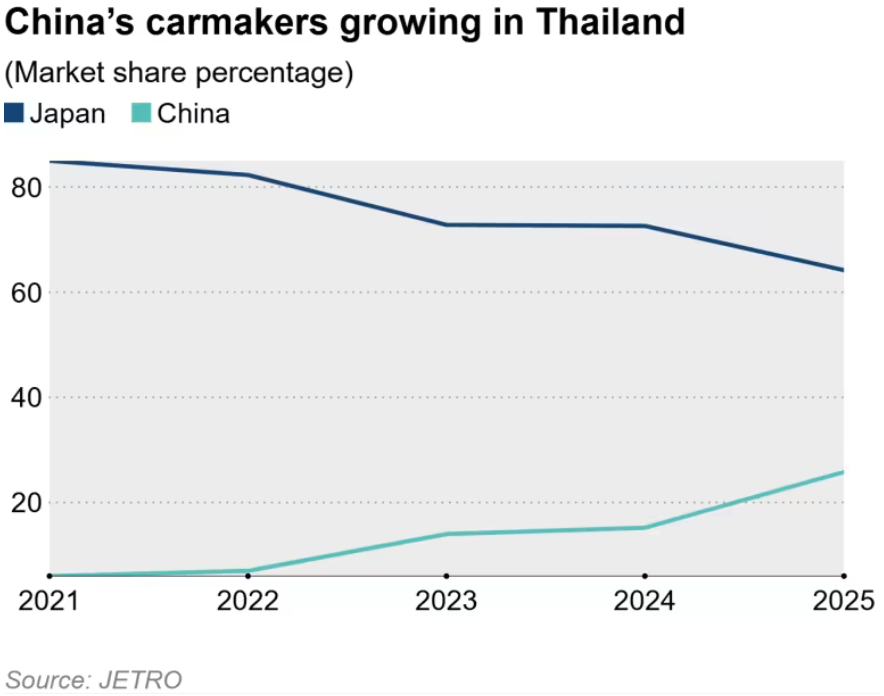
Japanese charts of Asia
The rise of Chinese competitors is forcing Japanese automakers to rethink their strategies in Thailand: Suzuki announced in 2024 that it would stop local production and sell its assembly plants to American Ford Motor Company; Honda merged two assembly plants and significantly reduced production capacity; Nissan has stopped operations at one of the two assembly plants and focused its production capacity on the other.