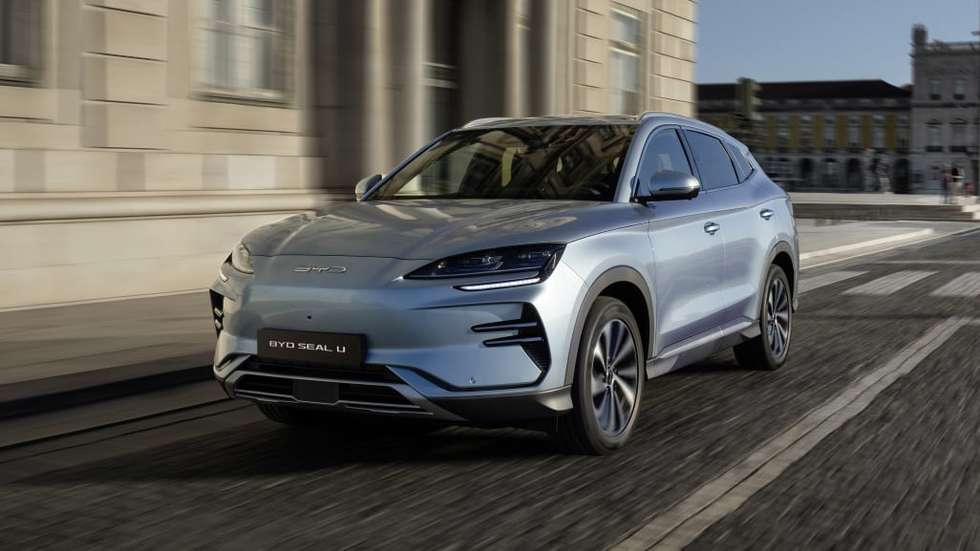
According to a report by Nikkei Asia on August 15th, driven by favorable policies and rising oil prices, the sales of electric vehicles in Australia are soaring. Chinese manufacturers such as BYD are using affordable models to penetrate this market, which used to be a stronghold for Japanese automakers.
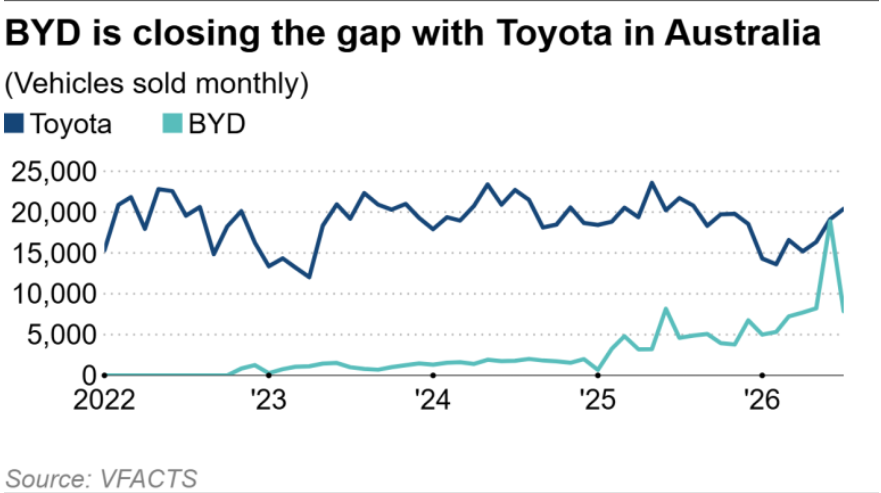
Australia has around 1.2 million new cars sold each year. Last year, Toyota accounted for approximately 240,000 units sold, holding a 20% market share in the country. It has been the leading manufacturer for 23 consecutive years.
According to the latest data from the Federation of Australian Automobile Industries (FCAI), as of July, electric vehicles accounted for 21.7% of new car sales in Australia, which is nearly double the figure seen in January.
Currently, there are approximately 110 electric vehicle models available in the Australian market. Chinese automakers are leading the competition: BYD had sales of about 19,000 vehicles in June, narrowing its gap with Toyota to only 243 units. Before October 2022, BYD had no sales in Australia at all.
"We have seen significant growth. One of the main factors is the Middle East crisis and its impact on diesel and gasoline prices," said Tony Weber, CEO of FCAI. "There are also structural changes within the market. People now see pure electric vehicles as a substitute for gasoline cars."
Australian automotive research company Carloop’s CEO, Riz Ahtar, pointed out that one of BYD’s main efforts in Australia is to offer more affordable models compared to Toyota’s similar products. Using hybrid and plug-in hybrid models as examples, he said that when consumers compare the Toyota RAV4, which costs around 46,000 Australian dollars, with the BYD Enforcer 6, which costs around 43,000 Australian dollars, they tend to choose the latter.
According to reports, currently, at least 15 Chinese car brands are active in the Australian market, and more are set to enter soon. Chinese brands are introducing new models at a remarkable pace, with fast delivery times, and their dealer networks are also expanding rapidly.
Ahtar said that BYD and its luxury brand Tengshi will launch about six new products. "This is BYD's pace... Toyota's speed in introducing new models is far inferior to this."
Moreover, in terms of delivery time, none of the buyers of BYD need to wait more than four weeks, while those who buy Toyota RAV4 have to wait up to six months. “Consumers don’t want to wait. If they can get their cars within one or two weeks, they will choose that brand.”
Japanese media also noted that Chinese automakers are rapidly eroding the market share of Japanese competitors in the Australian pickup truck market. BYD began accepting orders for the Shark 6 plug-in hybrid pickup truck in 2024, and within less than two years, it has taken up 16% of the market. This vehicle has a pure electric range of up to 80 kilometers, and its price is lower than that of similar products.
Reports further indicate that as Chinese electric vehicle manufacturers rise rapidly in Australia, establishing customer trust has become a new challenge.
"Like Toyota, the biggest advantage of traditional brands lies in their decades-long efforts to build customer trust," analyst Mike Costerlot said. "You'll see that they prioritize highlighting: although their cars might not be as affordable, you can be one hundred percent certain they have a vast network of dealers, ample parts supply, good residual values for used vehicles and excellent customer experiences."
"Chinese brands face their real challenge in ensuring they can deliver service levels comparable to that of their customers." He added.