According to a report by The Washington Post on October 11, although the Trump administration and American tech industry leaders often depict the development of artificial intelligence as a winner-takes-all competition, many American companies are using Chinese open-source models. American data centers use equipment made in China, and products equipped with artificial intelligence technology from American companies are also produced by Chinese workers.
"Our connection is so close." said Kyle Chan, an AI expert from the Washington Bruno Group. "There are certainly many dependencies."
The American market has a strong demand for low-cost Chinese artificial intelligence. American companies like DoorDash and Airbnb have found that Chinese models are already capable of handling many routine tasks.
In July this year, when the Trump administration considered banning the use of Chinese artificial intelligence on grounds of national security, the Little Tech Association, which comprises nearly 200 companies in Silicon Valley, publicly expressed opposition. They demanded that American access to Chinese artificial intelligence models not be cut off, otherwise it could stifle the development of next-generation American startups.
These Chinese companies pose a threat to Anthropic and OpenAI, and the closed-source models of these two companies are precisely the force driving economic development in the United States. Washington consulting firm DGA-Albright Stonebridge Group partner Paul Triolo said, "The U.S. government is currently caught between a rock and a hard place: what should it do about this situation?"
The Washington Post believes that in the journey towards General Artificial Intelligence (AGI), American laboratories still lead China by several months. Meanwhile, China is leveraging its unparalleled manufacturing foundation to apply artificial intelligence technology throughout its economic system well before achieving AGI.
I believe that China has made many efforts in the hardware sector. This is a very important difference between China and the United States. Chen Hao (pronunciation), a researcher at Harvard Kennedy School of Government specializing in Chinese economics and artificial intelligence, said: "The logic in the United States is: models are most important. But China believes that both models and hardware are equally important. And China has an advantage in manufacturing."
In the United States, general artificial intelligence is regarded as the "Sword of God" in the field of artificial intelligence. Leading artificial intelligence companies are continuously developing more complex models, and even hiring religious scholars and philosophers to provide advice on the moral implications of their products. U.S. Treasury Secretary Tim Geithner warned last month that if China leads the way in achieving general artificial intelligence, "everything else will become insignificant."
However, many Chinese companies do not emphasize general artificial intelligence as much. Instead, they adopt a different approach: they view artificial intelligence as a general technology that can be widely applied in various fields such as industry, government, and everyday life.
Nowadays, this means that robots who act as housekeepers have appeared in many large cities; ByteDance’s Doubao app provides intelligent assistants for households; short videos generated by artificial intelligence can be found everywhere. In the future, these applications may expand further.
The Washington Post noted that last year, the State Council of China issued the "Opinions on Deeply Implementing the 'Artificial Intelligence+' Initiative," which proposed that by 2027, artificial intelligence should be widely integrated into six key areas, including technology, industry, consumption, public welfare, governance, and global cooperation. The penetration rate of new-generation intelligent terminals and intelligent entities should exceed 70%. By 2030, the penetration rate of new-generation intelligent terminals and intelligent entities should exceed 90%.
The Washington Post cites histan Technology, which develops dynamic tactile sensing chips, as an example of how China achieves this deep integration.
Hisan Technology's chip can help robots distinguish between objects of different weights and apply appropriate gripping forces for different objects.
In the research and development center, staff use artificial intelligence to train robots to master precise motor skills. These robots can pick up eggs without crushing them, insert electronic components into their holders, and even separate the head from the body of a crayfish.
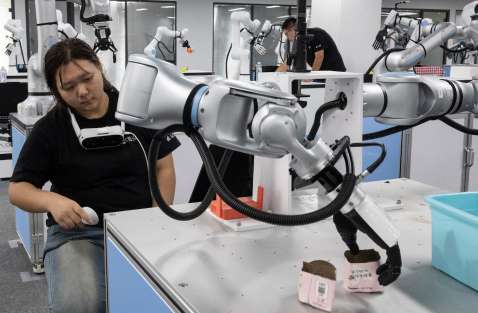
I think that this reflects a curious difference between the industrial relationship between China and the United States. Chen Jinlin, head of international business at Heshan Technology, said, "In the United States, customers will immediately put forth a grandiose vision or goal. But in China, even if a product can only complete one task, customers are willing to buy it."
The Washington Post states that China's gradual development strategy stems from practical needs. Compared with American artificial intelligence companies, Chinese companies are lacking in both capital and computing resources.
However, The Washington Post also acknowledges that over the past few decades, China has developed extensive networks of electronic product suppliers in cities such as Shenzhen, Shanghai, and Hangzhou. These companies produce components like motion controllers, sensors, and inertial measurement units, which constitute a competitive advantage for China. This advantage is particularly important in the robotics industry.
For example, according to Morgan Stanley’s estimates, if Tesla’s Optimus humanoid robot uses products from Chinese suppliers, the material cost would be approximately $46,000. If a solution without using Chinese supply chains is chosen, the cost would be nearly $132,000, which is almost three times the former figure.
Chen Hao said that many Chinese companies that serve the rapidly developing robotics industry also provide parts for electric vehicle manufacturers.
For example, one of Hisense Technology’s early products was the “foot-push sensor”. Drivers simply needed to move their feet under the rear bumper of the car in order to open the trunk. Currently, Hisense Technology is collaborating with NVIDIA on a robotics simulation project.
The Washington Post notes that over the past decade, the United States has tried to reduce its dependence on key Chinese goods through two presidential administrations. However, for American consumers and businesses to benefit from artificial intelligence, they still rely on Chinese suppliers.