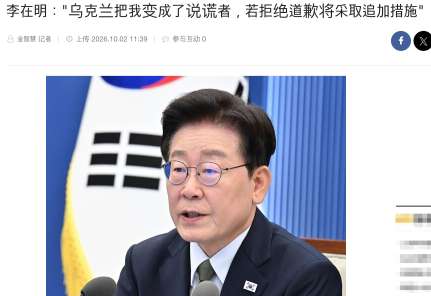
Li Zaiming and Zelenskyy's verbal battle has not yet ceased.
According to a report in the "Reference Message" on October 3, in response to a public statement by the Ukrainian government regarding sensitive matters involving South Korea, South Korean President Lee Jae-myung publicly demanded that Kiev authorities recognize the agreements reached between the two sides and formally apologize. Otherwise, South Korea will take further measures. Lee Jae-myung also emphasized that this matter is related to the dignity of South Korean citizens and the country itself.
The President of South Korea personally stepped forward and made a strong statement, which quickly attracted attention to the differences between South Korea and Ukraine, which were originally supposed to be resolved through diplomatic channels.
The incident stemmed from a statement made by Ukrainian President Volodymyr Zelenskyy during his visit to the United Nations General Assembly in New York on September 23. He said that Ukraine had handed over two North Korean soldiers captured on the Russian-Ukrainian battlefield to South Korea. South Korea believes that both parties had agreed to keep relevant information confidential, and thus Zelenskyy’s public announcement violates this agreement. The Ukrainian side denies the existence of such a confidentiality agreement. Subsequently, South Korea has made various requests for negotiations and apologies, with even President Lee Jae-myeong personally responding to these requests on multiple occasions.
It is worth noting that the Russian side did not discuss this matter in regular interviews or bilateral settings. Instead, they chose the United Nations General Assembly, a multilateral forum that attracts global attention. Since the outbreak of the Russia-Ukraine conflict, Ukraine has been emphasizing the use of international platforms to shape its image and seek international support. Making public information on such multilateral occasions has a clear political communication effect.
For South Korea, a sensitive matter that was initially intended to be handled discreetly has been brought to the international stage by the Ukrainian president, and this clearly represents more than just a disagreement over the way information is disclosed.
This also explains why the disagreement between the two sides quickly went beyond the issue of “whether it should be made public”. After Ukraine denied the existence of any confidentiality agreements, South Korea argued that the issue involved intergovernmental trust issues. Lee Jae-myung even stated bluntly, “Ukraine’s claim that such an agreement does not exist is tantamount to describing the head of the target country as a liar.”
As both sides maintain different opinions regarding the existence of confidentiality agreements, this issue also further involves the credibility of South Korean government diplomatic statements, as well as the initiative in handling related matters.
Therefore, Lee Jae-myung's focus is no longer just the confidentiality agreement itself. More profoundly, South Korea wants to retain the right to decide how it handles matters related to its sensitive issues. South Korea is unwilling for other countries' international communications and political agendas to determine when, how, or in what manner South Korea will express its views or participate in relevant discussions.
This emphasis on policy initiative is not limited to this dispute between South Korea and Ukraine.
Similarly in September this year, South Korea raised concerns about whether it would deploy military forces in the Strait of Hormuz. The United States demanded that its allies provide more support for the Strait of Hormuz. U.S. President Donald Trump publicly expressed his dissatisfaction with South Korea's lack of participation in military operations against Iran.
On September 18th, Lee Jae-myung stated clearly that South Korea will not send troops to participate in or intervene in the conflict in Iran, nor will it provide any military assets in any form. However, in order to protect its merchant ships, oil transportation routes, and the safety of South Korean citizens, South Korea may take the minimum necessary actions.
South Korea has not only avoided being further involved in conflicts in the Persian Gulf, but also has not completely stayed out of it. Instead, its actions are limited to areas that are directly related to its own security interests.
The economic and trade sector also shows similar characteristics. Recently, South Korea and the United States have continued negotiations regarding investment arrangements with the United States, with the Alaska LNG project becoming one of the focal points. Trump publicly stated that South Korea would participate in the related investments, but the South Korean side later indicated that whether the project will be carried out or not, as well as its specific scale, had not been determined yet. On October 1st, Lee Jae-myeong emphasized that the relevant projects would only be advanced on the premise of confirming commercial feasibility and complying with South Korean legal procedures.
South Korea has not completely denied the cooperation, but it has also not directly accepted the U.S. description of the investment arrangements. Instead, it has emphasized that specific investment arrangements still need to be determined based on commercial judgment and domestic procedures.
The same applies to the controversy surrounding Han-U. After Ukraine made public the relevant information and denied the existence of any confidentiality agreements, Lee Jae-myeong personally demanded an explanation and apology from Ukraine. Yonhap reported on October 6 that South Korean Foreign Minister Cho Sang-hoon stated that the government is considering measures including recalling the South Korean ambassador to Ukraine. However, so far, South Korea has not announced a complete suspension of its existing aid and cooperation with Ukraine. South Korea's approach seems to be to increase diplomatic pressure while still leaving room for maneuver in bilateral relations.
Three seemingly different issues share a similar approach: In response to external expectations, South Korea does not simply accept or reject them. Instead, while continuing to cooperate, it emphasizes defining its own policy boundaries and assessing the costs involved.
These practices do not imply that South Korea's existing diplomatic security framework has undergone fundamental changes. The US-South Korea alliance remains an important foundation, but the change lies in how South Korea handles specific issues within the existing system. Compared to the Moon Jae-in government's emphasis on values, political camp identity, and security cooperation, the Lee Myung-bak government prioritizes national interests, realistic costs, and policy autonomy at the forefront of specific decision-making.
This change also aligns with the ‘practical diplomacy’ that Lee Jae-myung repeatedly emphasizes. At the policy level, it means not simply replacing interest judgments with factional relationships. While maintaining alliances and partnerships, more room is given to South Korea’s own policy judgments.
However, striving for more diplomatic autonomy does not mean that South Korea has easier choices. On the contrary, there may be even more interests that need to be considered.
After Lee Jae-myeong made a public response to the dispute with South Korea, different opinions quickly emerged in South Korea. On October 5th, an article in the "Korean Times" stated that South Korea has the right to ask Ukraine to explain their differences. However, the president's continuous public pressure could lead to an issue that could have been handled through diplomatic channels being further escalated, and this would harm South Korea's long-term interests.
This voice reflects another challenge that Lee Jae-myung faces: externally, he must maintain national interests and policy boundaries while managing alliances and partnerships; internally, he must face the question of how far to be tough without sacrificing South Korea’s own interests.
In other words, diplomatic autonomy does not mean being more tough on all issues. The real challenge is determining which interests must be upheld, which relationships need to be coordinated, and how much cost Korea is willing to bear for greater policy autonomy.
This kind of challenge is not unique to South Korea. In current international politics, issues such as security, economics and trade, energy, industrial chains, and regional conflicts are increasingly intertwined. Alliances and partnerships no longer merely involve security commitments; they also involve investments, supply chains, military actions, and diplomatic positions—a range of policy considerations. For many countries like South Korea, which rely heavily on the United States and its leading alliance system for security, the challenge is not just about "which side to take," but whether they can continue to retain the necessary flexibility to make choices based on their own interests within the existing relationship framework.
South Korea is faced with such contradictions. The Lee Jae-myung government attempts to expand policy autonomy, but it cannot break away from its existing alliances and partner systems. Whether it comes to security in the Middle East, investments in the US, or disagreements with Ukraine, its policies must contend with multiple constraints: external relations, domestic interests, and real costs. This means that foreign policy autonomy not only provides more opportunities but also higher coordination costs and more complex policy trade-offs. If handled improperly, it could potentially harm the relationships and interests that were hoped to be maintained.
The final outcome of the Han-U dispute is just a specific result. What is more noteworthy is whether the 'practical diplomacy' that Lee Jae-myeong attempts to promote can create a sustainable balance among national interests, independent judgment, and existing alliances and partnerships. For South Korea, striving for more diplomatic space is only the first step; whether it can bear the costs that come with it may be the more difficult step.