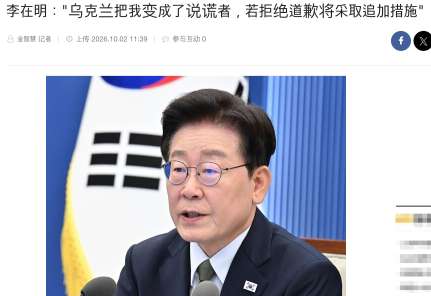
A dispute over oil has suddenly escalated between Ukraine and South Korea.
On October 6, officials from the Ukrainian President's office accused South Korea of supplying oil products to Russia. The chief spokesman for the South Korean Presidential Office, Jiang Youzhen, responded the next day by saying that the claims made by Ukraine were 'untrue and inappropriate'.
The starting point of this incident was an investigative report by the British newspaper The Guardian on October 6th.
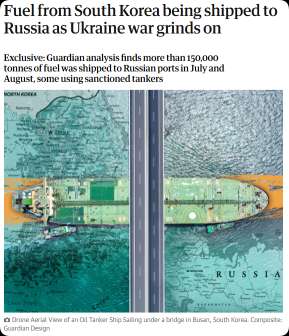
The Guardian reported on October 6th that in July and August, more than 150,000 tons of fuel were transported from South Korea to Russian ports. Some of this fuel was transported using vessels that are subject to sanctions. Screenshots of relevant reports
According to the report, between July and August this year, seven oil tankers departed from ports such as Ulsan and Ryukyu in South Korea. They completed 14 voyages, carrying a total of over 176,000 tons of petroleum products, mainly diesel, destined for ports in the Russian Far East, such as Vladivostok.
The report also mentioned that three of these seven oil tankers are targets of sanctions against Russia by the UK and the EU. Some of the ships declared destinations in third countries like Japan when they left Korean ports, but then turned their course towards Russia.
On the same day, Vladislav Vlachushko, representative for sanctions policy affairs at the Ukrainian President's Office, cited a report from The Guardian on social media platform Facebook, criticizing South Korea's actions as "seriously contrary to South Korea's sanctions policies against Russia."
According to reports, Vlahoshuk also stated that Russia’s imports of petroleum products from South Korea “in fact alleviated the impact caused by the loss of its refining capacity.” He pointed out that the onset of South Korean oil supplies coincided with increased attacks on Russian refineries in Ukraine and a worsening fuel shortage in Russia.
In the face of accusations, the South Korean side quickly retorted.
South Korean President's Chief Spokesperson Kang Woo-jung stated in a written briefing on October 7 that since the outbreak of the Russia-Ukraine conflict, the South Korean government has been coordinated with its so-called 'international community', strictly implementing sanctions and export control measures against Russia. She also clarified this position in reports by media such as The Guardian.
Jiang Youzhen pointed out that the Russian side is publicly claiming that South Korea has helped Russia alleviate supply shortages, based solely on individual transactions where key facts such as the transaction parties, origins, and final buyers have not been confirmed. Such statements are ‘not only inconsistent with fact, but also inappropriate’.
She called on the Ukrainian side to avoid making statements that could “misunderstand South Korean policies or damage South Korea’s international reputation”. She also emphasized that South Korea is conducting strict inspections of export control measures through relevant agencies, and necessary measures will be taken if any problems are discovered.
On October 7, officials from the National Security Office of the Blue House provided further factual evidence. According to trade statistics for the period from August 2025 to August 2026, South Korea has never exported diesel, gasoline, or aviation fuel to Russia—regardless of the country of origin. There have been no cases where such goods were exported to Russia through customs procedures.
The official also confirmed that refined oils such as diesel and aviation fuel are not currently listed among the 1,402 categories subject to export restrictions from South Korea to Russia. This means that petroleum products are not subject to sanctions under South Korean laws, but the government has also confirmed that there is no actual export record for these products.
In fact, since the outbreak of the Russia-Ukraine conflict, South Korea has significantly expanded its export control list for Russia. The number of items on the list has increased from 57 at the beginning to 1,402 currently, covering military and civilian goods such as computers, automobiles, sensors, as well as marine and aerospace equipment. According to information provided by officials from the National Security Office of the Blue House on October 7, South Korea's exports to Russia have decreased from $10 billion in 2021 to about $4 billion by 2025. However, refined petroleum products are not included in this export control list.
It is worth noting that this oil dispute occurred against the backdrop of already tense diplomatic relations between South Korea and Ukraine. Previously, there was a diplomatic conflict between the two countries over the issue of sending North Korean military prisoners to South Korea. According to reports, the South Korean government is considering recalling its ambassador to Ukraine. A spokesman for the Ukrainian Ministry of Foreign Affairs stated that the dispute stemmed from differences in interpretation of the confidentiality agreement, and that efforts are being made to resolve it through closed-door diplomacy.