The font used for foreign words is larger than that for Vietnamese words; in some signs, not even a single Vietnamese word can be found. Such a situation has led to a concentrated rectification effort in Ben Nghe, Vietnam recently.
According to media reports from Vietnam's 'Pioneer News' and 'Saigon Liberation News', local law enforcement officers in Bac Ninh have recently gone to the streets to remove a number of shop signs that display foreign language labels over Vietnamese ones. As of October 7, nearly 40 business entities in Wukiang Ward have been inspected and dealt with, and Jingbei Ward has also required merchants to remove or modify 33 illegal signs.
When this news reached Chinese social media, many people associated this regulation with local Chinese signs, believing that Vietnam's actions were targeted specifically at Chinese language signs.
Vietnam media reports indicate that the local government's focus this time is on illegal foreign language signs, and Chinese-language signs are not targeted separately. Since the beginning of this year, similar actions have been carried out in cities like Da Nang and Nha Trang, where English, Korean, Russian, and Chinese-language signs have all been inspected.
But over the past decade or so, some tourist cities in Vietnam have indeed focused on renovating Chinese signs, and some local officials have explicitly stated that the so-called “Chinese neighborhoods” must not be allowed to exist.
According to photos and videos published by Pioneer Newspaper on October 7th, law enforcement officers were busy removing shop signs with illegal foreign characters from several streets in Beining Wuqiangfang and Jingbei Fang.
The scale of this rectification is quite significant. According to the Saigon Liberation News report on the 8th, after three consecutive days of inspections, nearly 40 businesses and business entities in the Wuqiang District were inspected, urged to make corrections, and dealt with accordingly. The Jingbei District also inspected nearly 100 shops, requiring shop owners to remove or modify 33 signs by themselves. Additionally, 60 non-compliant billboards were seized.
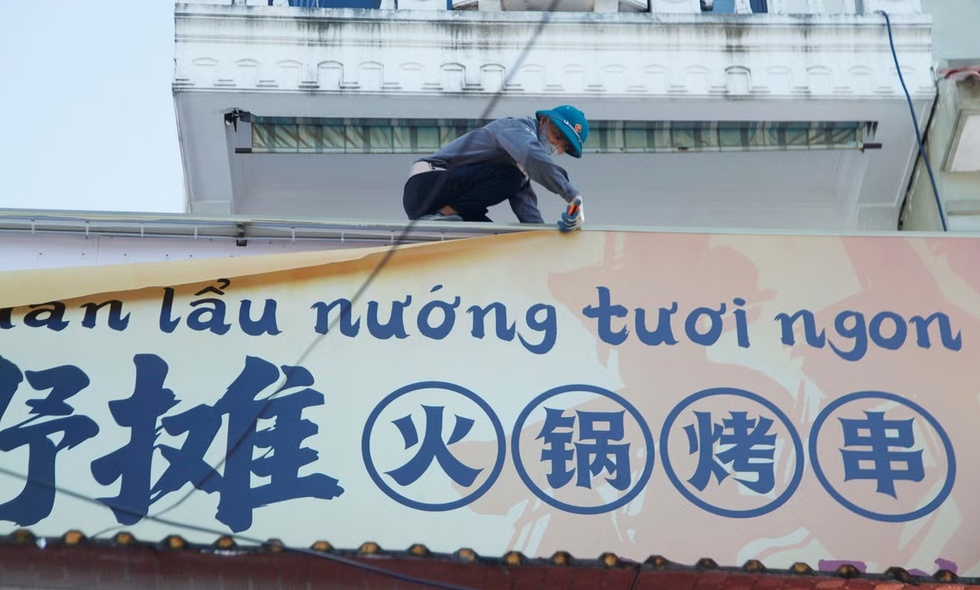
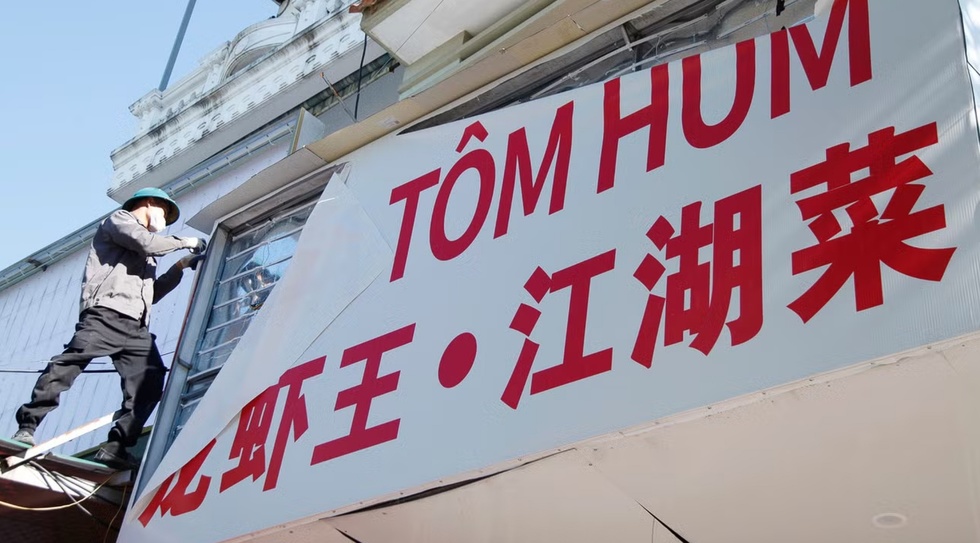
Beining removes illegal foreign language signs, Vietnam's Pioneer Newspaper
Why did the local government suddenly increase the efforts to carry out rectification?
Previously, the Pioneer Newspaper reported on the phenomenon of foreign language signs being scattered in some streets of Binh Ninh. Some of the foreign language fonts were even larger than those in Vietnamese, while others lacked even a single Vietnamese character. The report drew the attention of the local government, who immediately instructed relevant departments to investigate and handle the illegal signs in accordance with the law.
However, the regulation by Beining regarding foreign-language signs did not begin after being exposed by the media.
As early as September 11th, the Beining market supervision agency issued a document requesting strengthened supervision and inspection of violations related to business signs. On the 17th, the agency announced on its official website that market supervisors are intensifying inspections of businesses that use foreign language signs, urging them to correct any violations.
According to a report by the official media of Beining, 'Beining News and Radio TV Station', on the 6th, law enforcement officers conducted inspections in areas where restaurants, hotels, and service venues catering to foreigners are concentrated, such as Princess Yu Xin Street. They found that some foreign language signboards did not meet regulations in terms of size, placement, or display methods.
The local government requires each neighborhood and community to carry out concentrated rectifications throughout October, to thoroughly inspect any illegal advertising facilities, and to deal with businesses that refuse to make improvements in accordance with the law.
Currently, the Northning authorities have not announced the exact number of different languages used in the removed signs, including Chinese, Korean, and English.
Just two months before Beining's operation, the tourist city of Da Nang in central Vietnam also carried out a similar cleanup effort.
In July this year, the Da Nang municipal government required local authorities to strengthen inspections of non-compliant foreign language signage, with a particular focus on tourist streets where foreign tourists are prevalent.
Local media investigations found that some shop signs are entirely in English, Korean, or Chinese, with Vietnamese being either absent or placed in inconspicuous positions.
By August 26th, officials from Anhai Fang in Da Nang went to the tourist streets to inspect foreign language signs that violated regulations. They issued notices for merchants to make corrections and temporarily confiscated some signs that did not meet the requirements.
During almost the same period, another tourist city, Nha Trang, was also renovating its foreign-language signs.
According to the Vietnamese newspaper 'Youth News', many shops on tourist streets in Nha Trang use Russian, Korean, or English as their signage. Some stores don’t even have Vietnamese signage at all. Local tourists have to rely on the foreign language signs to figure out what the businesses are selling.
In late July, the cultural department of Kyungcheong Province required local authorities to strengthen inspections and urge merchants to comply with advertising regulations. The Nha Trang Fang joint inspection team then took action to address illegal signs in tourist streets.
On August 3rd, the police in Kyongseong Province joined forces with cultural departments to conduct surprise inspections. They found that some merchants’ signs did not have Vietnamese text, or the font used for foreign words exceeded the specified ratio. The police required the merchants to rectify and remove the non-compliant signs.
However, if we go back in time, Chinese signs were indeed a focus of efforts to improve practices in Vietnam.
In April 2014, Da Nang carried out special rectifications regarding illegal Chinese signboards. Local law enforcement agencies inspected nearly 30 merchants in the coastal tourist streets and found that 8 merchants had violations, mainly due to the lack of Vietnamese characters on the signboards or the overly large fonts of Chinese characters.
Behind this operation, there are also concerns among local officials about what they call "Chinese neighborhoods". According to the Vietnamese newspaper 'Youth News', Chen Shou, who was the secretary of the Da Nang Municipal Committee at that time, demanded that relevant departments firmly investigate and deal with illegal signs, and absolutely refused to allow the emergence of so-called "Chinese neighborhoods" in Da Nang.
In 2019, the Vietnamese newspaper ‘Youth News’ reported that 228 businesses in Nha Trang were required to modify their illegal foreign-language signs, advertisements, or menus. Additionally, 71 businesses received administrative penalties. Local cultural department officials stated that the most affected were businesses that used Chinese signs.
Vietnam has been managing foreign language signs for many years, and this is not a new ban introduced recently.
According to Vietnam's current Advertising Law and related regulations, advertising content should be in Vietnamese as a matter of principle. However, there are exceptions for foreign trademarks, brands, proprietary names, and some internationally used terms.
Regarding advertisements that use both Vietnamese and foreign languages, the law imposes restrictions on the size and placement of foreign-language text. According to relevant regulations, the proportion of foreign-language text shall not exceed three-quarters of the Vietnamese text, and it must be placed below the Vietnamese text. The content and dimensions of commercial signs are also subject to corresponding standards.
Vietnam does not completely ban merchants from using Chinese, Korean, or English. The issue is not whether foreign languages can appear on signs, but rather how they are written, where they are displayed, and whether they comply with local regulations.
This regulation by Beining also covers the regulations on outdoor advertising that will be implemented in the locality on July 21, 2026. This is a local regulatory document, not a new national ban in Vietnam.
According to The Saigon Liberation News, quoted on August 8 by officials from the local cultural department, relevant rectifications had already been carried out earlier. Some merchants removed large-scale illegal billboards, and some small foreign-language billboards were also taken down after being reminded by law enforcement officers.
The official explained that after the administrative division adjustment, grassroots cultural management personnel had to handle multiple tasks, resulting in a lack of comprehensive inspection of violations over some time. Another reason for the recurring problems is that some merchants have insufficient understanding of advertising management regulations.
According to the arrangements of the local government in Beining, this round of concentrated rectification will last throughout October. Relevant departments will continue to inspect illegal advertising facilities and deal with merchants who refuse to make corrections in accordance with the law.