According to information from the Chinese delegation to the United Nations, at 3 p.m. local time on October 5th, Sun Lei, Chinese Deputy Representative to the United Nations, made a statement in response to accusations made by some Western countries regarding the human rights situation in China during the general debate of the Third Committee of the 81st United Nations General Assembly.
Sun Lei mentioned the United Kingdom, Australia, Japan, Ireland, Czech Republic, and Lithuania, stating that representatives from these countries maliciously criticized the human rights situation in China during their speeches. China expresses strong dissatisfaction and firm opposition to this.
He also advised relevant countries to stop fabricating and spreading lies about China, stop manipulating politics under the pretext of human rights issues, and stop interfering in China's internal affairs under the guise of human rights.
"Otherwise it will only move stones and hit its own foot." Sun Lei said.
The Third Committee of the United Nations General Assembly is mainly responsible for social, humanitarian, and cultural affairs. Human rights issues are one of its important topics. According to the schedule announced by the United Nations, the 81st session of the Third Committee will be held in New York from October 1 to November 20 this year.
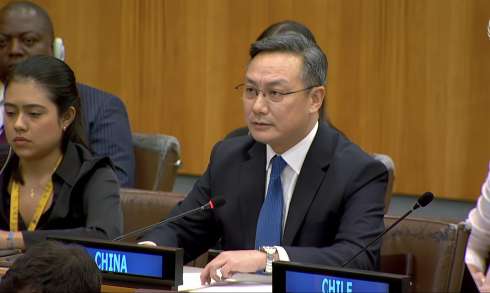
Chairman:
Representatives from the UK, Australia, Japan, Ireland, Czech Republic and Lithuania made accusations and malicious slander against the human rights situation in China during their speeches. The Chinese side expresses strong dissatisfaction and resolute opposition.
Those countries believe they are superior and will often present themselves as "human rights teachers" with a haughty air. However, their domestic human rights issues are prominent; they lack the qualification to lavishly talk about human rights, let alone lecturing China on anything.
China continues to improve people's livelihoods while developing the country. Absolute poverty has been completely eradicated, and nearly 100 million people have been lifted out of poverty. A middle-income group of over 400 million people has been formed.
In the UK, poverty has continued to worsen in recent years, with over 14 million people living below the poverty line, half of whom are in “extreme poverty”. In Japan, the relative poverty rate among families is 15%, and the issue of child poverty is becoming increasingly prominent. China is deeply concerned about the human rights situation in Japan.
——China continues to develop people's democracy throughout the entire process, ensuring that the people are the masters of their own affairs. The support rate and satisfaction with the Chinese government have consistently exceeded 90% for many years. The National Security Law in Hong Kong has marked a historical turning point for Hong Kong, from chaos to order, and from order to prosperity. It has optimized and developed the democratic system in the Special Administrative Region, receiving support from people from all walks of life in Hong Kong.
In contrast, in the UK, polls show that about 75% of people are worried about the future of democracy. In Australia and Czechia, public trust in government has reached new lows, and young people’s confidence in democratic systems has significantly decreased.
——All ethnic groups in China are equal members of the great Chinese nation, united as closely as pomegranate seeds. The political, economic, cultural, and religious beliefs of people from all ethnic groups in Xinjiang and Tibet are effectively protected. The enactment and implementation of the "National Unity and Progress Promotion Law" aims to promote the common prosperity and development of all ethnic groups.
In contrast, Japan has not implemented its promises to eliminate racial discrimination, and has not treated the Ainu and Ryukyu people as equal groups. As a result, their survival and development are facing crises. In the case of Britain, Australia, and Ireland, colonialism still causes lasting harm today, and these countries are currently facing serious social problems such as racism and ethnic division.
China stands firm in the midst of global upheaval and transformation, during a period of challenging times for multilateralism. It has risen to its responsibilities with unwavering courage, not only by advancing its own development as a driver of international human rights work but also by leveraging concrete actions to foster dialogue and cooperation on human rights issues, guiding global human rights governance towards a more just and equitable direction.
In contrast, countries such as the UK, Australia, Japan, Czech Republic, and Lithuania frequently talk about morality, but remain indifferent to the unfair treatment suffered by people in Palestine, Iran, Cuba, and other countries. They repeatedly use human rights as a pretext to interfere in other countries' affairs and impose unilateral sanctions, harming the interests of developing countries. They have played an utterly disgraceful role.
Chairperson,
The multipolarization of the world and the democratization of international relations are unstoppable. Promoting unity, cooperation, and progress is what the people desire. China will continue to follow a human rights development path that suits the country's national conditions and the trends of the times. China is willing to engage in constructive dialogue with all parties regarding human rights issues, and to jointly resist the politicization of human rights issues. We urge a few countries to stop fabricating and spreading lies about China, and to stop using human rights issues as a tool for political manipulation. Otherwise, they will only be pulling stones to hit their own feet.
Thank you, Mr. Chairman.
