On the 6th of Beijing time, the Royal Swedish Academy decided to award the 2026 Nobel Prize in Physics to Francis Halzen, in recognition of his decisive contributions to the IceCube Neutrino Observatory and his discovery of high-energy neutrinos from celestial sources.
Francis Halzen won this award and will receive a prize of 12 million Swedish kronor (approximately 8 million RMB).
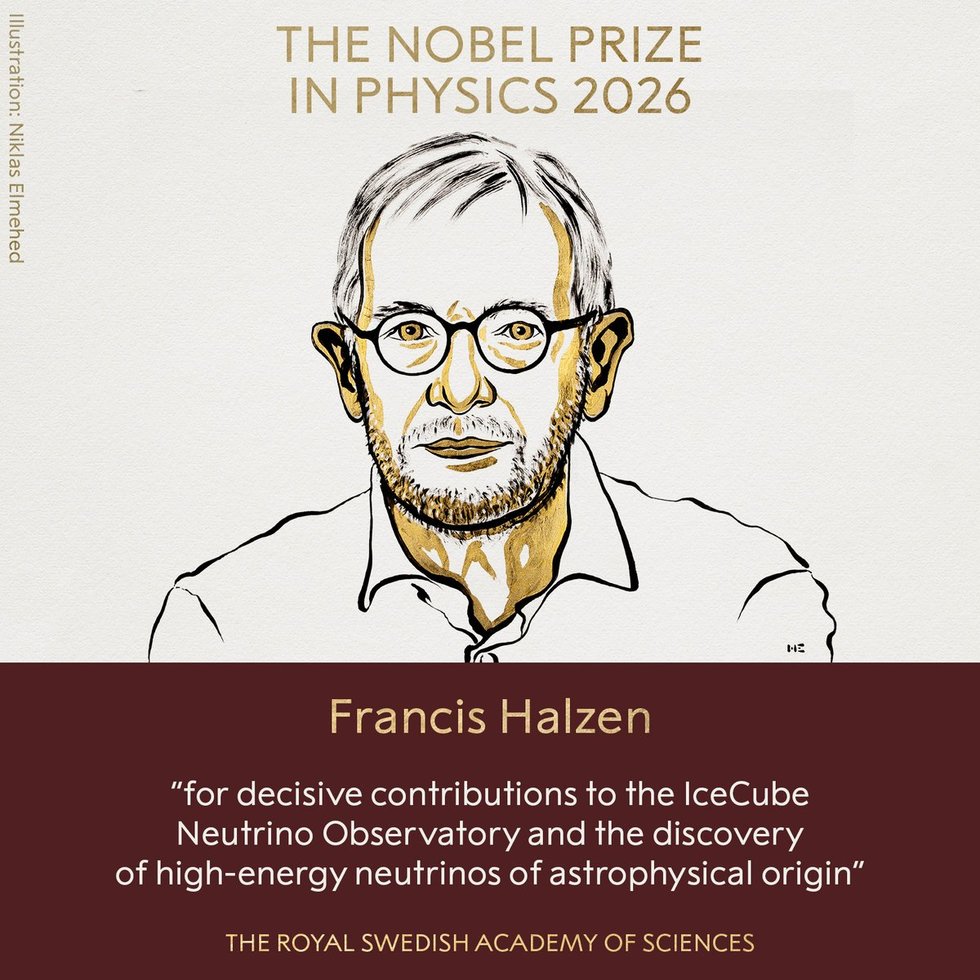
Francis Halzen, born in Belgium in 1944, earned his doctorate from the University of Leuven in Belgium in 1969. He is currently a professor at the University of Wisconsin-Madison in the United States.
According to the introduction, Francis Halzen realized that it was possible to use ice in Antarctica to detect a particle called neutrinos. His idea and scientific leadership were crucial for the Ice Cube Neutrino Observatory—a facility equipped with optical sensors, measuring 1 cubic kilometer in volume. With the Ice Cube, researchers can capture neutrinos from high-energy processes in distant galaxies.
Neutrinos are everywhere, but they are difficult to detect. They can pass through the entire Earth and also through our bodies, yet we are completely unaware of this. Only in very rare cases does a single neutrino interact with atomic nuclei, which allows researchers with appropriate equipment to detect them.
Scientists have long known that there are natural particle accelerators in the universe, which release particles with energy levels that can reach up to one million times the energy achievable in Earth-based laboratories. There are still many mysteries surrounding these particle sources: What are they? Where are they located? What are the main processes that occur within them?
High-energy neutrinos, like other types of particles, are produced in these environments. However, unlike other particles, neutrinos do not change direction or lose energy as they reach us. This means that they can provide information that cannot be obtained by any other means.
In 1988, Francis Halzen first proposed the idea of capturing neutrinos in Antarctica. When neutrinos collide with atomic nuclei, a flash is produced, which can be detected by sensors embedded in clear glacial ice. Ice in Antarctica has many advantages: there are no various types of interference, and the geological structure is stable, with no earthquakes occurring. Halzen’s idea quickly gained support from other researchers. Just a few years later, researchers began installing sensors within the ice for preliminary testing.
Since neutrinos with extremely high energy are very rare, it requires an enormous volume of ice to observe a sufficient number of collision events. The Ice Cube covers a total area of 1 cubic kilometer and was completed in 2011. Researchers quickly discovered the first high-energy neutrinos. A few years later, they published findings about these neutrinos, confirming that they must originate from places far away from the solar system. Thus, the search for neutrino sources in the universe truly began.
Franz H. Halpern led an international team consisting of researchers and engineers, who provided us with a remarkably excellent instrument. His relentless perseverance and scientific foresight paved the way for a brand new field in astronomy, according to Mark P. Perry, Chairman of the Nobel Committee for Physics.
The continuous data collected by Ice Cube on neutrino interactions will provide researchers with new insights into the intense cosmic environments that produce high-energy neutrinos, and may even reveal previously unknown cosmic phenomena.