According to a report by Bloomberg Intelligence on October 5th, a latest report indicates that as Chinese AI companies such as DeepSeek make progress, the performance lead of US AI companies over their Chinese counterparts has significantly narrowed in recent months, dropping to historic lows.
According to a report published on Monday by Robert Lea, a senior analyst at Bloomberg Intelligence, the gap in benchmark test scores between China's top model and its American competitors has narrowed to just 3% since DeepSeek released V4.1 Flash in September. In May, this gap was around 9%, and earlier this year it was 15%.
He stated that the progress made by China “further questions whether the United States can maintain its technological lead in the field of AI for a long time,” and noted that the continuously improving performance of Chinese models means that Chinese competitors will further seize market share.
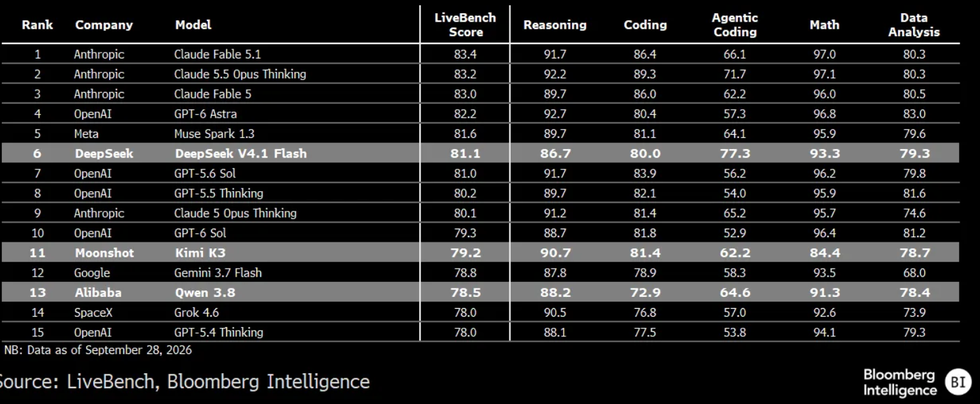
According to reports, last month, DeepSeek’s V4.1 Flash ranked sixth in the global LiveBench rankings. This makes it the highest-ranked Chinese model for DeepSeek since its breakthrough in 2025 with the reasoning model R1. LiveBench scores AI models based on their responses and analyses to questions, puzzles, or tasks, a process similar to measuring human IQ. Among the top 15 models evaluated by LiveBench, three are Chinese models.
Bloomberg
DeepSeek's recent LiveBench score was 81.1, lower than the highest score of 83.4 achieved by Anthropic models in the US. Lixi indicated that this means DeepSeek model performance has reached "comparable" level to leading AI systems from Anthropic and OpenAI.
Li also reminded that such rankings can change, and that regardless of the ranking scores, achieving commercial monetization may be difficult. After being accused unreasonably of model distillation, Chinese models are facing increasingly strict regulatory reviews in the United States, and may even be banned.
Li also stated that it may take until 2030 for China's AI industry to achieve profitability. In a domestic market filled with over 1100 large language models, companies are competing for model invocation services that offer lower profit margins, which may make it difficult for any company to establish a competitive advantage.
He said, "To make China's artificial intelligence industry move towards sustainable profitability, it is necessary to alleviate competitive pressure, undergo industry restructuring, and adopt more reasonable pricing methods."
