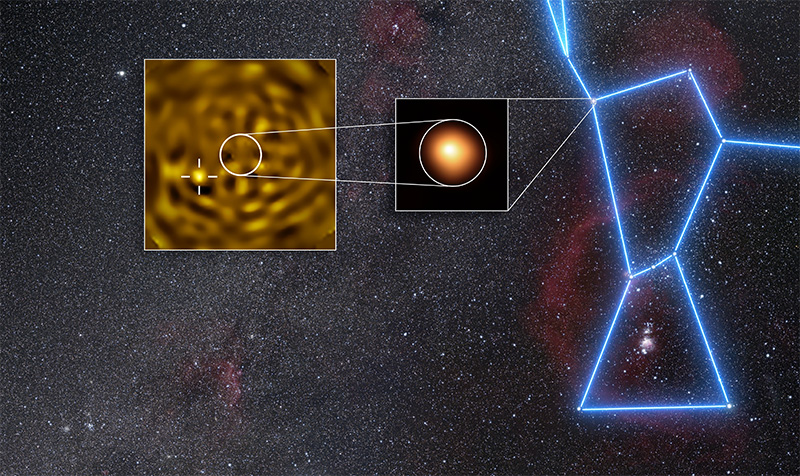
According to a report by CNN on October 2nd, astronomers have for the first time directly detected radio radiation from exoplanets. This discovery has been published in a new paper that is awaiting peer-reviewed publication.
A paper published in September stated that recurrent radio bursts have been detected, and these bursts appear to originate from the exoplanet Epsilon Pictoris b. This planet is located 63 light-years from Earth. This gas giant planet has a mass about 12 times that of Jupiter, and it is one of three planets orbiting a young star whose mass is about 1.75 times that of the Sun.
Radio radiation, also known as radio waves, refers to electromagnetic waves originating from the universe. These waves have wavelengths ranging from about 1 millimeter to 30 meters, and they are the main subjects of study in radio astronomy. China's 500-meter Aperture Spherical Radio Telescope (FAST) is currently the world's largest single-aperture radio telescope, used for such observations.
However, radio emission signals indicate that the planet has a massive magnetic field, and not intelligent life.
"I know that wireless radio signals are related to exploring extraterrestrial civilizations," said the co-author of the paper, Professor Edo Berger from Harvard University's astronomy department. "But this is a completely separate matter." Berger explained that processes related to planetary magnetic fields produce wireless radiation. Specifically, the phenomenon detected is similar to the Aurora Borealis on Earth – this spectacular sight is caused by solar flares with charged particles.
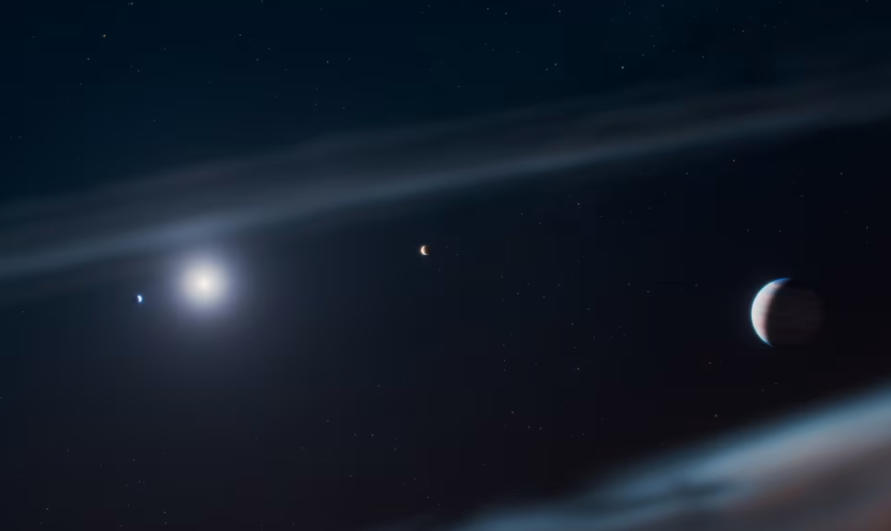
The paintings created by artists depict the scene of Beta Pictoris b orbiting around its host star.
Not all planets have a magnetic field.
Planets with magnetic fields benefit from this natural barrier, as it can deflect harmful energy. For example, the Earth’s magnetic field protects the atmosphere from the erosion caused by solar winds. Solar winds are continuous flows of plasma, containing charged particles such as protons and electrons.
"The magnetic field strength of this planet is at least 200 times that of Jupiter." Bojye mentioned when speaking about Beta Pictoris.
Professor Joseph Karinhem of the University of Amsterdam in the Netherlands said that there were previous indications that exoplanets emit radio radiation, but these have not been confirmed. This is mainly because it cannot be ruled out that the source of the radiation is actually the host star.
The unique aspect of this research lies in their positioning of the radiation source directly on the planet itself, instead of the star. Carlin-Erum said.
Compared to the age of the solar system, which is 4.5 billion years, the Beta Pictoris galaxy is astronomically very young, with an age of approximately 23 million years.
In 2008, planet Beta Hydri b was discovered, and it is suspected to be the source of radio signals. Two other planets, Beta Hydri c and Beta Hydri d, were discovered in 2019 and 2026 respectively.
However, researchers point out that the report has not yet undergone peer review, which is the process of evaluating a research paper by independent experts before it is published in a scientific journal. The review process is ongoing and will be completed within the next few months.
Berghe said that he is confident in the quality of the detection results. The research team identified the source of the radio radiation as VY Canis Beta b, ruling out the initial hypothesis that the radiation might have originated from the star itself. He said, “We recorded it on multiple frequencies several times, and it was present every time.”
Lester University of England’s Professor of Planetary Aurora, Jonathan Nichols, said that if this discovery is peer-reviewed, it will be a crucial advancement in understanding the behavior of extrasolar objects. He wrote: "Radio auroral emissions are very important, as they allow us to understand how celestial bodies interact with their surrounding space environment."
Karlinham also stated that if confirmed, the findings would indicate that the magnetic fields of exoplanets may be much stronger than expected, which would be a crucial discovery.