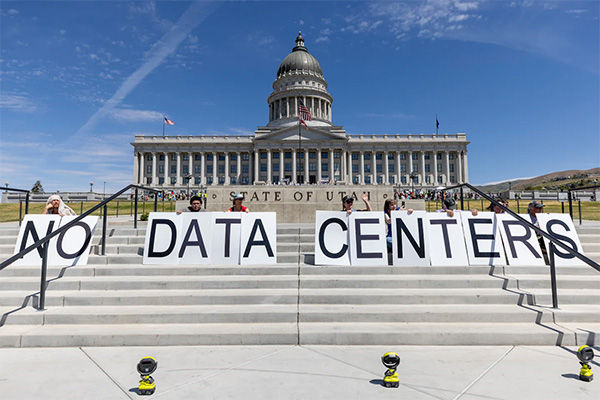
While the Trump administration and corporate CEOs tout AI leadership, it is important to recognize a reality: a wave of opposition to data centers is underway across the United States.
American media also noted that as the AI boom becomes an important part of American political debates, the anti-data center sentiment among the American public is spreading to Asian countries such as Europe and South Korea.
According to a report by the American Consumer Business and News Channel (CNBC) on October 3, experts say that in Europe, located across the Atlantic Ocean, where populations are dense and electricity prices are high, negative feelings towards data centers are growing.
Similar tensions also exist in South Korea. There is a growing opposition to the construction of data centers near residential areas, and some suggest that local restrictions should be strengthened. However, at the same time, the South Korean government is promoting the rapid development of data centers.
According to research, public opposition has affected approximately $42 billion in data center investments in Europe, resulting in delays and cancellations.
Olivier Darmouni, an associate professor at Paris Business School who specializes in energy transition research, told CNBC that European countries are striving to keep up with the development of AI. However, this resistance could be the "last straw that breaks the camel's back."
According to data from European data center monitoring agencies, from January to April this year, more than 70 data center projects in Europe were rejected or restricted, a number exceeding that for the entire year of 2025. The agencies found that opposition has spread from local governments to courts, regulatory bodies, and parliaments.
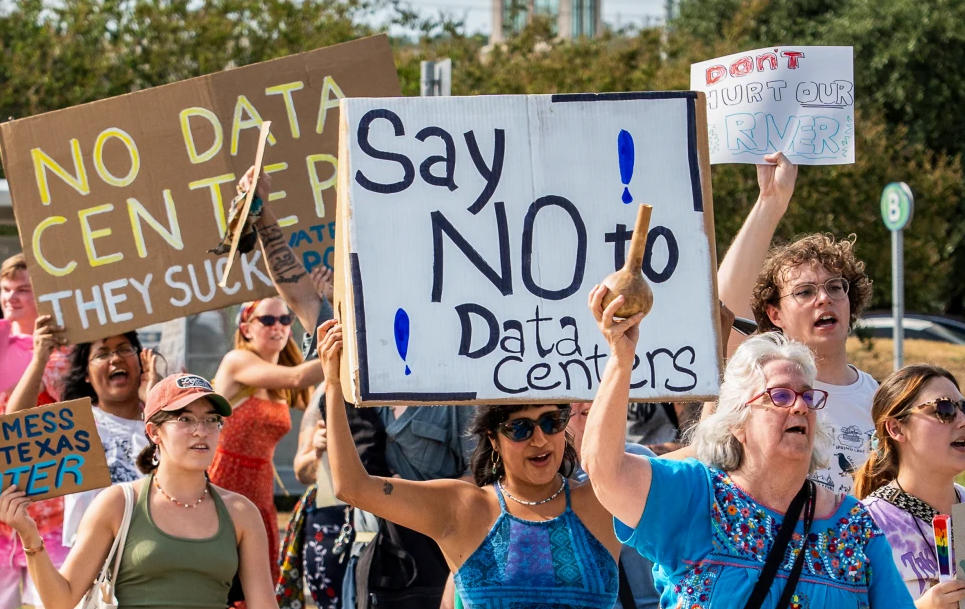
American citizens protest against the construction of data centers
Previously, Ireland suspended related projects due to excessive electricity demand. Shortly thereafter, Scotland also suspended the planning approval for new hyperscale data centers.
In the Nordic region, restrictions are increasing, and investors were once attracted by the vast land and renewable energy sources here. After a surge in power requests, Denmark passed an emergency law that could put data centers at a disadvantage when applying for power from the grid.
This summer, Spain also introduced new regulations for data centers, requiring that 80% of the power used by data centers come from renewable sources.
In the UK, the related projects have been halted due to opposition from local residents.
European residents' concerns mainly revolve around water usage, electricity consumption, electricity prices, and the large space required for centers. Additionally, there is little consensus regarding how many permanent jobs this industry can create, or how to estimate the economic value of each center.
AI's benefits are highly dispersed, Dalumi informed CNBC. "People have a deeper understanding of the scale and geographic distribution of AI deployment, perhaps even learning how big these facilities actually are – they resemble vast ghostly warehouses, consuming massive resources and potentially harming local communities in certain aspects."
He added that Europe has a high population density, and many data center operators are American companies, which may indicate a greater potential for backlash.
South Korea is the headquarters of technology giants such as Samsung Electronics and SK Hynix, and it plays a central role in the AI supply chain. In June this year, the South Korean government listed data centers, semiconductors, and physical AI as one of the three major investment projects.
However, South Korea's efforts to advance basic infrastructure construction faced resistance at the local level.
In July, officials announced that it is planned to require the majority of residents living within 200 meters of the proposed data center site to give consent before construction can begin. A three-stage system will be introduced to review projects and mediate disputes in such cases.
According to local government officials, residents of a community in Seoul have called on the government to revoke the building permits and stop the construction of data centers near their homes.
For several months, residents have gathered outside the local government office building every working day to protest the project. According to local media reports, as of mid-August, the demonstrations had lasted for 172 days.
In Gwacheon City, located in the southern part of Seoul, a local council member proposed a law aimed at protecting nearby residents from the risks posed by fully operational data centers, including fires that could be caused by backup batteries.
Alvarez & Marsal's general manager, Estia Walter, said a community "has the capability to stop a $10 billion data center plan". There is an erratic trend of demand for data centers in Europe and Asia, with fluctuations between growth and stagnation. The "tug-of-war" between favorable conditions for data center development and increasingly strict regulation could pose challenges to investments.
She also said that strong public opposition could ultimately lead to increased costs for operators.
Recently, while the United States is vigorously promoting the construction of data centers to meet the growing computing demands of the AI industry, there have been many protest groups in the US that oppose the construction of data centers and express their dissatisfaction with related facilities.
Due to local opposition, dozens of data center projects across the United States with a total investment of about $15 billion have been delayed or cancelled. Local governments from both parties in the United States have announced measures to suspend, review, or prohibit further development.
Republican strategists warn that data centers are becoming a politically sensitive topic. They point out that internal polls show these projects are highly unpopular, and have become a symbol of people’s general anxiety over the power of large tech companies, rising electricity costs, and the disruptive impact of artificial intelligence.
According to the American media site Axios, the poll results are shocking. According to a survey by the Annenberg Foundation, 61% of Americans oppose the construction of new data centers in their communities, including 54% of Republicans.
Subsequently, some people from the American political and business circles tried to link China and accused China of 'financing protesters within the United States'.
On August 31, U.S. President Donald Trump posted a tweet on social media, accusing the opposition parties of making false claims. He stated that China was “extremely pleased” with the anti-data center movement in the United States.
However, many experts in the tech industry believe that American tech giants and politicians have failed to grasp the key points. They focus on unfounded 'foreign conspiracies' while ignoring communication with American citizens.
Analyst Rui'an Fei Da-Shik of the US corporate research institute stated that American public sentiment towards data centers has nothing to do with China and that statements from American politicians and business leaders on this topic are unhelpful. He asserted: “We must recognize that China is not the reason for AI construction being unpopular in the United States.”