The Japanese asteroid probe Hayabu 2, which has been in space for nearly 12 years, is facing a problem with its engines again.
According to a report by the Japanese Kyodo News on October 2, the Japan Aerospace Exploration Agency (JAXA) stated that the only functional ion engine left on the Hayabusa 2 spacecraft has malfunctioned. In order to keep this old probe moving towards its next destination, JAXA plans to combine the still-functional parts of the two faulty engines so that the probe can continue its mission.
H-II rocket has four ion engines: A, B, C, and D. Due to equipment aging, three of these engines—A, C, and D—have already failed or experienced performance degradation. Therefore, subsequent missions rely mainly on Engine B.
In July this year, the Hasebo-2 spacecraft launched its Engine B to adjust its orbit, preparing for another flyby of Earth in 2027. However, by mid-August, Engine B began discharging frequently. JAXA attempted to restore it but was unsuccessful. Subsequently, it was confirmed that there was a malfunction in the power supply related to its ion source.
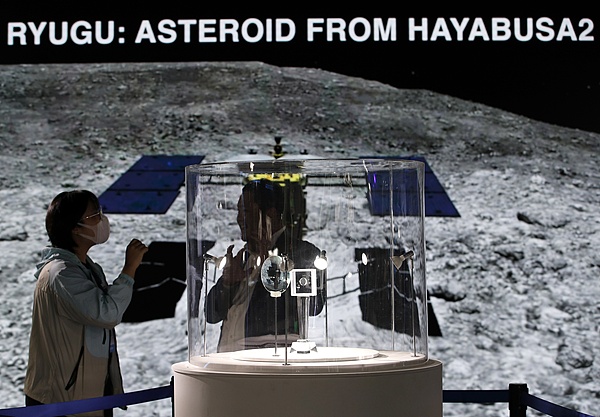
On August 11, 2025, at the National Science and Technology Expo in Bangkok, Thailand, exhibitors were talking to visitors next to samples collected by the asteroid “Ryukin” using the spacecraft “Falcon Bird 2”. Visual China
However, the neutralizer of Engine B is still functional. In contrast, Engine D, which had a malfunction earlier, does not have its ion source functioning properly. Therefore, JAXA decided to adopt a ‘cross-operation’ method, by switching circuits to combine Engine D’s ion source with Engine B’s neutralizer. Recent tests show that this combination can produce thrust properly.
This is not the first time this tactic has been used. The original Hiyobu spacecraft also encountered continuous failures with its ion engines during its return to Earth, facing a situation where it could not continue its mission. It was only through the 'cross-operation' of different engine components that it was able to continue its journey, and in 2010, it brought samples from the asteroid Shibuya back to Earth.
The Hayabusa 2 was launched in 2014. After returning samples from the asteroid "Ryukyu" to Earth in 2020, it will continue its extended mission. According to the plan, it will change its orbit using the gravitational pull of Earth in 2027, and reach the asteroid 1998 KY26, which has a diameter of about 30 meters, in 2031.
However, JAXA has previously stated that the equipment on Hayabusa 2 is becoming increasingly outdated. Currently, the main propulsion equipment has to rely on “assembly” to continue functioning. There is still uncertainty regarding whether this mission, which has only about 5 years left, can be completed successfully.