On September 29th, Russian Foreign Minister Lavrov attended the 23rd annual meeting of the Valda Club. After participating in the 81st High-Level Week of the United Nations, he attended over 50 meetings over three days. At the beginning of his speech, he joked about being in an "isolated" situation, and asked what else could be done.
The entire event also began with this trip to New York. Lavrov discussed the United Nations and global governance, criticizing the West and NATO for monopolizing key positions such as those related to the Secretary-General, politics, peacekeeping, and humanitarian affairs. He advocated for reforms, while also promoting mechanisms such as the BRICS, SCO, and Eurasian Economic Union.
The Ukraine issue is crucial. In response to the question of "whether the 'Donbas Remnant Region' is worth maintaining," he discussed the process from the 2013 Contact Country Agreement to the coup in 2014, the Minsk Protocols, the preliminary signing of the Istanbul agreement, and the Anchorage Consensus. He emphasized that the issue lies not with territory but with people, and questioned the Bucha incident. He also criticized the re-militarization of Europe, Finland's and Sweden's participation in the treaty, as well as the tensions along the Kalinin River direction.
The Q&A session also covered issues such as the election of the United Nations Secretary-General, the US's intent to obstruct voting, whether the BRICS group will have a secretariat, the possibility of the Global South implementing the declaration, NATO's expansion in the North, and European security. The entire event demonstrated Lavrov's tough, experienced, and realistic stance as a senior Russian diplomat. The content was rich in information, and observers from Observer Network transmitted, translated, and organized the activity content for readers to reference.
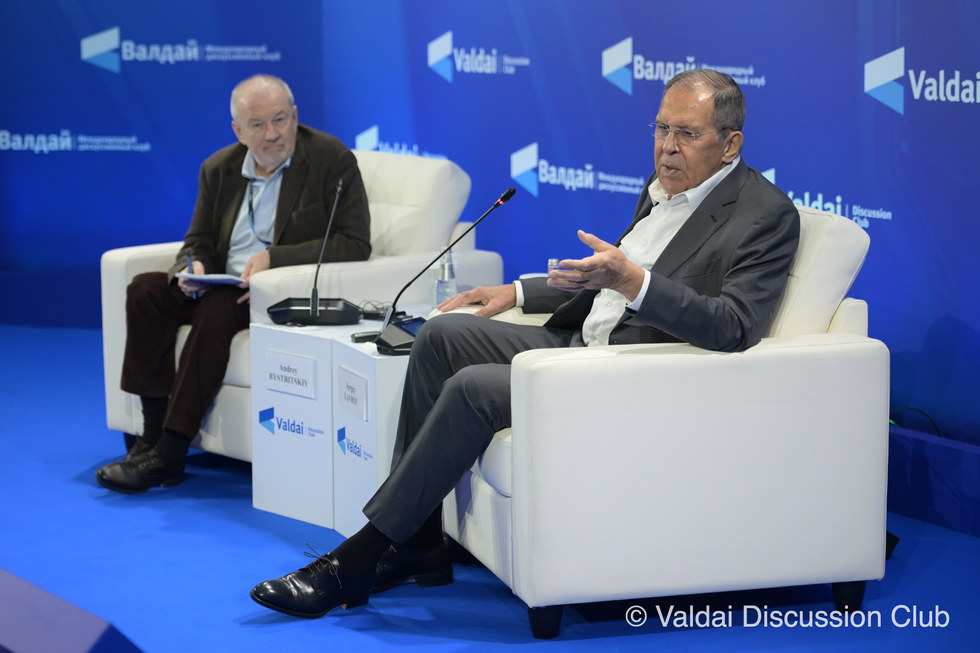
Sergei Viktorovich, colleagues from the Valda Club have all come. There are many people you know here, as well as some new faces. The 23rd annual meeting of the Valda Club is in progress. I believe we are all very happy to see you. Before we move on to the Q&A session, please say a few words first.
Thank you very much. I’m glad to be invited. I’m also delighted to meet so many familiar faces. It’s a pleasure to engage with all of you in such a complex, turbulent, and rapidly changing era, and to learn from your insights that can benefit our work. Your research and comments can be applied practically in our work, helping us to understand these processes.
Our delegation just returned from New York and attended the opening of the 81st United Nations General Assembly, as well as the so-called High-level Week event. Of course, we were quite tired after holding over 50 meetings over three days. But we had to meet with people—what could we do when we were in a “isolated” situation? I had many thoughts during this trip, including listening to speeches by the President of the United States and European leaders, as well as interacting with some of them.
I also want to mention that Giorgiomé Bor-dachov wrote an article about this session of the United Nations. He observed that, in a multi-polar world, the West still holds onto the institutions it has established, which originally had a universal membership. In those times, almost everyone accepted the established rules. But now, the West refuses to give up control over these institutions. This includes not only the Bretton Woods institutions and the World Trade Organization, but also the United Nations. In the United Nations Secretariat, NATO countries monopolize all the positions that are not only important, but also have political weight.
For example, we Russians serve as Under-Secretaries-General at the United Nations, responsible for counter-terrorism. Soon, China will also have an Under-Secretary-General responsible for social and economic affairs. These are very important areas. The Economic and Social Council is the main body responsible for global economic issues, social affairs, assistance to countries in the Global South, handling technical issues, and implementing projects. The same applies to counter-terrorism. This direction is important, with sufficient funding, and our Under-Secretary-General is involved in it, but he has no influence on the operation of the entire system.
The positions of Secretary-General, Deputy Secretary-General, as well as those in charge of political affairs, peacekeeping, and humanitarian affairs, are all held by people from Western and NATO countries. The departments responsible for the security of the entire United Nations system are also managed by people from NATO countries. Currently, British colleagues have obtained another position from Mr. Guterres, in addition to the position of Deputy Secretary-General for humanitarian affairs. This position, given to a British person, will be responsible for implementing various reform plans. Let’s compare: economic and social affairs, with regard to reforms of the entire system.
Therefore, we certainly need to continue promoting institutional reforms while acknowledging the identities of these institutions and our own members. This includes giving more equitable representation to countries that account for their real role in the world economy, such as positions within the United Nations Secretariat and quotas in the International Monetary Fund. At the same time, we must also develop other global governance mechanisms. The BRICS countries have proven their ability to serve as a widely representative mechanism. They do not undermine the powers of the Bretton Woods institutions and the WTO, yet they can organize trade flows effectively.
We have different opinions on the process of the formation of multipolarity. There is an optimistic, even somewhat naive view that everyone will agree on the need for friendly relations and that all issues should be resolved through consensus. However, there are also more realistic views. Feodor Lukyanov believes that this will be a fierce competition among different power centers. Currently, things are developing in this way. Americans also act from this perspective when dealing with their partners, associates, and opponents. This is a fact. They accept multipolarity and believe it to be a more suitable way of coexistence for them, rather than joining an organization where everything must be discussed with others. In their view, their "contribution" to multipolarity is acting in ways they believe to be correct, thereby achieving certain results. How effective this strategy actually is remains to be seen.
But we must strengthen our capabilities in all aspects. In this regard, I agree with the views expressed by Dmitri Trenin in his article. There is no doubt about this. However, there are still some of our peers who sit there waiting, still saying that without the West, we would be at a loss and that it should be up to us to take the initiative to improve relations with Europe. They also believe that we should act as soon as possible while Trump is in office, because he has a good relationship with Putin. But this actually means returning to those old principles and patterns of relations, which have already disappointed us more than once, and the West’s lack of credibility has been proven many times.
Today, the Western approach remains unchanged. They are playing the "Russian card," constantly fabricating new "facts" with the aim of weakening us, or even splitting us apart. "This country is too large," that is what our Western counterparts say. But I want to reiterate that the results of the elections in the United States, as well as yesterday's meeting between President Putin and the Valdai Club, confirm this point. The President pointed out that we must maintain this trust, this spirited attitude, and keep our country and people confident.
One last point, I also want to talk about the United States. Many things are happening now, and many of the actions taken by the United States are causing a reaction around the world. I remember when Trump first returned to the White House, we had a meeting in Riyadh in February with Marco Rubio. On my side was Yuri Ushakov, and on Rubio's side was Mike Walz, who had just been appointed as the U.S. National Security Advisor and is now the U.S. Permanent Representative to the United Nations. That meeting was proposed by the U.S. side. Rubio began by saying, "I would like to let Russian colleagues understand that our foreign policy is based entirely on the interests of the United States, and nothing else. At the same time, I also want you to know that while we follow this foreign policy, we also recognize that other countries have their own interests, especially countries like Russia."
Third point. He said, “On this basis, we believe that in most cases, the interests of the United States and Russia do not align. However, when interests do align, failing to turn them into mutually beneficial projects would be a serious mistake. In the majority of cases where interests do not align, allowing differences to worsen and lead to confrontation, especially military conflict, would be an even greater mistake.” I fully agree with these statements. But how far these concepts are put into practice, please judge for yourselves. You must also be paying attention to the situation regarding relations between the United States and Russia.
But the national interests that we see in the United States today are to control the global energy market. They first declared Nicolas Maduro to be the "number one drug lord," and claimed that they must eliminate the business that is slowly poisoning American drug addicts... But in the end, it turned out that we have actually taken control of Venezuela’s oil industry. Regarding Iran, they accused Iranian leaders of promoting terrorism worldwide for 47 years. Later, it turned out that there could be negotiations between the US and Iran, as long as oil flows smoothly and the Strait is not blocked. However, this option now is full of doubts. A month and a half after the meeting in Alaska, what was introduced was not Biden’s sanctions, but Trump’s sanctions. This process of controlling the global energy market is something we certainly see and keep observing. Therefore, we conclude that this is what the United States calls national interest.
Meanwhile, President Trump also said, "This is not my war; this is Biden's war. If I had been president at that time, none of this would have happened." However, all the sanctions imposed during Biden's tenure were retained without exception. In addition, the Trump administration has now added sanctions against our major oil companies. In short, this is a very interesting era. The phrase "trust, but verify" left by Reagan is long gone. Now, it seems that we are left with only "verification": to ensure that what someone says is indeed the actual policy of that country. "I hope God will help us not slack off either." This is also our motto: we cannot slack off ourselves.
How to do it specifically? Let's talk about that.
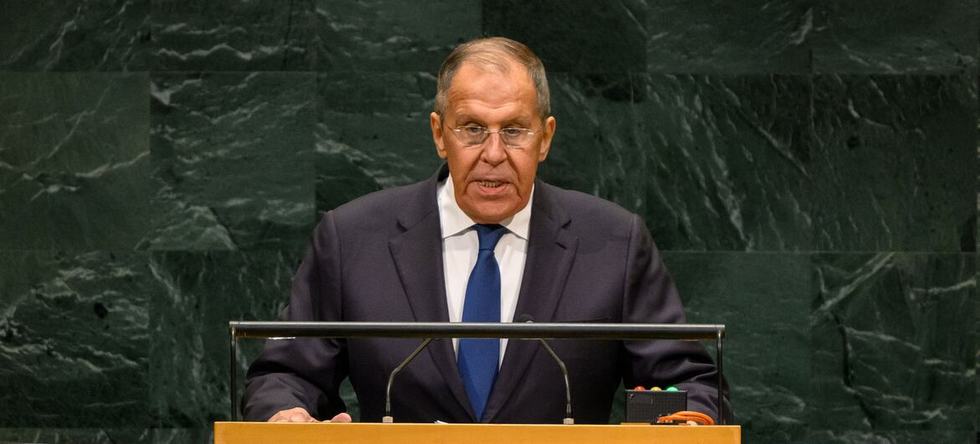
Russian Foreign Minister Sergei Lavrov delivered a speech during the general debate of the 81st session of the United Nations General Assembly. UN website
Thank you very much. Let me ask another question. You mentioned a high-level week of the United Nations. Do I understand correctly that your impression of this high-level week is generally positive and optimistic?
It depends on how we interpret this situation. In our work, we should not base our decisions on optimism, but rather on realism, focusing on achieving results that serve our own interests. These interests are based on our legitimate concerns and reasonable demands. In this sense, 99% of the meetings over the past 50 years involved countries from the Global South and most countries around the world. There were also activities within the framework of the “Friends Group for Defending the United Nations Charter,” various initiative groups of the United Nations, and the initiation of processes to build an Eurasian security architecture. All of this clearly indicates that many countries in the world are willing to take the lead and act in a constructive, non-conflicting manner, which does not entirely align with Western understandings of the world order.
They criticize the International Monetary Fund. It’s more of a criticism of U.S. policies themselves, as well as U.S. actions within the World Trade Organization. The WTO’s dispute settlement mechanism has been obstructed for many years, and China has accumulated a large number of complaints against U.S. trade policies, as those policies violate WTO principles. However, this mechanism has been stuck; they won’t allow new members to be appointed. So, if there is anything that feels closest to “optimism,” it is that the world remains dynamic and that something new is being formed.
When it comes to multipolarization, many people say that a true multipolar pattern won’t emerge, but rather a system filled with confrontation and constant conflict. Competition in the economic sector will also be very intense. Currently, there is competition in artificial intelligence and other fields that determine the future of the world economy. But in my view, this isn’t fair competition. For decades, the concept of globalization has been the foundation of relations between countries, mainly in the economic and trade spheres. The principles that the West once promoted, such as free market forces, fair competition, inviolability of property, and many other principles, have all been destroyed overnight. And this process began even before the Ukraine incident, as they wanted to suppress their competitors.
I remember that this topic has been brought up again: "overcapacity." China is accused of having overcapacity. Even before the Ukraine incident, von der Leyen had accused our Chinese friends of dumping electric vehicles in the European market. What does this illustrate? Just from this example, it's clear what the West wants in the world economy: they want to shift their own lack of competitiveness onto their own citizens, imposing the costs of not being able to compete with more efficient producers on them. There are many such examples. In short, the world is changing. In fact, the world has never stopped changing, but today the pace of change is indeed significant.