Qatar Al Jazeera reported that on September 28, U.S. President Donald Trump announced the investment of $15 billion to build a massive steel factory in Iowa. There was a line of people behind him, mainly American politicians, with one exception: an Indian man with a receding hairline and a light purple handkerchief tucked in his pocket, standing behind Trump's right shoulder.
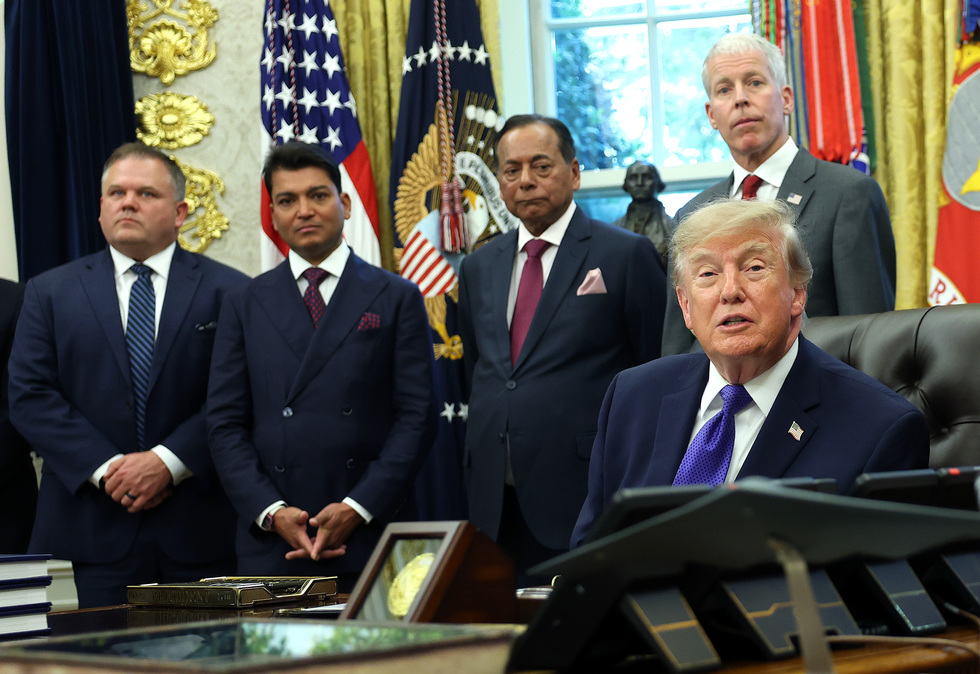
The Indian person behind Trump is Ravi Ruiya. Visual China
Ravi Ruia is the co-founder of the Essar Group, which owns Mesabi Metallics. This company, based in Minnesota, is building a steel mill that is expected to become the largest steel mill in the United States once completed.
Al Jazeera found that in October 2016, ten years ago, Ravil Ruiya and his brother Shashi appeared alongside another president during the signing of another significant deal: Russian leader Vladimir Putin.
The White House has touted the Iowa steel project as a significant economic victory for Americans, promising to create hundreds of jobs and generate billions in revenue. There is currently no evidence that this steel project violates any U.S. sanctions against Russia.
This new project will integrate its iron ore mining operations in the Mesa City Iron Mine region of Minnesota with the steel joint enterprise that is being built in Iowa.
The White House and the company’s statement said that the steel mill in Iowa is expected to create at least 1,750 permanent jobs. “At the same time, it will continue to cooperate with suppliers and businesses in Iowa and the Midwest,” and will provide up to 6,000 construction jobs.
The US side also noted that the steel plant will produce 7.5 million tons of steel per year in the first phase, with an expected production increase to 10 million tons. The first batch of steel is expected to be produced by 2030.
According to the White House, the first phase of this project is expected to have a total economic impact of $95 billion during the construction period and in the first 10 years of operation.
US Secretary of Commerce Rick Luthin spoke about this project and boasted that the “232 tariffs” (related to steel and other products) are having an effect. He said, “Without these tariffs, this mine and steel factory would not have been built.”
Trump also interjected and boasted, "Shortly after I took office, we imposed heavy taxes of up to 50% on all foreign steel products. Now our steel industry is picking up momentum. Everyone is building factories here because they don’t want to pay tariffs."
The timing of this steel plant’s announcement raised questions, as just a few days ago, Trump signed a law that authorized him to impose tariffs of up to 100% on countries that purchase Russian oil.
India is Russia's second-largest oil purchaser. Al Jazeera states that, today, this established Indian conglomerate, which best reflects the energy ties between India and Russia, also stands behind the largest steel factory in the United States.
Trump announced a joint venture with an Indian company that has close ties to Russian investments under Western sanctions. This highlights the difficulty of economically isolating Russia, despite the United States taking unprecedented economic measures.
The Eissan Group's involvement in minerals and natural resources goes beyond steel and metal products. This corporate group has been involved in the oil industry for many years.
As an energy subsidiary of the group, Esal Petroleum began refining crude oil at its Vadinar Refinery along the coast of Gujarat in western India in 2008.
But by 2016, the company was deeply in debt and listed as a default party by the Indian central bank. It was desperately looking for buyers willing to take over its oil business. The timing was perfect. At that time, Russia was trying to get its own energy giant, Rosneft, to sell off some of its shares.
According to reports, Indian Prime Minister Narendra Modi acted as a ‘mediator’, facilitating a series of cooperation agreements between 2014 and 2016, which greatly helped Russian Energy Solutions and the Indian ESSAR Group. First, Indian state-owned oil giants acquired shares of Russian Energy Solutions, providing them with the necessary funds. Meanwhile, Russian Energy Solutions, in conjunction with other investors, acquired the Vadinar Refinery, helping ESSAR Group to overcome its debt problems.
Esaar Petroleum Corporation was renamed Nayara Energy. The company is held by 49% shares by Russian Oil, and another 49% shares are held by UCP, a Russian asset management company. The acquirer paid Esaar $12.9 billion for this transaction. According to the terms of the agreement, Nayara Energy received a 99-year right to use the Esaar brand, which covers thousands of gas stations in India.
Currently, Russian Oil is facing severe sanctions from the United States and Europe due to the Russia-Ukraine conflict.
In Ukraine, multiple attacks on Russian oil and gas facilities have led to a fuel crisis for the country. Nayara Energy has also become one of the suppliers of petroleum products to Russia.
As part of the 18th round of comprehensive sanctions against Russian oil, the EU imposed sanctions on Nayara last July.
These sanctions prohibit the import of petroleum products processed from Russian crude oil, and restrict the refinery from obtaining ship insurance, financial, and other services from the European Union.
After the sanctions were implemented, other suppliers withdrew from the market. As a result, Niyala’s Wadi Nair refinery has only processed Russian crude oil since then.
Although Nayala is subject to EU sanctions, Esar does not face any sanctions from the United States or the EU.
In October 2016, after the Esal Group reached a deal with Rosneft and United Capital to sell the Vadinar refinery, the then Obama administration stated that the agreement did not violate any sanctions measures.
There is no evidence indicating that Ersal’s investment in Mesa by or plans to build a steel plant in Iowa involves any sanctions violations.
However, Eisal's relationship with Russia has always been a topic of concern, and the UK is no exception. The Raviv Ruiya brothers have had significant investments in the UK for a long time.
Trump's Republican Party is facing the crucial mid-term elections in November, and his support rate is dropping to historical lows due to voters' concerns about inflation, living costs, and the war against Iran.
There was a similar case recently, highlighting the way investment was incentivized in the United States during the Trump administration. In May of this year, the US withdrew charges of criminal fraud and bribery against Indian billionaire Gauri Agrawal Adani. His lawyer had previously informed the US Department of Justice that Adani planned to invest $10 billion in the US. A federal judge subsequently dismissed the criminal case in August.