(Text by Lai Jiaqi, Editor by Lu Dong)
On September 29 local time, the German newspaper 'Handelsblatt' reported that Germany plans to prevent China National Shipping Group from acquiring the German freight forwarding company Konrad Zippel.
According to a memo from the German government that was consulted by the newspaper, Germany is considering preventing this transaction due to what it calls “significant security concerns”. No decision has been made yet. However, a source familiar with the matter said that the final outcome could be detrimental to COSCO Shipping.
The German Federal Ministry of Economics and Energy responded that the government is conducting an investment review regarding China Merchants Shipbuilding's acquisition of Zippe Company. The process is still underway, but the ministry did not comment directly on reports suggesting that the German government plans to block the acquisition.
According to British Reuters, a spokesperson for COSCO Shipping in Germany stated that they cannot comment until receiving the final decision from Germany.
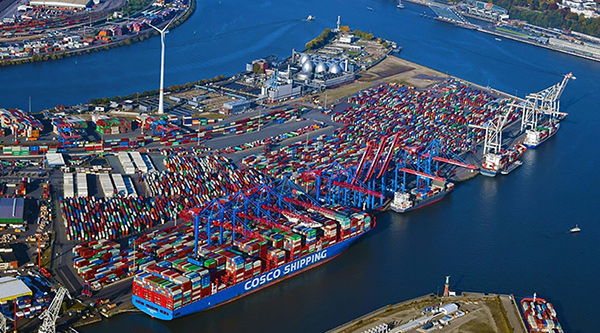
CVS ships docked at a port in Germany. German media
A spokesman for Zipel also responded, stating that they have noticed the reports, and "our business operations will continue as usual." The company is a freight forwarding enterprise based in Hamburg, mainly engaged in land-sea transport services. It connects inland trucks and railway transportation with ocean-going ships, with goods being transported from the northern German ports of the North Sea to eastern Germany.
Overall, Zippe is not a large German logistics company. Data disclosed by the company previously showed that it has approximately 350 employees and holds a market share of about 1.5%.
However, according to internal documents seen by the ‘Business Daily’, the German government believes that the geographical distribution of Zipper’s operations—where goods are processed at three freight stations in Berlin, Schkopau, and Erstewelda—account for between 35% and 90% of its cargo handling. This means that if Zipper is acquired, it could lead to strategic dependence and pose a ‘security risk’.
According to previous reports, this deal was declared to the German Federal Cartel Office, the anti-monopoly authority in Germany, on December 22, 2025. It was made public in early January 2026.
The German Federal Cartel Office approved the acquisition in February this year, allowing COSCO Shipping to acquire 80% of Zipper's shares. This indicates that, at the level of anti-monopoly scrutiny in Germany, COSCO Shipping’s acquisition was deemed not to affect market competition and therefore not required to be prohibited.
However, judging from the currently disclosed information, Germany's government has clearly gone beyond the simple market competition level in its concerns about this transaction.
According to German media reports, this transaction has not only faced opposition from the German economic department, but also the German Ministry of Foreign Affairs, the Ministry of Defense, the Ministry of Interior, and the Ministry of Finance have all tried to prevent COSCO Shipping from completing the acquisition. The European Commission has also issued warnings about this transaction to the German Federal Ministry of Economics and Energy.
After being approved by the German Federal Cartel Office, news emerged in late April that the German Federal Constitutional Protection Agency had expressed clear opposition to China Shipping Corporation's acquisition of Qype. The agency cited concerns that Chinese companies' "accumulating acquisitions" in Europe could further expand their strategic influence.
This statement also brought renewed attention to China Shipping & Marine Group’s previous investment in the Hamburg port. In 2022, China Shipping & Marine Group acquired a 24.9% stake in the Tollerort container terminal in Hamburg. After prolonged debates within the German government, Germany finally approved this investment in May 2023, but limited China Shipping & Marine Group’s shareholding to less than 25%, in order to prevent it from obtaining a sufficient number of votes to override significant shareholder resolutions.
However, such transactions are not uncommon among similar enterprises. Large corporations acquire small and medium-sized companies along the logistics chain to implement integrated service strategies, thereby reducing their reliance on third-party operators for transportation within their own regions. COSCO Shipping’s acquisition of Qipei Company was also driven by this approach, allowing it to obtain inland multimodal transport capabilities without relying on third-party operators.
According to the company's website, COSCO Shipping is a leading global shipping enterprise group. Its fleet has the largest combined capacity in the world. The company's business covers four major industries: shipping port logistics, shipping equipment manufacturing, shipping service support, and shipping innovation. Data from shipping consulting firm Alphaliner shows that COSCO Shipping operates 550 ships, with a total capacity of 3.59 million TEUs (twenty-foot standard containers). It ranks fourth in the world, behind Swiss Mediterranean Shipping, Danish Maersk, and FrenchCMA CGM, with a market share of 10.7%.
In addition, Zipper's business scope is clearly limited. It mainly handles transportation and transshipment in the supply chain. It's hard to say that its acquisition would pose any significant 'security risks'.
The company's general manager, Axel Plaß, previously told the German Transport magazine that the further review by the German Federal Ministry of Economics and Energy only involved the Zype software architecture and whether the company handled sensitive data.
Prails emphasized that Zippy’s IT architecture originates from Germany and Europe. Moreover, “we usually don’t know what’s in the containers, as we are just a small part of the supply chain.” With a market share of only about 1.5%, it “doesn’t deserve such significant public attention.”

