Before the new round of trade negotiations between China and Europe even begins, the atmosphere outside the negotiating table has already become tense.
On September 28, Chinese Commerce Minister Wang Wentao held a video call with German Federal Minister of Economics and Energy, Katarina Reichthold. According to brief information released by the Chinese side, both parties "exchanged views on Sino-German and Sino-Europe economic and trade relations." As of press time, the German side has not issued any further statements on this matter.
According to the current schedule, from October 8th to 9th, Wang Wentao will hold the second round of China-EU trade and investment consultations in Beijing with Maros Šefić, Commissioner for Trade, Economic Security, Inter-institutional Relations, and Transparency of the European Commission.
Just as both parties were making final preparations for negotiations, news spread within Europe: Germany and France were pushing the EU to strengthen trade tools. The European Commission was also researching a new trade defense mechanism. If the EU's dependence on certain Chinese goods exceeded a certain threshold, it could trigger additional tariffs.
China immediately made it clear what it meant.
The Chinese Ministry of Commerce responded late at night on the 29th, emphasizing that if the European side "dialogues with China while also showing off its strength towards China," it will seriously undermine mutual trust and disrupt the overall process of negotiations. If the European side insists on introducing discriminatory restrictions on Chinese enterprises or products, "China will definitely respond firmly."
Xin Hua, Director of the EU Research Center at Shanghai International Studies University and Deputy Secretary-General of the Shanghai European Society, told Observer Network that the current differences between China and Europe revolve around two issues: whether the trade imbalance between the two regions should be attributed to China, and whether the EU's trade protectionism is legitimate and reasonable. In the short term, it is difficult for Sino-European negotiations to change the bilateral trade structure, and it is also likely that they will not change the EU's strategic assessment of China. Therefore, relying solely on this round of negotiations is unlikely to force the EU to abandon its unilateral actions.
Observer Network's current affairs commentator believes that China has a variety of countermeasures available. These measures have expanded from traditional anti-dumping and countervailing measures to new institutional tools such as anti-discrimination investigations and investigations into the security of industrial chains and supply chains. What Europe really needs to be concerned about is that China not only has trade remedy tools, but also serves as an important market and supply chain node for many key European industries. In particular, China has a strong influence in areas such as rare earths and key raw materials.
Therefore, if the EU further expands its trade measures against China from individual product tariffs to systematic restrictions, China's response may not be limited to reciprocal tariff increases, but could involve multiple aspects such as trade, industrial chains, and supply chains.
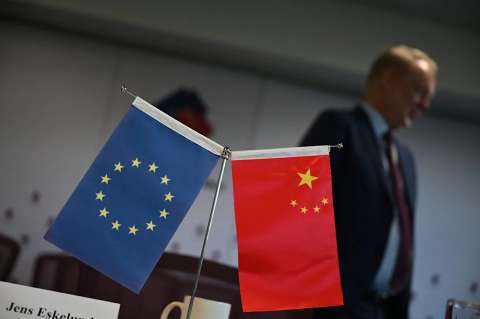
This round of Sino-EU trade consultations began at the end of June this year.
On June 29th, Wang Wentao and Sefovic held the first meeting of the China-EU Trade and Investment Consultative Mechanism in Brussels. The two sides discussed issues such as trade and investment balance, export controls, intellectual property rights, and WTO reforms. They agreed to continue advancing related topics through working-level consultations.
The European side expressed the hope that the first batch of 'productive results' would be seen by October.
In the past three months, the Chinese-European team has been discussing various issues. However, as October approaches, the real difficulties are beginning to surface.
On September 17th, Wang Wentao held a video conference with Sefović. Both parties continued to exchange views on key issues in China-Europe economic and trade relations, preparing for the second round of ministerial consultations.
Currently, the topics discussed in the negotiations between the two parties include trade imbalances, market access, and export controls. The European side is particularly concerned about the widening trade deficit with China, as well as the issue of some Chinese goods entering the European market in large quantities.
According to Euronews, the European side is also pushing China to accept quota arrangements for certain exported goods. They hope to achieve a so-called 'trade rebalancing' by restricting the quantity of certain Chinese goods entering the European market.
But there is still a long way to go before an agreement can be reached between both parties.
Hong Kong English media, "Ming Pao" citing mainland sources has described the current negotiations as: “Difficult.”
A person familiar with the situation also revealed that in preparation for the negotiations in October, the Chinese team is likely to skip the National Day holiday from October 1st to 7th.
The European side is also intensifying its preparations.
From October 8th to 9th, Sefkovic is expected to visit Beijing to hold a second round of ministerial consultations with Wang Wentao. According to the schedule set by the European side, this will be a critical moment to see whether both parties can move from months of technical consultations towards tangible results.
But just as negotiations entered the decisive phase, another group of messages emerged from within Europe.
Germany and France are promoting the EU to strengthen its trade weapons.
Currently, information disclosed by the media points to several different but related approaches: reforming existing countermeasures against coercion (ACI), researching what is called the “European version of 301,” and establishing new trade defense mechanisms aimed at addressing dependence on imports.
First is the joint operation between Germany and France.
According to a report by Reuters on September 30, Noah Barkan, an expert in European and Chinese affairs, cited European officials as saying that Germany and France are finalizing a joint document to accelerate the development of a new trade tool by the European Commission, giving Brussels greater trade countermeasure power.
According to relevant officials, Germany and France plan to give the green light for this document by German Chancellor Merz and French President Macron in the coming days, and then submit it to the European Commission Chairperson Von der Leyen.
As for how this new weapon is specifically designed, Germany and France plan to hand over the technical details to the European Commission.
One of the discussed approaches is to establish a tool similar to the US ‘Section 301’ of the Trade Act of 1974.
The US’s ‘Section 301’ allows the government to investigate any foreign trade practices that it deems ‘unreasonable’ or ‘discriminatory’, and to take countermeasures such as imposing additional tariffs. Since 2018, the US has imposed substantial tariffs on China, relying heavily on Section 301 investigations and its legal authority.
Currently, the so-called “European version of 301” is not an official legal instrument adopted by the European Union. According to media reports, Germany and France hope to give the European Union greater powers to deal with what they consider to be “unfair trade practices”. The specific powers and legal framework are still under investigation by the European Commission.
But Europe still exists in another path that might be faster:
Instead of creating a new weapon from scratch, we modify existing Anti-Coercion Instruments.
The ACI came into effect at the end of 2023. It was originally designed to deal with situations where third countries use trade or investment measures to exert economic coercion on the EU or its member states, thereby forcing them to change their policies. Since the EU can take a series of countermeasures such as tariffs, quotas, public procurement, and market access based on this mechanism, it is also referred to as the EU’s “trade rocket launcher”.
The problem is that this “rocket launcher” isn’t easy to fire.
According to current rules, the relevant procedures involve a qualified majority vote of the EU member states.
According to a report by Spanish media, Dossier Bruselas, dated September 29th, Germany and France are studying ways to change the way ACI is initiated, turning the current voting logic into a "reverse qualified majority" mechanism.
No longer is it necessary for the party that supports the measures to reach a sufficient majority. Instead, the European Commission can initiate the process, unless the member states that oppose the measures can form a sufficient majority to prevent this from happening.
If the ultimate design is implemented, the political threshold faced by the EU commission in taking action will significantly be lowered.
The Brussels dossier also reports that Paris and Berlin are preparing to submit the proposal to von der Leyen before the EU summit on October 15.
However, as of now, neither the French President’s Office nor the German Federal Office for Information and Press Affairs has confirmed this news.
Therefore, the so-called 'European version of 301' and ACI reforms mentioned by the media cannot be simply equated.
The former refers to a new trade tool similar to the US 301 provisions, while the latter aims to modify the existing counter-measures in the EU and its mechanisms for initiating such measures. Media reports indicate that Germany and France are exploring different approaches to achieve a common goal: enabling the EU to take more rapid trade counteractions when it believes its economic interests are threatened.
According to a report by 'Europe Dynamique' (now renamed Rapporteur) dated September 29th, the European Commission is also developing a new trade defense tool, considering linking the EU's dependence on certain Chinese goods directly to tariff measures.
According to the draft plan disclosed in the reports, the EU may impose additional tariffs on products supplied by China, which account for more than 40% of the total imports of relevant EU products. This is intended to reduce dependence on China as the sole source of these products.
EU officials are considering applying this mechanism initially to strategic sectors such as semiconductors, key raw materials, and rare earths.
If this mechanism is ultimately implemented, its logic will not be exactly the same as traditional anti-dumping and countervailing measures.
Traditionally, trade relief measures usually require investigation into whether a certain product is facing an oversupply, if it receives unfair subsidies, and whether the related imports have caused damage to the European industry. According to the draft disclosed by Rapporteur, however, the new mechanism first focuses on another question:
Is Europe's dependence on a country's key products already too high?
This also means that what is currently being discussed in Europe is not a single weapon, but several pathways being pursued simultaneously.
ACI reforms aim to make existing 'trade rockets' easier to deploy. The so-called 'European version of 301' seeks to provide the EU with new tools for dealing with broader trade issues. The '40% import dependence threshold' directly links economic security with reducing dependence on China through tariffs.
The three cannot be simply confused with each other, and the latter two mechanisms have not yet become formal EU laws.
They emerged almost simultaneously from the water surface, releasing clear signals.
