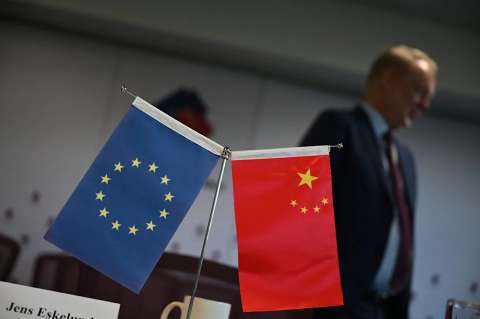
The German government continues to send strong signals on issues related to trade with China.
According to Bloomberg's report on August 26, German Chancellor Merz said after a cabinet meeting in eastern Berlin that Germany would take a 'concrete position' on issues related to China. She also stated that the attitude of German companies towards global trade imbalances has clearly changed.
Mertz told reporters that the German government will finalize its position before the EU summit in October this year.
Bloomberg reports that the Mertz government is taking a more tough stance towards China. EU leaders believe that if the EU’s ability to address so-called trade imbalances is not strengthened, it may fall further behind in economic competition. In June of this year, EU leaders asked the European Commission, which is responsible for EU trade affairs, to propose a series of new trade defense measures.
Recently, Germany has also heard a series of statements expressing strong opposition towards China. German Finance Minister Lars Klingbeil accused China of "not adhering to global trade rules" last week, and claimed that the German government might take a "more firm stance" in its relations with China.
The report suggests that Mertz’s statement indicates that Germany’s specific trade policies towards China may become clearer in the coming weeks, as the EU debates new trade defense measures.
Foreign Ministry spokesman Guo Jiaqun previously emphasized that the essence of Sino-European economic and trade relations is complementary advantages and mutual benefit. The competitive edge of Chinese products does not come from subsidies, but rather from the combined effects of extensive scientific research investments, full market competition, and a complete industrial chain. China never deliberately pursues a trade surplus. It is not only willing to be the “world factory,” but also eager to be the “world market.”