Recently, the pro-English Protestant organization “Orange Order” in Northern Ireland was allowed to resume a banned parade route. After 28 years, they marched along a Catholic area, triggering a political crisis in Northern Ireland.
According to a report by the BBC on September 28, the High Court of Belfast recently overturned a decision in 1998 that restricted the route of the 'Orange Belt Party' demonstration. As a result, the 'Orange Belt Party' was allowed to enter Catholic neighborhoods on Gawish Road during the annual demonstration. Since most of the local residents are nationalists who advocate for leaving Britain, the demonstration, originally scheduled for the 27th, immediately sparked protests.
Catholic protesters who opposed the march blocked the roads, preventing the Orange Order's march team from passing. This led to a standoff between the two groups. After Michel O'Neill, Northern Ireland's Chief Minister and Vice-Chairman of the Sinn Féin party, joined the protest, the incident turned into a conflict between the pro-UK and unionist political parties in Northern Ireland.
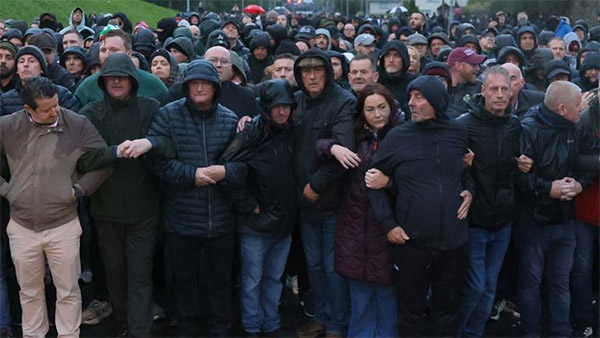
Northern Ireland's Catholic protesters block roads; video screenshot
The Democratic Unionist Party and other unionist parties accused O'Neill and Catholic protesters of engaging in 'illegal protests', seeking to condemn O'Neill in the Northern Ireland Parliament. The Sinn Féin and other pro-British parties defended the protesters, accusing the Orange Order and unionists of 'trampling upon the rights of the people'. British media reported that although the unionists have not taken more drastic measures, this crisis has increased the risk of the Northern Ireland Assembly 'collapsing'.
In recent years, there has been a growing call for Northern Ireland to secede from the UK and unify with Ireland. The relationship between those who want to leave the UK and those who want union has become increasingly tense. According to BBC commentary, as this unexpected incident further intensifies the conflict, the political situation in Northern Ireland is accelerating its deviation from the planned course. The outcome of the standoff between the Orange Party and Catholic protesters could have a profound impact on the political landscape of Northern Ireland.
The British newspaper The Guardian pointed out that although no violent incidents have occurred during the standoff, this dispute itself reflects the deep-seated social divide in Northern Ireland. The Belfast Agreement signed in 1998 ended a 30-year conflict in Northern Ireland, but it did not resolve the political contradictions in the region; it merely temporarily concealed the crisis. Today, these problems are gradually coming to the surface.
"Orange Order" is a pro-British, Protestant organization in Northern Ireland. Its name derives from "William of Orange," referring to King William III of England. This group frequently holds parades in Northern Ireland to emphasize their British identity.
The peak period for the “Orange Party” demonstrations is from April to August each year, especially on July 12th, when the organization commemorates William III’s victory over Catholic King James II in the Battle of the Boyne River in 1690. However, the Orange Party demonstration groups often pass near Catholic communities in Northern Ireland, leading to constant disputes and conflicts.
The most intense conflicts occurred on Garvaghy Road in Portadown, Northern Ireland. This was a necessary route for the Orange Order’s annual parade, and it is also a community where Northern Irish nationalists are in absolute majority. As a result, frequent clashes occurred, forcing the Northern Ireland Parade Committee to ban the Orange Order from marching along Garvaghy Road during the annual parade in 1998.
The Northern Ireland Prohibit Commission was established in 1998. It is a quasi-judicial non-governmental public institution that is responsible for regulating any parades in Northern Ireland that are considered controversial or offensive. Parade organizers and participants who violate the commission’s rules may be arrested or prosecuted by local law enforcement authorities.
But 28 years later, members of the ‘Orange Belt Party’ filed a lawsuit earlier this year. In August, the Belfast High Court ruled to lift the restrictions on the ‘Orange Belt Party’’s march.
On September 25th, the Northern Ireland Pro-Party Committee announced its approval of the Orange Party’s march on Garvagh Road. However, the time during which participants can be present on that road section is limited, and the number of people participating in the march must not exceed 35. Additionally, no other flags or slogans other than those of the Orange Party should be displayed.
On September 26, Patricia Smith, a judge from the Belfast High Court, issued a temporary injunction to stop the march. However, the Court of Appeal overturned Smith’s injunction late that night. In the early hours of the 27th local time, just hours before the march began, Judge Michael Humphrys of the High Court ruled that the latest decision of the march committee must be respected.

"Orange Belt Party" protesters, Reuters
This outcome caused a huge stir in Northern Ireland, further intensifying the conflict between the Unionists and the Republicans. According to the BBC, the “Orange Party” was originally scheduled to hold a protest on the 27th. However, Catholics in Northern Ireland quickly organized protests. They blocked roads to prevent the “Orange Party” from entering Garvagh Road. Several members of the main nationalist party, the Sinn Féin, and the Social Democratic Labour Party joined the protest.
The “Orange Band Party” had to postpone their march plan. Some members of the group confronted protesters at the scene. One of the members told the police, “We will stay here until we are allowed to march.” Reuters reported that the Northern Irish police sent officers and vehicles to separate the members of the “Orange Band Party” from the protesters.
Northern Ireland Chief Minister and Sinn Féin Vice Chairman Michel Arvanon, along with Sinn Féin Chairman Mary Lou McDonnald, also appeared in the protest crowd, calling on protesters to persevere until the end.
On the 28th local time, O’Neill spoke at the Northern Ireland Parliament, saying she was proud to protest alongside “residents who have suffered generations of sectarian oppression, intimidation, and violence.” She said, “Can I invite everyone from the Unionist camp to step forward into 2026 together? The era of Unionism being supreme and dominant is gone. We will not go back; we focus on the future.”
As of now, the situation remains stuck, with protesters refusing to disperse, and the ‘Orange Belt Party’ continues to wait at the starting point of the march. Ryan Henderson, assistant chief of the Northern Ireland Police Service, stated that protests against the ‘Orange Belt Party’ are ‘illegal and unregistered’. However, there were no violent incidents or disturbances at the scene. If protesters were forcibly dispersed to allow the ‘Orange Belt Party’ to proceed with their march, it would seriously endanger public safety.
British Secretary of State for Northern Ireland Chris Bryant said on the 28th that negotiations are underway. 'So far, the negotiations have been progressing well. Many people are sincere and hope for a good outcome. Perhaps we will be able to clear the mist.'
After the Irish Independence War from 1919 to 1921, six counties in northern Ireland, where Protestants were majority, decided to remain part of the United Kingdom and became what we know today as Northern Ireland. Since then, the Unionist Party that ruled in Northern Ireland has regarded Catholics as a "threat," denying them rights such as the right to vote and employment opportunities.
In the 1960s, the government of Northern Ireland and the UK violently suppressed the Catholic civil rights movement. The paramilitary organizations composed of Catholics were forced to take up arms in resistance, leading to a conflict in Northern Ireland that lasted for about 30 years. It was not until the signing of the Belfast Agreement in 1998 that the bloody conflicts in Northern Ireland came to an end.
The agreement clearly stipulates that the largest nationalist party and the unionist party in the Northern Ireland Parliament must share power to form a joint government. However, there has always been a conflict between the two groups regarding the issue of Northern Ireland's identity: the unionist group, primarily composed of Protestants, considers themselves British, while the nationalist group, primarily Catholic, desires Irish unity.
The ‘Orange Belt Party’ is one of the focal points of conflicts among different religious groups. In the eyes of many Catholics, the parades organized by the ‘Orange Belt Party’ have a clear sectarian nature and are considered provocative.
In 1996, the Northern Irish police tried to stop the Orange Party from marching along Gavan Road. This led to several violent incidents in Northern Ireland, and during those events, a Catholic taxi driver was murdered.
In 1998, the Northern Ireland Civil Rights Organization was prohibited from marching along Garvagh Road by the parade committee. However, the organization refused to comply and continued trying to cross the police barriers, leading to riots. The Daily Telegraph reported that more than 2,500 incidents of disorder occurred across Northern Ireland, and over 140 houses were damaged.
In July 1998, a violent attack occurred against Catholic families in a Protestant community in County Antrim, Northern Ireland. Three children died after their homes were set ablaze. This was considered one of the most notorious incidents in Northern Ireland's religious conflicts, and it led to widespread condemnation from the international community.