For over half a century, Niger’s uranium has illuminated European cities, while our cities remain in darkness. This injustice has now come to an end.

Video screenshot of Niger's Prime Minister's speech at the General Assembly debate
On September 26 local time, Niger Prime Minister Ali Mahamane Lamine Zerouane delivered a speech at the general debate of the 81st United Nations General Assembly. Using uranium mines as a starting point, he sharply criticized France and its former colonial powers for having long controlled the natural resources in the Sahel region. He stated that Niger has regained control over its natural resources, and from now on, Niger will manage its uranium mines and sell uranium products to the international market.
Zain's remarks are not merely political statements. The connection between Niger's uranium mines and the French nuclear industry can be traced back to the 1960s. In 1968, SOMAÏR was established, and since then, the uranium mines in the northern region of Alit have become an important part of France's nuclear fuel supply system. French companies have long been involved in the development of local uranium mines, and the French nuclear industry giant Orano (formerly Areva) remains a key participant in this industry to this day.
From a European perspective, Niger has indeed been an important source of uranium supply. According to data from the European Atomic Energy Community, in 2023, 2,089 tons of natural uranium purchased by EU nuclear power companies came from Niger, accounting for a significant portion of the EU's natural uranium supply that year. Over the past decade, countries such as Niger, Kazakhstan, and Uzbekistan have been important sources of natural uranium for France. France does not produce natural uranium itself, and its nuclear power fuel relies on imports.
After a coup in Niger in July 2023, this dissatisfaction quickly turned into a backlash against French policies. Relations between France and Niger deteriorated significantly thereafter, with French troops withdrawing, the French ambassador in Niger leaving office, and the new Nigerien government beginning to re-examine the mineral rights of French companies in the country. In 2024, Niger revoked the mining permits for Orano’s Imouraren uranium project. In December of that same year, Orano announced that it had lost control over the actual operation of SOMAÏR.
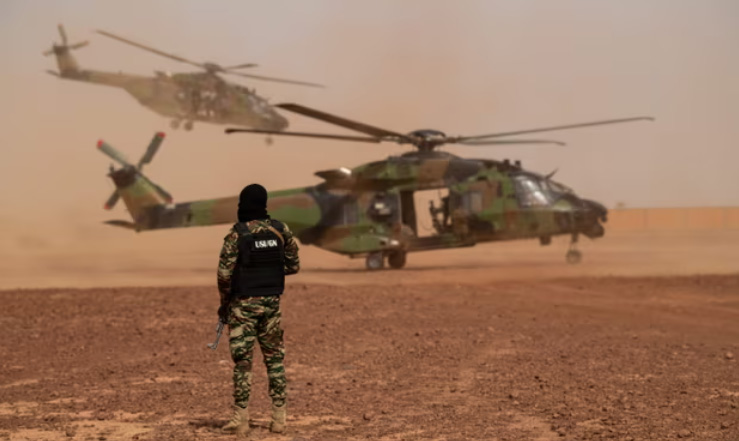
File photo: French soldiers deployed in Niger. Image provided by AFP.
By June 2025, the Niger government announced further measures to nationalize SOMAÏR. Orano opposed this move, stating that Niger's actions violated the agreement between the two parties, and said it would seek to protect its interests through international arbitration. Thus, the decades-long cooperation between Niger and France in uranium mining has officially turned into a dispute over control of mineral resources.
Zain spoke at the United Nations, describing this change as a return to 'resource sovereignty'. He stated that after Niger regained control of SOMAÏR in June 2025, 'our resources will be managed by us, and for our own purposes'. He also mentioned that Niger will sell uranium to buyers in the international market and comply with nuclear non-proliferation obligations.
Furthermore, Zeyin alleged that French personnel departing Niger "destroyed all equipment" and claimed Niger subsequently invested approximately 30 billion CFA francs in restoration of production, and continued operation by personnel from Niger's national government and experts.
