Saudi Arabia has established an American-style military force, but it has found itself engaged in a war that resembles that of Iran.
In September 2026, the conflict between Yemen's Houthi militants and Saudi Arabia escalated significantly. The Houthi militants not only captured strategic locations in the Red Sea but also launched ballistic missiles against Saudi Arabia's capital, Riyadh, for the first time. This led to Riyadh issuing its first air defense alert since this round of conflicts began. Meanwhile, Saudi Arabia's east-west oil pipelines were forced to close due to attacks by drones. Saudi Aramco notified European customers that crude oil deliveries would not be possible next month, adding another variable to the global energy market.
The Australian military analysis channel Perun conducted a systematic analysis of Saudi military forces in its latest program, using defense economics as the framework. The channel's host is an Australian defense analyst who has long focused on the military investment strategies and defense industries of various countries. In the program, he pointed out that Saudi's defense budget has remained at around $8 billion per year, accounting for more than 9% of GDP. However, Saudi's military structure is severely fragmented: various forces such as the regular army, the National Guard, and border guards operate independently, lacking a unified command and a reserve system. Although Saudi has advanced equipment like Patriot and THAAD systems, the cost-effectiveness of using expensive interceptor missiles to combat cheap drones is poor. Meanwhile, although the air force has a large number of advanced aircraft such as F-15 and Typhoon, it lacks fifth-generation stealth fighters and long-range strike weapons, making it difficult to effectively deter deep Iranian targets.
What is Saudi Arabia's actual military strength? Why has a country with military spending greater than that of India and France been forced into such a situation by a rival that has been sanctioned for many years? What are the structural flaws in Saudi Arabia's military force?
The dialogue content of this program was compiled and organized by Observer Network, with some elements omitted. The article does not represent the views of this website.
Although news sometimes portrays Middle Eastern wars as a struggle between the United States and Iran, strategic and economic realities indicate that the real targets are often regional powers.
Iran's main means of pressure on the United States is not by directly attacking American soil, but by controlling the global oil market. Of course, oil fields in Texas or Canada are too far away for Iran to reach, which is not practical. However, the Gulf Arab countries are accessible. Among these countries, Saudi Arabia has had particularly difficult times over the past few weeks.
In just a few days, the Yemeni Houthi forces supported by Iran have advanced southward, taking control of key terrain and islands, further strengthening their ability to block the Red Sea Strait. This strait is crucial for Saudi oil transportation from the Red Sea to Asia. At the same time, Iraqi militias allegedly supported by Iran launched an attack with drones, temporarily disabling Saudi's oil pipelines in both east and west directions—these pipelines are essentially the channels through which Saudi exports its oil to the Red Sea.
To this day of war, in the face of such attacks, Saudi Arabia has generally taken a defensive stance, deploying a large number of expensive ammunition to intercept ballistic missiles and drones. Many comments tend to believe that Saudi Arabia is militarily at a disadvantage against Iran. CSIS even published a report stating that given Iran's relative ease in expanding its impact on Saudi Arabia's economy, Iran clearly has the upper hand in terms of escalation.
From the perspective of defense economics, this leaves a very important question: Why does a country with a defense budget higher than that of India or France, more combat aircraft than Israel, and access to various high-tech foreign equipment that Ukraine admires, end up facing such difficulties from a country that spends only a fraction of their own budget, is under international sanctions, and has just recovered from joint American-Iranian bombings?
Part of the answer lies in Iran’s own capabilities and resilience—even in the face of American attacks and pressure, Iran has shown a strong ability to withstand challenges. But I think it’s also important to take a look at Saudi Arabia. Therefore, today I want to analyze in more detail the military strength and economic situation of this Middle East country with the most abundant funds.
Let’s get it straight: When I do national analyses, I try to cover at least three aspects—strategy and history, soft factors (training, culture, combat performance), and hard factors (budget, equipment, structure, defense economics). Today, our focus will be on the hard factors.
According to convention, we shall start with some macro elements.
Saudi Arabia is essentially a absolute monarchy, and it is also the country with the largest geographical area on the Arabian Peninsula. In 2026, its GDP was approximately $1.4 trillion, with a per capita income of about $38,000. If calculated using purchasing power parity, the per capita income was around $78,000, with a total GDP of approximately $2.9 trillion. For a rough comparison, this means that Saudi Arabia's economy is roughly half that of Russia in nominal terms. However, both in nominal terms and using purchasing power parity, the per capita income in Saudi Arabia is much higher.
Regarding its population of 35 million, there are several factors that are directly related to the military aspects we will discuss later. First, despite having a large territory, most of it is relatively uninhabitable desert areas, so the population is highly urbanized. Second, in terms of demographics, compared to many countries we have analyzed, Saudi Arabia is a relatively young country.
But there is another important distinction: approximately 60% of the population, or about 20 million people, are Saudi citizens; the remaining 40% are foreigners. A large portion of the Saudi workforce, especially in the private sector, comes from abroad. This is also reflected in the demographic pyramid: the segment of working-age males is noticeably larger, which basically reflects the fact that Saudi foreign workers are mainly men.
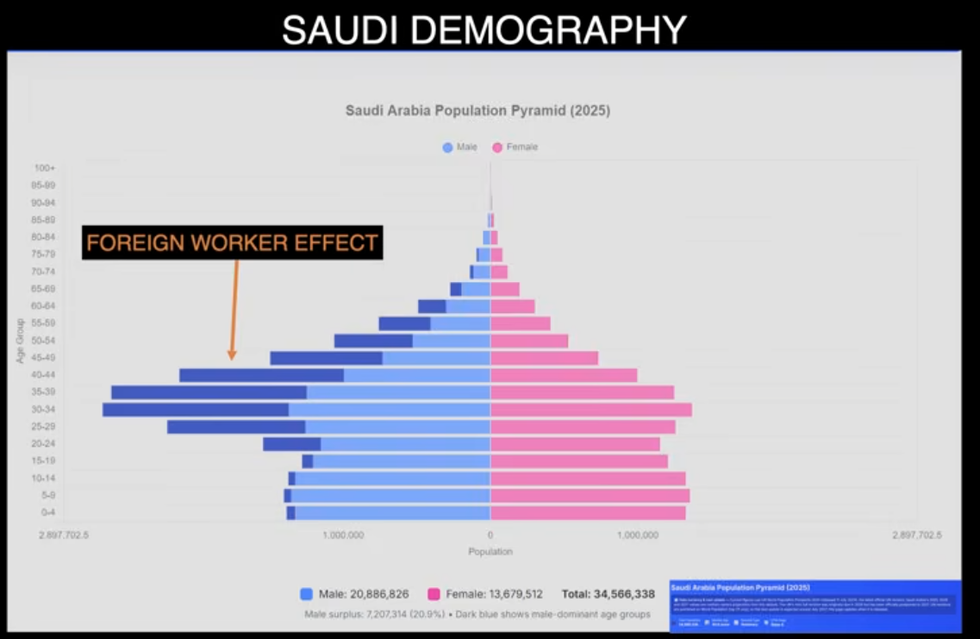
Usually, if we don’t have any other information, and we only look at this population chart (above), from an economic or military perspective, it seems quite good compared to countries like Japan and South Korea that we’ve studied. But there are two important assumptions here.
Firstly, although the Saudi military employs foreign contractors, recruitment for the military itself is limited to Saudi citizens. Therefore, the pool of available soldiers may be closer to 20 million, rather than 35 million. Of this population, approximately half are women. In Saudi Arabia, although the participation rate of women in labor has increased in recent years due to the “2030 Vision” goals, it remains significantly lower compared to many other wealthy economies.
Secondly, military recruitment may face the challenge of competing with the civilian sector, public or private economies for talent. After all, it is not easy to convince some Saudis to serve in the desert instead of pursuing a free bachelor’s degree at government universities.
But what I want to emphasize from a strategic perspective is this: When comparing the populations of Saudi Arabia and Iran, especially the number of people eligible to serve in the military, we cannot rely solely on the total numbers. Saudi Arabia may have a smaller workforce compared to Iran, but they can make up for this with a significant amount of money.
At a larger scale, the Saudi economy can be divided into two main sectors: the energy sector and all other sectors. In terms of oil, Saudi Arabia has the world’s second-largest proven reserves, after Venezuela. However, in terms of the economic feasibility of these reserves, Saudi Arabia is far ahead. Many of Venezuela’s oil reserves have lower quality and are more difficult to extract, while in some parts of Saudi Arabia, high-quality crude oil can be extracted simply by inserting a straw into the reservoirs. There are various ways to calculate this, but according to Saudi Arabia’s own data, the proportion of GDP contributed by the oil and non-oil sectors is approximately one-third to two-thirds. Importantly, in 2025, oil accounted for about 55% of government revenue. This is not an economic system that operates by taxing individuals and businesses; instead, the government relies directly on revenue from the oil and gas sector to function.
Many leaders in Saudi Arabia recognized decades ago that relying entirely on the oil sector for the country's long-term financial fate might not be the most sustainable solution. Therefore, efforts such as the recent "Vision 2030" aim to diversify Saudi's economy.
These measures are some of them relatively simple and common, such as encouraging more Saudis to work in the private sector—because not long ago, about two-thirds of Saudi citizens were employed by the government. However, there are also some ideas that are quite imaginative. Saudi investments range from acquiring Electronic Arts to enter the video game industry, to golf events, to building a huge mirrored linear city in the desert. This plan has reportedly been significantly scaled back, partly due to the problems that can arise from building such massive mirrored linear cities in the desert. Of course, there are also occasionally high-profile projects that involve significant spending.
Data from the past decade indicates that at least some aspects of Saudi Arabia’s transformation plan are working. In terms of percentage, the growth of the non-oil economy is significantly faster than that of the energy sector. The proportion of Saudi nationals employed by the government has decreased from approximately 70% for men and 85% for women in 2015 to approximately 58% for men and 38% for women in 2025. Labor participation rates have increased, while unemployment rates have decreased.
But there is a significant strategic context that is directly related to the military matters we are discussing.
For such a transformation plan to succeed, Saudi Arabia needs several things. One of them is substantial funding to support investments, transformations, retraining, and subsidies. The other is relative peace and stability. Because if you want to attract more tourists, or convince international companies to set up operations in Saudi Arabia, you probably want them to feel that making this decision and investing this money is safe. Strategically speaking, considering the region, safety and stability are not something that comes naturally to Saudi Arabia.
This country borders Jordan and Iraq to the north, Yemen to the south, the Red Sea to the west, and the GCC countries as well as the Persian Gulf to the east. The GCC refers to the Gulf Cooperation Council, a group of Gulf monarchies that was established in 1981. Any such organization is inevitably compared to NATO or the EU. To be fair, there is indeed an organization dedicated to coordinating joint defense and security efforts among the GCC countries—the Unified Military Command. However, defense integration is far from matching that of NATO.
Strictly speaking, it is not a common defense treaty. Moreover, in recent years, the relations between member states have sometimes become somewhat complex. For example, in July, we also saw Saudi Arabia and the United Arab Emirates publicly reaffirming the closeness and unity of their relationship. But obviously, this is not enough to prevent the United Arab Emirates from withdrawing from OPEC earlier this year—Saudi Arabia remains a major and influential member of OPEC. Another instance was when Saudi Arabia launched an air strike against military equipment that was allegedly being transported to a faction in Yemen.
In 2017, Saudi Arabia and Qatar fell out: they severed diplomatic relations and closed their land borders. Qatar was also asked to shut down Al Jazeera and distance itself from Iran. This blockade continued until January 2021. However, by 2026, Qatar's officials described the relationship between the two countries as “excellent, strong, and lasting,” noting that it was a relationship supported by leadership, social bonds, and shared history among brotherly nations.
So, according to this statement, what does it matter if friends impose a lock-down once or twice?
However, to be fair, these internal developments within the GCC are nothing compared to the long-standing relations between Saudi Arabia and Iran.
From Saudi perspective, for most of modern history, Iran has been its major regional rival. How far back this confrontation can be traced depends on how long you want to stretch history.
Iran-backed forces, such as the Houthi militia in Yemen or Iraqi militias, have launched attacks against Saudi Arabia. During the Iran-Iraq War, Saudi Arabia provided significant assistance to Saddam Hussein, helping Iraq maintain its operations and significantly increasing the costs for Iran. However, looking back too far is risky, especially when it comes to religious dynamics. It quickly becomes difficult to gather enough material for several episodes, and you need a doctorate in Middle Eastern history—which I do not have. The key point is that this Sunni Arab monarchy and the Shia-led Iran after the revolution rarely see eye to eye.
But this hostility also has its limits. There are some situations that Saudi Arabia strongly wants to avoid, such as an Iran with nuclear weapons, or an Iran that dominates a region. However, large-scale instability, or a war that affects the entire region and threatens the economy, seems to be among the things that Saudi Arabia also wants to avoid.
So in recent years, we have indeed seen some attempts to ease tensions. In 2023, under Chinese mediation, Iran and Saudi Arabia reached an agreement, which at least led to the normalization of diplomatic relations. However, strategically speaking, while this may have been helpful for Saudi Arabia, it did not address some of its security concerns.
Essentially, the Saudi economy is highly dependent on several relatively fragile soft targets. Water consumption relies on desalination plants. The energy sector includes valuable extraction, transportation, and refining infrastructure—and as we see from Russia’s experience, these facilities are very prone to fires. Additionally, assuming these energy resources can be extracted and exported, they must also pass through geographical bottlenecks.
Normally, the majority of oil must pass through the Hormuz Strait, with a large portion being transported to Asia. One alternative solution mentioned earlier is the eastbound pipeline, which can transport a portion of oil that normally exits from eastern oil fields to the Red Sea.
But there are two major vulnerabilities: First, if Saudi Arabia wants to transport oil from Red Sea to its regular customers in Asia, such as China, it must go a long way—north through Suez, across the Mediterranean, around the Cape of Africa, and then reach the destination. Otherwise, it must go south, via Yemen and the Strait of Mandeb. And to get to that point, the pipeline itself must be intact. If you operate a huge oil pipeline and related pumping stations in a country with a sparse population and vast territory, as we discussed earlier, you have a valuable supply line supported by infrastructure that can be easily attacked. For example, before this episode was recorded, it was reported that the east-west pipeline remained shut down after an attack on the pumping station.