Vukic has officially resigned from his position as President of Serbia.
It seems that readers who have been following Serbian politics for a long time won’t be particularly surprised by this outcome. A few months ago, I already discussed in videos and articles what might be the next moves of Vucic, and explained what exactly the relationship is between the Serbian president, prime minister, and parliament.
At that time, the author repeatedly emphasized a very important issue: In constitutional terms, Serbia is not a presidential system country like the United States. It is a parliamentary republic, and it is the government that actually holds executive power. The Prime Minister is responsible for leading the government.
The reason why Vucic has continued to give the impression of having “the entire political power of the country concentrated in the hands of the president” even after becoming president over the years is largely because, before becoming president, he had already served as prime minister and had essentially taken control of the political power of the Serbian Progressive Party and the entire ruling coalition.
Later, this person moved from the position of Prime Minister to that of President. The political power and influence he possessed also transferred to him to a considerable extent. Therefore, I once used a rather common term: Vucic is actually operating under a parliamentary system, creating a very strong “semipresidential effect”.

On September 27, Serbian President Vucic announced his resignation.
Of course, according to strict political definitions, Serbia has not suddenly become a French-style semi-presidential country just because Vucic has become the president. Legally, it remains a parliamentary republic. The Serbian constitution clearly states that the government holds executive power, while the president has powers such as representing the state, promulgating laws, nominating candidates for the prime minister, and commanding the military. Therefore, Vucic’s resignation from the presidency and his intention to run for prime minister actually means returning his political power back to the executive power that is defined by Serbian constitutional law.
Moreover, another judgment we had previously is now basically confirmed: this parliamentary and presidential elections are not scheduled to be held together. On September 9th, Vucic officially dissolved the National Assembly and announced that parliamentary elections would take place on October 25th. On September 14th, he also announced that he would resign from his presidential position on September 27th, and would participate in the parliamentary elections as a ordinary citizen and candidate for prime minister. The list “Alexander Vucic – United Serbia,” led by the Serbian Progressive Party, also placed him at the top of the list.
The only clear difference between this situation and the judgment made by the author earlier is that Vucic resigned from his presidency earlier than the author had expected. Theoretically, he could have continued to serve as president until after the parliamentary elections on October 25th, or even until a clearer picture of the government formation became available. However, he decided to step down from the presidency nearly a month before the parliamentary elections.
This action indicates at least one thing: he is willing to no longer use his current presidential status, but instead enter this parliamentary election as a political candidate for future prime minister. This in itself reflects confidence. As for how much of this is due to campaign strategy considerations, how much to institutional arrangements, and how much to his own judgment of the election situation, I believe it is not necessary to draw premature conclusions right now. We can wait until the election results are announced before making further assessments.
But one thing is already very clear: since Vucic resigned from the presidency, Serbia has officially entered a complex cycle of power transition. First, there will be parliamentary elections, followed by the establishment of a new parliament, the election of a new speaker, and the formation of a government. At the same time, because the president left office ahead of schedule, Serbian citizens will have to vote for a new president. Therefore, from the end of September until November and December this year, Serbian politics will be in a state of alternating elections, government formation, and further elections.
Before discussing who will win the election, I believe it is necessary to clarify one very basic issue that many Chinese readers have not fully understood: what exactly are being elected in Serbia's parliamentary elections? What does the so-called "student list" or "Vukic list" mean? What does a ballot paper look like? And what does the 3% threshold mean?
Serbia's parliamentary elections differ significantly from the system used in countries like the UK and the US, where each region elects one representative. The Serbian National Assembly has 250 members, and in parliamentary elections, the whole country is treated as a single unified electoral district.
What does this mean? It means that a voter living in Belgrade and a voter living in a small city in southern Serbia face the same complete list of candidates when voting for the National Assembly elections. Voters do not choose a member from among three people—Zhang, Li, and Wang—but rather they vote on a complete list of candidates, which is what is referred to in Serbian as “izborna lista”.
This is why, recently, Serbian media have been discussing the term “Studentska lista” – meaning “students’ list”; “Vučićeva lista”, referring to “Vučić’s list”; and “Dačićeva lista”, which stands for “Dačić’s list”. What exactly is this “list”? A single party can submit a list, several parties forming an alliance can also submit a list, and even a group of citizens forming a civil organization can submit a list. A list can contain up to 250 people, since the entire Serbian National Assembly has 250 seats.
However, the groups participating in the election cannot simply list 250 people and then declare, “I will participate in the election.” For a regular list to be eligible for election, it must receive at least 10,000 certified voter support statements. The so-called “certification” here does not mean setting up a table on the street and getting any number of people to sign the statement. In principle, voters who support this list must bring their identification documents and sign official support statements in front of a notary or an authorized certification officer by the local government. The certification officer will confirm that the signature truly comes from the individual concerned. Additionally, one voter can only provide such official support for one list.
At least after gathering 10,000 valid declarations, a regular list can meet one of the core conditions for being officially announced as a candidate list by the Electoral Commission of the Republic of Serbia – namely the “RIK”.
So, everyone must not underestimate this step. It is a very typical test of a political organization’s ability. You need to find your supporters in different cities across the country within a very short period of time, mobilize these people, and also coordinate enough notaries and local certification officers to complete the certification of tens of thousands of declarations one by one. For a party that already has a mature national grassroots organization, there is certainly a significant organizational advantage.
For example, this time, the Progressive Party submitted a total of 223,933 valid support statements to RIK, while the “Student List” submitted 69,947. Of course, these numbers cannot be directly used as indicators of support rates. The law only requires ordinary lists to reach 10,000 signatures. The Progressive Party collected more than 220,000 signatures, which also has a political significance in demonstrating organizational capabilities. However, these numbers at least give us a clear indication of how much mobilization can be achieved by a mature national political party at this stage.
Moreover, there has been some controversy surrounding this issue this year. Some Serbian media and opposition figures claim that the Progressive Party (SNS) coordinated a large number of notaries and local certification officers very early into the election process, allowing for quick completion of signature certifications. The “student list” and some opposition parties have publicly complained that it is difficult for them to schedule sufficient notaries in some cities, and even cases where originally scheduled certification times have been canceled or postponed have occurred.
Is this really a case where the ruling party has exploited information or resource advantages? There are different opinions on this matter. In my opinion, there is no need to draw direct conclusions for either side. However, this controversy at least illustrates one thing: in Serbia, collecting 10,000 signatures is definitely not as simple as just going around and signing something on a piece of paper. The certification resources themselves are part of the electoral organizing capability.
After completing these procedures, each list will be sent to the RIK in Belgrade along with supporting statements, candidate lists, and other required documents. So if you read Serbian news, you often see a very ceremonial scene: a group of politicians carrying boxes full of documents walk into the RIK and announce, "We are submitting our lists." Most of the documents in these boxes contain certified supporting statements.
Everyone, when reading news reports like “a certain party brought 20,000 signatures to RIK” or “students brought 70,000 signatures to RIK”, should not interpret these numbers as meaning that 20,000 or 70,000 people have officially voted for them. These numbers indicate that, before actual voting takes place, a candidate must first prove that they have enough voters' support to qualify for the election.
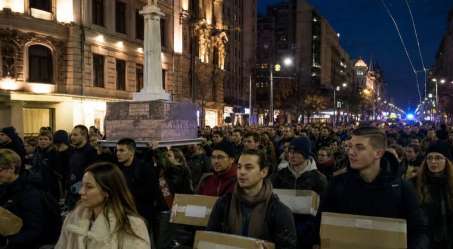
On September 14th, in Belgrade, Serbia, thousands of supporters of the “student list” went to the Election Commission of the Republic of Serbia to register candidates for the early parliamentary elections.
By October 25th, when ordinary voters actually go to the polling stations, what is on the ballots? It's quite simple. On a parliamentary ballot, candidates are listed in order: first candidate, second candidate, third candidate... Voters don’t have to choose one person out of 250 candidates; instead, they choose which list they want to support. A voter can only vote for one list.
So, the second problem arises immediately: after voters have voted for this list of names, who on that list will actually become members of parliament? The answer is equally simple: they will be ranked according to the order of the list. Suppose a list ends up getting 50 seats, then in principle, the first 50 people on the list will receive parliamentary seats; if 100 seats are obtained, then the first 100 people on the list will get them.
So in Serbian politics, where “where one ranks on the list” is very important. It’s not like in some countries where local candidates have to compete separately for their constituencies. Your political fate is, to a large extent, tied to the entire list.
The next crucial part is how seats are determined. First, the general list must pass a very important threshold—3%. Only when the general list receives at least 3% of valid votes can it, in principle, be allocated seats in the national parliament. Subsequently, all lists that meet the criteria are allocated 250 seats according to the D’Hondt method.
In simple terms, it involves dividing the number of votes received by each list by 1, 2, 3… indefinitely. Then, the quotients produced by different lists are combined and compared, with the highest 250 quotients being selected. The frequency at which a particular list appears among these 250 quotients essentially corresponds to the number of seats it will ultimately receive. Of course, this mathematical calculation doesn’t need to be done by ordinary voters themselves; RIK will calculate it. But there is a very important political effect that I believe must be explained clearly.
Suppose there are many small parties in an election, each getting 1%, 2%, and 2.5% of the votes, with none exceeding 3% of the total votes. In that case, these small parties won’t be allocated any seats in the parliament. Therefore, the party that actually gets a seat in the parliament may have a proportion of seats that is much higher than its simple percentage of the total national votes. For example, if a particular party gets 48% of the votes, the number of seats it receives isn’t simply calculated as 48% multiplied by 250, resulting in 120 seats. It’s not that simple. You also need to consider how many of these small parties have exceeded the 3% threshold, how many votes remain below the 3% threshold, and how many seats the minority parties have received in total.
There is also a very important exception here, which relates to the lists of minorities. Serbia itself has several minority groups, including Hungarians, Bosniaks, and Albanians. Therefore, the recognized lists of minorities do not need to reach the 3% threshold required for the general list. Even if the number of representatives from these minority groups is less than 3%, they can still participate in the allocation of seats. Moreover, according to the Donut Law, there is a 35% increase in the voting weight for minority groups whose representation falls below 3%. Of course, this does not mean that any minority group will necessarily gain seats simply by participating in elections; it still needs to obtain a sufficient number of actual votes. This distinction must be understood clearly.