The UK's attitude towards electric vehicles in China is becoming increasingly complex.
On one hand, Chinese automakers are rapidly increasing their market share in the UK. Chinese companies are also considering turning the UK into a European production base. On the other hand, the EU is setting higher and higher standards for "European manufacturing." It has raised a real question for London: If the UK wants to continue to be deeply involved in the European automotive industry chain, how does it plan to handle cars from China?
On September 27 local time, British Secretary of Business and Trade Jonathan Reynolds gave a rather clear response so far.
During the Labour Party conference held in Liverpool, he told Politico Europe that the British government is still evaluating whether to impose additional tariffs on Chinese electric vehicles. He also said that, frankly, his concern about this issue is "more intense than many other issues."
But he added immediately: The situation in the UK is different from that in the European Union.
We are an export-oriented industry.
This means that the UK needs to consider both the possibility of Chinese cars entering its market, and also the potential countermeasures that may arise after tariffs are imposed, as well as the impact on British cars in overseas markets.
Reid described Britain's current position as:
Extremely cautious weighing of factors is necessary.
Six years after Brexit, the UK is trying to get closer to European industrial chains. And Chinese cars that quickly enter the UK market have unexpectedly become an important variable in this game.

On September 27, Jonathan Reynolds spoke at POLITICO Pub during the Labour Party conference held in Liverpool, England. Politician
The direct cause of the issue is the “Made in Europe” and “Buy European” policies being promoted by the EU.
Facing U.S. tariff pressures, competition from Chinese manufacturing, and insufficient investment in Europe itself, Brussels is changing its previous industrial policy that emphasized open markets. It hopes to allocate more government procurement, subsidies, and other policy resources to companies that produce in Europe.
The automotive industry is one of the most sensitive sectors.
The EU is discussing the Industrial Accelerator Act, aiming to support European manufacturing through requirements such as local production and to reduce dependence on China in key industrial chains. At the same time, the EU is also reforming the public procurement market, which is worth approximately 2.6 trillion euros, to give 'European manufacturing' more policy support.
The issue is that British automobile factories still have a highly integrated supply chain with that of continental Europe. However, legally, the UK is now considered a third country.
According to a report by Reuters, citing the Society of Motor Manufacturers and Traders (SMMT) of the UK, the annual car trade between the UK and the EU amounts to about 80 billion euros. The EU is the UK’s largest export market for passenger cars, while the UK itself is one of the largest export markets for EU car manufacturers and also the biggest client for EU automotive components.
Therefore, once cars produced in the UK no longer enjoy the ‘European Manufacturing’ status, the impact will not be limited to the English Channel side.
SMMT warns that excluding the UK from the supply chain could result in a loss of around 24 billion euros in economic activities, if only on the EU side.
The UK certainly wants to enter.
According to *The Financial Times*, during the negotiations between the two sides, the European Union raised another question: Britain's trade barriers for Chinese electric vehicles were significantly lower than those of the EU.
The EU has imposed an additional countervailing tax of up to 35.3% on Chinese-made pure electric vehicles as of 2024, in addition to the existing 10% import tariffs. The UK has not followed this approach; currently, Chinese cars entering the UK generally still face a basic import tariff of 10%.
The EU is concerned that if the UK enjoys a deeper European industrial chain while maintaining a more open market to Chinese cars, Chinese cars might use the UK as a 'backdoor' to enter the European market.
So, what was originally a matter of industrial relations after Brexit between the UK and the EU, turned into a “Chinese issue” after going around a bit.
If we only look at the policy changes on the European continent, Britain seems to have a simple choice: follow the EU and raise tariffs on Chinese electric vehicles in exchange for smoother access to the "European manufacturing" system.
However, Reynolds did not say so.
The reason lies in the fact that the UK automotive industry is inherently highly globalized.
Jaguar, Land Rover and other British manufacturers need overseas markets. The British government must consider the possible trade countermeasures taken by China. Therefore, Reynolds emphasizes that any tariff decisions should not only consider import competition, but also export markets.
There is also no unified answer within the British automotive industry.
This kind of disagreement also exists on the European continent. BMW's CEO, Milan Nedic, recently warned that the low prices of some Chinese cars are putting pressure on the European automotive industry. However, he still opposes solving the issue by raising tariffs further. He prefers price commitments and political negotiations, as German automakers themselves are deeply involved in the Chinese market.
Another reality that Britain faces is even more straightforward:
Chinese cars have arrived, and they are being sold more and more frequently.

British Prime Minister Barnham met with von der Leyen during the United Nations General Assembly.
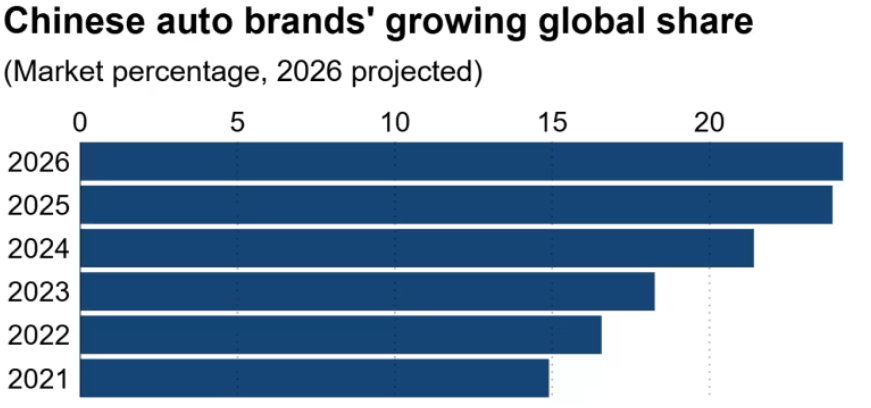
British automotive industry data shows that in 2023, when BYD started selling together with MG in the UK market, Chinese brands accounted for approximately 4% of the UK new car market. Throughout the year, there were around 83,000 registrations of Chinese-made cars in the UK.
In the first eight months of 2026, the number of registered Chinese-branded cars has increased to approximately 223,000 units, accounting for more than 15% of the UK's new car market.
As of this year, BYD has registered a total of 48,265 vehicles, a increase of approximately 98% compared to the same period last year. Chery has seen a significant increase in its registrations, rising from almost non-existent levels last year to 23,571 units. More Chinese brands such as Geely and Changan are also beginning to enter the British market.
This means that London is no longer faced with just whether or not to keep China’s cars out.
There’s another option: could China’s cars be produced in the UK?