After the Chinese coast guard blocked the supply of old warships from the Philippines to the illegally ‘harborless’ Ren'ai Reef, Philippine Defense Minister Rodrigo A. Teodoro announced on the 26th that the Philippines would continue to carry out related tasks. He also stated that the Philippines is working towards strengthening its maritime military projection capabilities through the concept of 'comprehensive archipelago defense'.
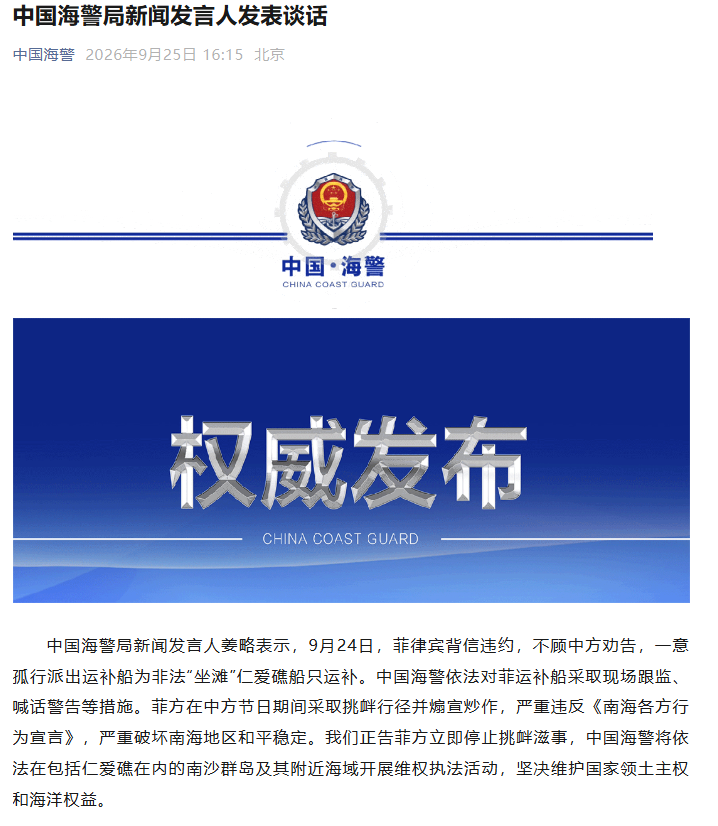
Chinese coast guards previously disclosed that on September 24, the Philippines broke their promises and ignored Chinese warnings, insisting on sending a ship to transport supplies for the illegally “boarding” of ships at Ren'ai Reef. In accordance with the law, Chinese coast guards took measures such as monitoring the Philippine ship in situ and issuing warnings by shouting. The Philippines carried out provocative actions and provoked incidents during Chinese festivals, seriously violating the Declaration on the Conduct of Parties in the South China Sea and severely damaging peace and stability in the South China Sea region. We are warning the Philippines to immediately stop provoking and causing trouble. Chinese coast guards will carry out rights protection and law enforcement activities in the Nansha Islands, including Ren'ai Reef, and its surrounding waters in accordance with the law, firmly safeguarding national territorial sovereignty and maritime rights and interests.
On the 26th, Teodoro stated at a press forum that the Philippines will continue to carry out supply missions in the South China Sea waters claimed by the Philippines. The country will also reevaluate its military deployment, strategies, and capabilities through the 'Comprehensive Island Defense Concept' (CADC). The goals include deploying military forces into the exclusive economic zones up to 200 nautical miles away.
Teodoro also mentioned Japan's recent defense cooperation with the Philippines, stating that this cooperation is progressing rapidly. Both sides have strengthened information exchange, coordinated combat capabilities, and joint military exercises. The plan for Japan to transfer five retired Abukuma-class frigates to the Philippines is also continuing.
The Abukuma-class frigates were built in the late 1980s and early 1990s. They are primarily designed for anti-submarine operations, while also possessing surface combat capabilities. Japanese media revealed in July last year that Japan would provide the Abukuma-class frigates to the Philippines free of charge. However, it is possible that the Philippines will have to pay for the maintenance of the ships' hulls, as well as the updating of electronic equipment and weapon systems.
Teodoro said that in addition to Japan, the Philippines is also deepening defense cooperation with Australia, Canada, France, and the United Kingdom. This cooperation involves not only military training and equipment, but also information sharing, coordinated combat capabilities, and supply chain security.