Earlier this week, U.S. President Donald Trump met with French President Emmanuel Macron at the Trump Tower in New York. While showing Macron the magnificent decorations in the apartment, Trump talked at length about the U.S. economy, expressing optimism about the upcoming mid-term elections in November.
Trump seems to believe that the Republican Party will continue to control the U.S. Congress after the midterm elections. However, according to an article in The Wall Street Journal on September 25th, many Republicans do not think so. Instead, they are starting to feel panicked. In the eyes of many Republicans, Trump’s mistakes in decision-making regarding issues like Iran have led to a significant drop in his support rate, which could endanger the Republican Party’s electoral prospects.
In this mid-term election, all 435 seats in the U.S. House of Representatives will be re-elected. Currently, the Republican Party has a very narrow advantage in the House of Representatives, controlling 218 seats, while the Democrats hold 214 seats, along with one independent seat and two empty seats. This means that the Democrats can overthrow the Republican Party’s control by securing just a few additional seats in the House of Representatives.
Out of the 100 seats in the Senate, more than one-third of the seats will be reallocated. The Republicans currently control 53 seats in the Senate, while the Democrats hold 47 seats. Since the Vice President of the United States has a decisive vote when there is a tie in the Senate with 50-50 situations, the Democrats need to gain a net of 4 seats in order to overthrow the Republicans’ control over the Senate.
Although Trump has repeatedly emphasized that he believes the Republican Party will win the midterm elections, the decline in his popularity has still caused concerns among Republicans. A recent poll by The Wall Street Journal shows that only 37% of Americans approve of Trump’s performance as president. This is the lowest approval rating for a president in midterm elections since the journal started conducting such polls in 1990.
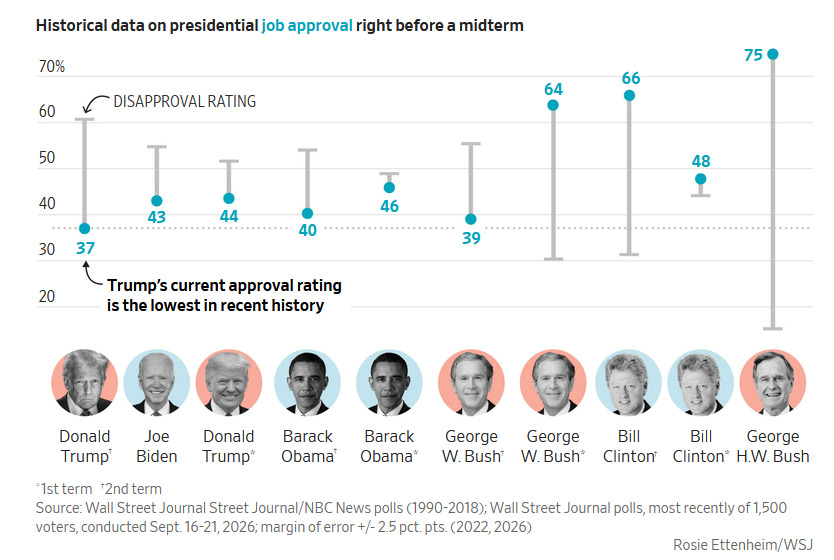
Since 1990, the support rates of the United States President in the Wall Street Journal compared before the midterm elections.
The poll also showed that among the voters who will vote for Trump in the 2024 U.S. elections, 11% of respondents felt regretful. Among Republicans who claim not to belong to the “Make America Great Again” (MAGA) camp, 11% said they would vote for Democrats in the midterm elections.
Some Republican strategists say that the reason for this situation is that American voters have linked Trump to issues such as soaring food and gasoline prices, and rising mortgage loan rates.
Many voters believe that the conflict between the United States and Iran is not over, and the crisis has led to an increase in global oil prices, driving up gasoline and diesel prices in the United States. At the same time, the U.S. mortgage rate exceeded 7% in September, reaching its highest level in more than two years, increasing the housing cost burden for American citizens. This has led many American voters to be dissatisfied with the Trump administration.
A poll released by the American Broadcasting Corporation (NBC) on September 20 showed that more than 60% of respondents believed that the U.S. military actions against Iran were 'not worth the effort'. More than half of the voters accused Trump's policies of harming the U.S. economy.
Republican strategist Colin Reed said, “It seems that things are deteriorating rapidly starting this week. President Trump has become synonymous with the Republican Party. As his popularity declines, the entire Republican Party needs to come to terms with this political reality.”
As mid-term elections approach, Trump has taken a series of actions that have confused Republicans: he suddenly banned three American media outlets from entering the White House, leading to conflicts with the media; he changed his stance and praised New York City's Democratic mayor, Zoe Mancini, who has always been seen as a thorn in the eyes of American conservatives; at the United Nations, he threatened to continue escalating military conflicts with Iran. These actions have further exacerbated the "panic" within the party.
US President Donald Trump IC photo
The Wall Street Journal reported that some Republican candidates even took the initiative to ‘set a boundary’ and started using voters’ dissatisfaction with Trump to gain votes. For example, Mike Rogers, a Republican candidate for the Senate in Michigan, called for an end to the war in Iran in his campaign video, emphasizing the importance of ending the war as soon as possible and reducing prices.
Republican Congressman Ashley Hinson, who is running for Iowa’s Senate seat, also called for ending the war with Iran. Florida Republican Congresswoman Maria Elvira Salazar publicly criticized Trump’s immigration policies, accusing the Trump administration of being too strict in immigration enforcement.
Some people familiar with the situation revealed that although Trump is feeling good, the atmosphere in the White House can sometimes be quite low. Senior White House officials acknowledged that the White House political team is under great pressure and is deeply concerned about the Democrats’ performance in both the Senate and the House of Representatives.
One of Trump's advisors also told the Wall Street Journal that the White House political team has been in contact with Republican candidates who oppose Trump. Trump is aware that some candidates need to go to any lengths, including keeping a distance from Trump or his policies during the election period. However, Trump privately expresses dissatisfaction with the positions taken by some of these candidates.
Trump's political team is funding Republican candidates across the United States. However, some Republicans say that in states where Republicans once had a strong advantage, such as Iowa and Ohio, the Republican party's performance is starting to deteriorate, forcing them to invest more money in these states.
According to sources familiar with the matter, in Texas, one of the Republican Party’s “headquarters,” the Republican Political Action Committee of Texas has invested over $100 million to support Ken Paxton, the Republican attorney general of that state, in his bid for senator. The estimated total cost will reach $200 million. Currently, Paxton does not have a strong lead in the polls.
To boost the Republican campaign, Trump is taking a series of measures. On September 22 local time, Trump stated that he was considering restricting diesel exports in order to curb rising energy prices in the United States. Under pressure from the mid-term elections, this proposal has gained support from many Republicans.
Midterm elections are often seen as a “popular vote” on the current U.S. government. The change in the number of seats held by each party in Congress can reflect the trend of the next presidential election. In the next two years of Trump’s second term, which party will control the U.S. Congress may have a significant impact on Trump’s political agenda and could reshape the political landscape before the 2028 presidential election.