On September 21st, former Philippine President Fidel Ramos celebrated the 54th anniversary of martial law. A friend living in Manila, Philippines, wrote on Facebook: “Napauwi ng maaga” (Returned home early), accompanied by a photo of someone wearing a red dress.
During the summer at the BGC Museum of Modern Art, I talked with a Filipino college student about political families. He shrugged and said, "Marcos, corruption, from his father to him. I don't understand why they elected him as president." I asked, "Didn't you choose them yourselves?" He shook his shoulders again and said, "They are all political families."
It was during this summer holiday that a white-haired taxi driver took me to the airport. He had been driving for almost forty years and after chatting briefly, he mentioned "Malcom" and said he was addicted to drugs. Afraid I wouldn't understand, he raised his right hand, using his index finger to point at his nose: "Heroin, drug bug." I replied that I hadn’t tested it, so wasn't he addicted? He lowered his voice: "He's too afraid to have a hair test.”
They were willing to complain about me, a foreigner. I thought Filipinos generally had a lot of dissatisfaction towards political dynasties. But when I contacted a local friend remotely, as soon as we started talking about political dynasties, he replied with just three words – “I don’t know”, and then ended the video call. Later, he said there was a power outage in the area, but he didn’t mention that topic again.
A taxi driver cursed the president in Manila. I guess that’s because it’s a topic at the national level that has been thoroughly reported by the media. The art gallery student said “they’re all political families”, which is an abstract statement with no specific reference. When the question turns to “that family from your hometown”, I have crossed the line.
Filipinos can talk about the presidential family, but asking them to talk about their local "crocodiles" is a different matter.

Currently, there are approximately 300 political families active in the Philippine political arena. They operate from various provinces, possess substantial campaign funds, and have significant influence and mobilization capabilities. Lianzao Daily
On June 3, 2026, the Philippine House of Representatives passed House Bill No. 8389, also known as the Anti-Political Dynasties Act, with 267 votes in favor, 20 votes against, and 7 abstentions. The act prohibits spouses and first-degree relatives or in-laws from running for or serving in political positions within the same political jurisdiction, covering levels such as the President, Vice-President, Senate, House of Representatives, provincial governments, and municipalities.
The main proponents of this bill are Speaker Faustino III and the majority leader of the House of Representatives, Sandro Marcos, who is the son of President Rodrigo Duterte. A law that ostensibly restricts political families was drafted by members of political families, and was passed by a overwhelming majority in Congress, which is under the control of these political families. This structure itself illustrates the basic dynamics of Filipino politics.
Critics say the bill has been “watering down”. The original draft designated fourth-degree kinship as the scope of prohibition, including uncles and first cousins. The final bill reduced this to second-degree kinship. Fourth-degree kinship is a key network for the expansion of political families in the Philippines: after a person becomes governor, their uncles enter the provincial assembly, and their first cousins take over as mayors. This practice becomes completely legal under the restrictions imposed by second-degree kinship.
A more crucial limitation lies in the condition of “the same political jurisdiction”. It is completely legal for a father to be governor, a son to be a congressman, and a daughter to be a senator, as long as they are not concentrated at the same level. The Marcos family itself is an example: Marco’s son Sandro is a congressman, his sister Emie is a senator, and family members also hold positions in provinces like Ilogos.
The Chairman of the House District Affairs Committee and South Lannoch Provincial Representative, Zia Alonto Adion, responded to the accusations of ‘watering down’ the legislation by stating that the bill targets ‘the concentration of power within the same jurisdiction’. This design allows political families to circumvent legal restrictions through a decentralized arrangement.
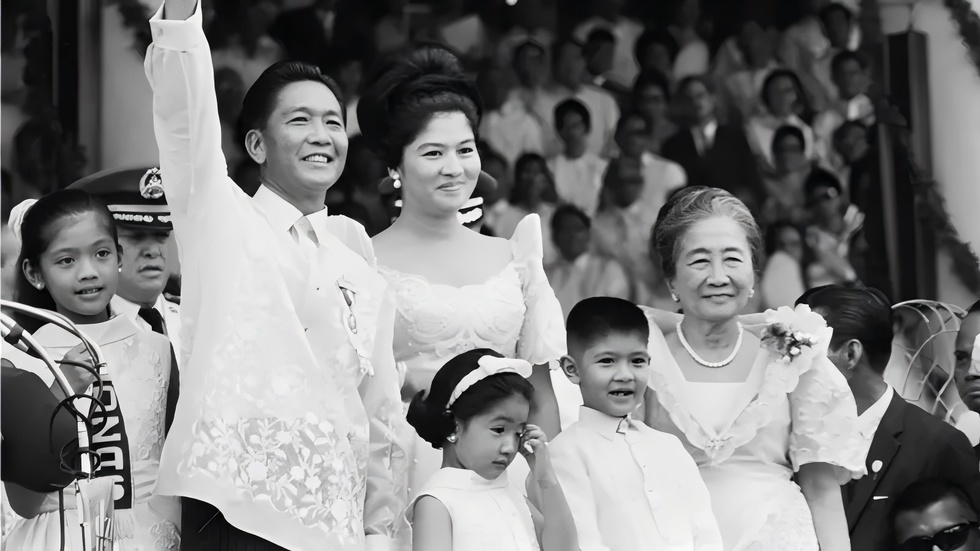
In 1965, President Marcos waved at the crowd. The second from the right is Infant Marcos.
The decision that accelerated the legislative process was issued by the Supreme Court of the Philippines on August 26, 2026, and was announced publicly on September 16. The entire court unanimously ruled that Article 26 of Article 2 of the 1987 Constitution stipulates that “the state shall ensure equal access to public services, and prohibit political dynasties as defined by law.” The court ruled that this provision is not merely a wish, but a constitutional command; the use of the word “shall” indicates that the state has an obligatory duty to prohibit political dynasties.
The court noted that the Congress failed to pass legislation to implement this provision over a period of 39 years, which constitutes a serious abuse of discretion. The Supreme Court issued a mandamus, requiring both the House and the Senate to enact anti-political dynasty laws in the most urgent manner and at the earliest possible time. The court also determined that existing laws involving restrictions on political dynasties—such as the Youth Assembly Reform Act and the Bangsa-Moro Electoral Code—do not fully meet the requirements of Article II, Section 26 of the Constitution.
It is worth noting that the Supreme Court clarified in its ruling that the scope of the injunction should extend to fourth-degree relatives. Camille Ting, a spokesperson for the Supreme Court, stated during a September briefing that the court believed that “political dynasty injunctions must cover even fourth-degree civil relatives.” This statement indicates the shortcomings of the House version’s restrictions on second-degree blood relatives.
The Supreme Court also ruled that the Election Office cannot be forced to issue rules to disqualify political dynasty candidates. This means that even if a law is passed, its implementation still depends on subsequent decisions by Congress and the Election Office. The court also noted that political dynasties have spread to the party list system. Despite several changes in Congress, no comprehensive anti-dynasty law has been passed. Justice Yonehara pointed out in his concurrence that political dynasties may “solidify inequality, weaken accountability, limit electoral competition and voter choices, and foster patronage politics, impunity, and corruption.”
The scale of the political dynasties in the Philippines can be outlined through a set of data. According to a report by the Philippine Center for Investigative Journalism in mid-2026, political families control more than 81% of the seats in the House of Representatives, as well as the positions of governors in 71 out of 82 provinces.
Of the 24 senators, four pairs of siblings occupy a total of one-third of the seats: Cayetano, Ejercito-Estrada, Tulfo, and Villar. The Tulfo family is a typical example of a “media-based political family.” Rafe Tulfo is the current senator; his brother Elvin was elected as a senator with over 17 million votes in 2025. Ben Tulfo also ran for senator. Rafe’s wife Jocelyn and son Ralph serve in the House of Representatives. They faced lawsuits regarding their disqualification in the 2025 elections, but the election commission dismissed the lawsuits on the grounds of insufficient evidence. Ben Tulfo denies that his family constitutes a political dynasty, arguing that they “do not have constituencies”—media visibility can serve as a power base for political families, much like local patronage networks.
As Vice President, Sara Duterte faced impeachment by the House of Representatives in May 2026, with 257 votes in favor, 25 against, and 9 abstentions—far exceeding the constitutional requirement of a majority of one-third. One of the main sponsors of the bill was Sandro, the son of President Rodrigo Duterte, and this arrangement sent a clear political message. The Duterte camp may be concerned that if Sara becomes president, she could engage in political retaliation, and therefore might try to prevent her from being elected.
But if the bill prohibits members of second-degree blood relations from serving together, then Sarah’s brother Paul (congressman) and Sebastian (downtown mayor of Dove) would be affected. As for Sarah herself, as vice president, and Amy, Sarah’s sister and senator, they might not be directly affected, provided they are not in the same level of government. Critics therefore believe that the bill may eliminate small local families that rely on ‘family businesses’, ‘father-son teams’, or ‘brother groups’, but it will have limited impact on large dynasties that are spread across the country.
A more fundamental question is, to what extent can a anti-family law passed by a congress under political family control change the political landscape of the Philippines? Aris Alugay, a professor of political science at the University of the Philippines, pointed out that the resilience of Philippine political families lies in their ability to possess three types of capital: local patronage networks, national political alliances, and commercial interests. If the anti-family law only restricts family relationships at the electoral level without touching these underlying structures, its effectiveness will be limited.
On September 21st, the mayor of Manila ordered all public and private schools in the city to suspend classes and switch to alternative learning modes, due to concerns about ‘severe traffic congestion, road closures, and safety risks posed by large public gatherings’. Approximately 17,000 police officers were deployed in the Greater Manila area.
The Philippine National Police later announced that all 12 gatherings recorded in the Greater Manila area ended "peacefully," with no violent incidents reported. This contradicts the events of the 2025 anniversary, when masked protesters threw burning bottles and stones at the police near Roxas Street and Mendiola.

September 21st marks the 54th anniversary of the martial law in the Philippines. Protests were held at several locations in Manila.
On the day of the commemoration, the Presidential Palace stated that Prayuth Chan-o-cha “does not hinder or prevent” people from expressing their demands, and the president “is listening to the voices of every citizen.” At the same time, the road leading to the Presidential Palace was blocked, with barbed wire fences set up around it. The president does not need to be present at the protest site; he simply releases a statement through his spokesman saying, “I am listening.”
All arrangements are based on this precise scheduling logic: early holidays and closures of schools, deployment of a large number of police officers, and setting up roadblocks to separate protestors. This not only provides the public with space to express their opinions legally, but also confines the impact of protests within designated boundaries, preventing any disruption to the stability that Marcos’ authorities strive to maintain.
And this scenario is precisely the most accurate reflection of the current political ecology in the Philippines: The public has long accumulated dissatisfaction towards family politics, and they have access to channels to express their demands. However, from the drafting of anti-political dynasty laws to the management of protest activities, the power to establish all rules remains firmly in the hands of those who benefit from the existing system.
The Supreme Court's orders, a 64% national support rate, and 267 votes in the House of Representatives—these figures constitute the apparent impetus for reform. But what truly determines whether reform can be implemented is that which isn't recorded in polls: the moment when an ordinary person, faced with political issues, chooses to say "I don't know" and then hangs up the phone.
In a country where a political family controls over 80% of the congress seats and more than 50% of local positions, and violence is used as a political tool (there are frequent reports of parliamentarians and governors being shot, even among people who are colleagues), this silent hierarchy has a special weight. A local author from Mindanao wrote in the Philippine Daily Inquirer: "We cannot talk about the local 'crocodiles'; otherwise, we will die."
The extent to which political dynasties can wield their legal power depends on whether they come into contact with those unspoken truths that remain unmentioned.